Custer
Custer is United States hero in Age of Empires III. Its listed ability is Regeneration.
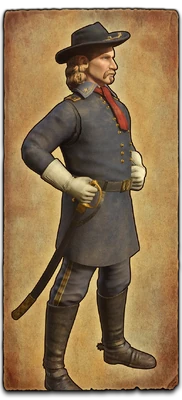
Recorded values
- Durability & mobility
- 5,000 hit points · 7.5 speed · 24 line of sight
- Hand attack
- 45 damage · 1.5 attack interval
- Siege attack
- 14 damage · 6 range · 3.0 attack interval
- Trample attack
- 30 damage · 2.0 attack interval
- Ability
- Regeneration
Role, availability & values
It has 5,000 hit points. It moves at 7.5 speed. Attack profile: Hand attack deals 45 damage. Siege attack deals 14 damage. Trample attack deals 30 damage. Special ability or role: Regeneration. If reduced to zero hit points, it collapses rather than dying; after regenerating 100 hit points, a friendly unit or building nearby can revive it.
Matchup & timing
Custer’s 5,000 hit points make him exceptionally durable in the United States campaign, but that durability does not make his position irrelevant. Use his 7.5 speed to support a push or defend an objective, then keep a friendly force nearby if he collapses. His profile belongs to the campaign scenario and should not be applied to the ordinary U.S. civilization.
United States hero durability and recovery
Custer is a United States hero associated with The WarChiefs and Definitive Edition. The profile records 5,000 hit points, 7.5 movement speed and 24 line of sight, making him a mobile commander who can scout while remaining resilient. His hand attack deals 45 damage every 1.5 seconds, with a 14-damage siege attack and a 30-damage trample attack. The hero also regenerates. If reduced to zero hit points, Custer collapses rather than being removed; after he regenerates 100 hit points, a nearby friendly unit or building can revive him. This recovery rule rewards withdrawing him from a dangerous fight and keeping allies nearby, rather than sacrificing him for a final attack. Use his speed to move between threatened areas and his siege attack to assist against structures, but avoid leaving him separated from support. The trample attack can contribute against groups, while the hand attack gives reliable single-target pressure. His large health pool is not a reason to ignore focus fire: withdraw early enough for regeneration and protect the recovery location until he can rejoin the army.
Combat use and battlefield support
Custer’s combination of speed, hit points and regeneration lets the United States hero move between skirmishes, but his large health pool should be treated as a resource to preserve. The 45-damage hand attack supports direct combat, while the trample attack is a separate area option and the siege attack adds pressure on buildings. Pull him away before he collapses, allow regeneration to restore health, and keep nearby allies ready to revive him if needed. This makes controlled retreats more valuable than a last stand.
Hero recovery window
After a collapse, do not move the supporting force away too soon. Protect the nearby friendly unit or building while regeneration reaches 100 hit points, then bring Custer back only when the area is safe.
United States hero and high-mobility combat role
Custer is a United States hero with 5,000 hit points and 7.5 speed, making him exceptionally durable and mobile in the scenarios where he appears. His 45-damage hand attack and 30-damage trample attack allow him to fight groups at close range, while the 14-damage siege attack contributes against structures. Regeneration helps him recover between engagements. Treat Custer’s extraordinary statistics as specific to his scenario profile rather than a normal United States hero template, and follow mission objectives to decide where his combat strength is needed.
Collapse and safe recovery
Custer collapses rather than dying when reduced to zero hit points. After he regenerates to 100 hit points, a nearby friendly unit or building can revive him. His large health pool should not encourage leaving him surrounded: withdrawal preserves the hero and avoids giving the enemy control of the recovery area. Keep troops nearby if a risky objective causes him to collapse, then protect the revival until he can rejoin the force. His speed makes it possible to move between mission fronts, but use that mobility to reach objectives or withdraw—not to separate from all support.