Gate
A Gate is a movable opening in a Wall line that prevents enemy passage while allowing friendly units through. It preserves a route for the player’s army without leaving the whole defensive perimeter open.
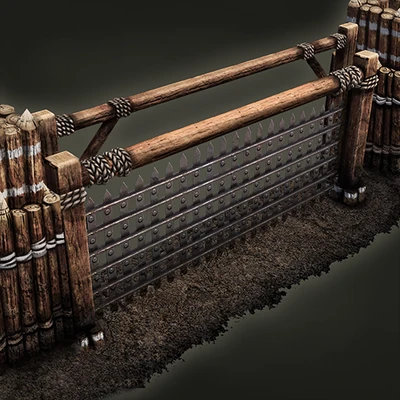
Recorded values
- Cost
- 50 Wood
- Available
- Exploration Age; Industrial Age (Lakota)
- Function
- Blocks enemy units; Allows friendly units to pass through
- Construction
- 1 sec
- Structure
- 1,000 hit points · 1 line of sight · 5x1 footprint
Function & construction
Gates are built as part of a wall system and need connected fortifications to control movement. Their durability can interact with wall upgrades, including improved hit points from a wall pillar. Civilization or technology effects may change cost or construction rewards, so the precise profile can vary.
Placement & timing
Place a Gate where friendly reinforcements need to cross and keep the rest of the perimeter closed. During a defense, check that the opening is not left available to enemy units. A Gate controls access but does not replace defenders or protect the surrounding wall from siege.
Opening in the wall network
A Gate is a movable opening that lets friendly units pass through a Wall while blocking enemy movement. It costs 50 Wood, takes one second to construct and has 1,000 hit points in the standard profile. The structure is most useful when a defensive perimeter needs a controlled route for reinforcements, Villagers or a counterattack. Place it where the friendly army can reach it quickly, and connect the surrounding Wall sections so the opening forms part of a continuous defense. A Gate is not a substitute for defenders: opponents can still attack the Gate or surrounding Wall with siege, and the player must manage access so the opening is not left vulnerable. During a raid, ensure the Gate is closed or configured to deny enemy passage before sending workers through. Lakota have a special listed age/cost context for Gate access, and civilization bonuses or wall technologies may alter durability or construction effects. Check the current civilization’s building entry when using a nonstandard wall roster. The Gate’s purpose is control over passage, allowing a wall to protect the settlement without trapping the player’s own units behind it.
Managing friendly and enemy movement
Because the Gate’s function is passage control, test the route before relying on it as the only entrance through a Wall. Leave space for friendly units to turn and move through, and close the opening when the enemy threatens the perimeter. A Gate can be attacked like other structures; support it with defenders and repair the surrounding wall line when siege begins.
Wall health and upgrades
Wall-related upgrades or civilization bonuses can change the practical durability of the surrounding defense. The Gate controls passage through the line, but its hit points do not make the adjacent Wall immune to siege, so reinforce the whole perimeter.
Controlled access
Treat the opening as part of the whole wall plan. Let friendly reinforcements pass when needed, then close it again before enemy units reach the perimeter. Repair and defend the connected Wall sections as well as the Gate.
Friendly passage through a wall line
A Gate is a movable opening in a wall system: it blocks enemy units while allowing friendly troops through. Placed in a connected perimeter, it preserves a route for reinforcements without leaving the entire defensive line open. The Gate costs 50 Wood and has 1,000 hit points in the recorded profile. Its five-by-one footprint must align with the wall layout, so plan the opening before the surrounding segments are complete. Wall pillars can strengthen adjacent segments under their rules, and defensive technologies may alter durability or rewards.
Control access during a defense
Use the Gate where friendly units need to cross and check its state before an enemy reaches the perimeter. An open passage can give opponents access if the game’s control rules or micro leave it exposed. The Gate controls movement but does not stop ranged attacks or replace defenders, and siege can threaten the structure. Keep troops ready to respond to a breach and avoid placing the opening where units can be trapped against terrain. Build time is short, but the strategic value depends on how the surrounding wall channels traffic. Lakota access is listed from the Industrial Age; most other wall access begins earlier.