Steamer
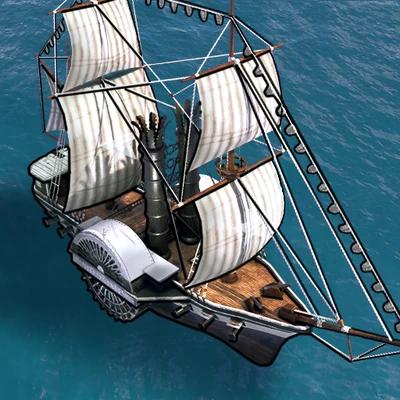
Steamer is a naval support unit shared by several Federal American and Revolution paths. It can gather from fish and whales, transport units, train infantry and cavalry, and build Docks.
Recorded values
- Available
- Fortress Age · European Dock
- Training
- 40 sec · 90 XP per train
- Durability & mobility
- 1,700 hit points · 75% ranged resistance · 8.5 speed · 26 line of sight
- Ranged attack
- 50 base damage · range 18 · attack interval 2.0 · area of effect 1 · bonus damage: 0.5x vs. Artillery
- Ability
- Gathers from fishes and whales; Transports land units; Trains infantry and cavalry; Builds Docks
Role, availability & values
The Steamer is produced at the European Dock. Its many abilities make it a mobile support platform rather than a combat ship alone; its recorded profile also includes a ranged siege attack.
Matchup & timing
Use it when water control can support multiple tasks at once, such as gathering, troop movement or establishing a new Dock. Keep the Steamer protected while it works and choose its role based on the map’s coastline and landing sites.
A multi-role Federal American ship
The Steamer combines naval movement, transport, economy and production. It costs 250 Wood and 650 Coin, takes 40 seconds to train and has 1,700 hit points, 75% ranged resistance, speed 8.5 and line of sight 26. Its functions include gathering Fish and Whales, transporting land units, training Infantry and Cavalry, and building Docks. This makes it a mobile support platform for Federal American or revolution paths that provide it, rather than a standard warship available to every civilization. The listed European Dock is its source, but the civilization and mode determine whether the unit is actually on the roster. On a water map, decide which job matters before sending the Steamer out: gathering needs a safe route to food sources, transport needs an embarkation point and a landing site, and Dock construction exposes the ship while it works. Keep it away from concentrated naval fire and do not assume its high hit points make it a frontline combatant. Its value is the ability to connect land and water operations while contributing to the economy.
Using transport and shipboard production
A Steamer can move land units across water and train Infantry or Cavalry, letting an army reinforce from a ship when the shoreline is contested. Load units before approaching the landing zone, scout the coast, and unload where the force can fight immediately; transport capacity is wasted if troops arrive piecemeal under enemy fire. Building a Dock can establish a new production point, but the ship needs protection while stationary. Gathering from Fish and Whales adds an economic role, though the Steamer cannot maximize gathering and front-line transport at the same moment. A 75% ranged resistance helps against ranged attacks but should not be interpreted as protection from every naval counter or siege effect. Use speed 8.5 to reposition between safe tasks, and keep a route open back to friendly waters. Its 26 line of sight can assist with reconnaissance, but a separate escort should handle enemy ships. The Steamer’s 250-Wood, 650-Coin cost is substantial, so prioritize it when water control allows several of its functions to pay off rather than on a map where its transport or gathering options are irrelevant.
Selecting the ship’s task
A Steamer can gather, transport, produce units or establish a Dock, but its actions compete for position and attention. During a safe opening, gathering Fish or Whales can support the economy; before an attack, load land units and inspect the opposite shore for a landing site. If the force needs reinforcement, shipboard training offers a way to add Infantry or Cavalry near the water, but units must still disembark safely. Building a Dock helps establish a second shoreline base, but the vessel must remain stationary and protected while it constructs. Treat each task as a phase and move the ship when the objective changes. The large 650-Coin cost means it should be chosen because water enables several useful jobs, not simply because a map contains a coast. Keep an escort with it and avoid engaging enemy warships while carrying valuable units or building infrastructure.
Risks while working offshore
A ship that is gathering or building is a predictable target, so scout the area and keep an escort close. If the Steamer is transporting an army, load the full force before crossing and avoid a landing directly beneath an enemy Dock or coastal defense. Its speed gives it options to change routes, but losing a 250-Wood, 650-Coin support ship can also remove access to transport, gathering and production at once. Choose a safe task sequence and disengage when the shoreline becomes contested.
Sustain the ship’s value
The Steamer’s support functions stay relevant after the initial crossing. Once land units are ashore, it can resume gathering or train reinforcements, provided the coastline remains secure. Keep a route back to friendly water and avoid leaving it stationary near an enemy landing force. Its value falls sharply if it is lost because it combines several roles in one costly hull.
Naval support platform and transport
The Steamer is a naval support unit used by several Federal American and revolutionary paths. It can gather from Fish and Whales, transport land units, train infantry and cavalry, and build Docks. With 1,700 hit points, 75% ranged resistance and 8.5 speed, it can support a water operation while moving between tasks. Its versatility makes it valuable, but each job competes for the same ship’s time; a Steamer gathering cannot simultaneously deliver an army.
Water control and task sequencing
The Steamer is produced at a European Dock from the Fortress Age for 250 Wood and 650 Coin, with a 40-second train time. Its ranged siege attack allows it to contribute against coastal targets, but it should not be treated as a dedicated warship. Scout the water before transporting troops, choose safe locations for a new Dock and keep the Steamer near friendly naval protection. Use its training ability only when it is close enough to shore under the relevant rules. Decide which task is most urgent, then reposition after it is complete.