BUILDING · SCENARIO EDITOR
Wooden Fort
A compact wooden defensive landmark for a custom settlement or battlefield.
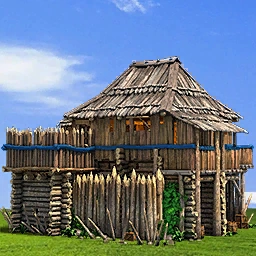
Overview
A compact wooden defensive landmark for a custom settlement or battlefield.
Function and access
A compact wooden defensive landmark for a custom settlement or battlefield This determines what the structure contributes to the settlement: economic buildings support resource flow, production buildings add access to an army line, and defensive buildings protect space or routes.
- Available: Scenario Editor
- Cost: not separately recorded
- Construction time: not separately recorded
- Requirement or context: Scenario Editor
Durability and battlefield role
The structural values describe what this building can protect, garrison, or attack. Use them to decide whether it is a safe production point, a defensive anchor, or a structure that needs support; scenario and campaign buildings may have rules that differ from standard matches.
- Hit points: 3,800
- Melee armor: 8
- Pierce armor: 11
- Garrison capacity: 30
- Range: 8
- Attack: 10 (primary projectile); 11 × 4 (secondary projectiles)
- Line of sight: 12
Function and availability
A compact wooden defensive landmark for a custom settlement or battlefield. Garrison capacity: 30; Listed range: 8; Line of sight: 12. This entry belongs to the Scenario Editor or a scripted scenario set; it is not necessarily a structure players can construct in a standard match. Scenario authors can place it to establish a recognizable landmark or shape routes through the map; its behavior may be controlled by the scenario rather than normal construction rules.
Building statistics
- Hit points
- 3,800
- Garrison capacity
- 30
- Range
- 8
- Attack
- 10 (primary projectile); 11 × 4 (secondary projectiles)
Building values can vary by edition or scenario.
- Focus
- Scenario Editor · nonconstructible
- Signature / category
- Construction & function
- Release / context
- Scenario Editor
- Region
- Scenario Editor
- Classification
- Scenario Editor