Fluyt
The Fluyt is the Dutch Commerce Age warship and troop transport. It has more durability and a stronger ship-to-ship role than a Galleon, while its distinctive ability lets it train land troops from the coast.
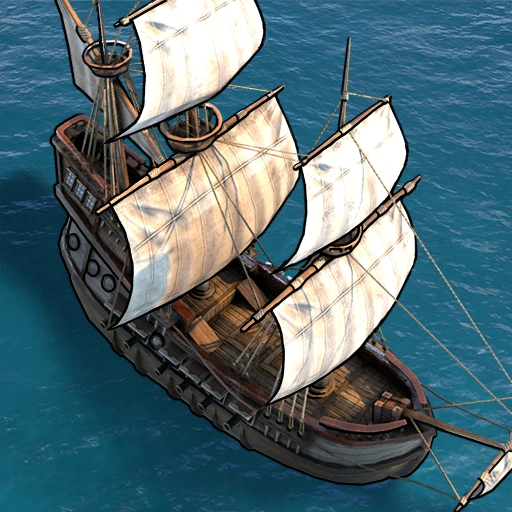
Recorded values
- Available
- Commerce Age · European Dock
- Training
- 40 sec · 60 XP per train
- Durability & mobility
- 1,000 hit points · 75% ranged resistance · 8.5 speed · 26 line of sight
- Ranged attack
- 20 range · 2.0 attack interval · bonuses: 0.5x vs. Artillery
- Ability
- Transports land units; Trains infantry and cavalry
Role & counters
Dutch Docks can produce a limited number of Fluyts. Each can carry land units and train eligible infantry or cavalry while stationary beside a shoreline; the training ship cannot move or attack during that process. Its large garrison capacity also lets it move an army across water.
When to field it
Use it when a coastline enables surprise reinforcements or a safe transport route, and protect it while it is stopped to train units. Compare the naval commitment with ordinary Dock production if the sea is already contested.
Dutch transport and coastal production
The Fluyt is a Dutch Commerce Age ship trained at a European Dock for 300 Wood and 300 Coin. It has 1,000 hit points, 75% ranged resistance, speed 8.5 and line of sight 26. It can transport land units and train eligible infantry or cavalry while stationary beside a shoreline; while training, it cannot move or attack. The ship’s 20-range attack has a 0.5× multiplier against Artillery, so it should not be treated as an artillery counter. Its large durability and transport capacity make it useful for moving an army across water or establishing a coastal reinforcement point. The stop-to-train function leaves it vulnerable, so scout and secure the shoreline before using it as production. Unload units where they have room to form and move, and keep an escort nearby if the opponent contests the water. The Fluyt’s price is a substantial naval investment, but it can combine transport, support and troop training on hybrid maps. If the sea is controlled by the enemy, ordinary Dock ships or land production may be safer.
Stationary troop training
The Fluyt’s ability to train infantry and cavalry works while the ship is stationary beside a shoreline, and during that period it cannot move or attack. Secure the coast before using it as a production point, and keep an escort nearby to protect the ship while its queue runs. The 1,000 hit points and 75% ranged resistance provide durability, but the Fluyt is still a valuable 300-Wood, 300-Coin target. Use its transport capacity to move units across water, then train reinforcements near a safe landing when the map permits. The unit’s range-20 attack deals reduced damage to Artillery, so rely on dedicated ships for naval counters. Its Commerce Age access gives Dutch players an early way to influence a coastline, but the ship should be planned around the fleet rather than sent alone.
Transport security
Load troops only after checking the landing route. If the Fluyt is stopped to train units, it cannot move or attack, so protect it with other ships and keep the coast clear.
Dutch sea control
The Fluyt’s durability helps it transport units, but it should still travel with naval support when the opponent contests the coast. Plan its stationary training function only after clearing nearby ships.
Dutch transport and onboard production
A Dutch Fluyt costs 300 Wood and 300 Coin, trains in 40 seconds and has a limit of four. It carries 50 land units and can train Infantry and Cavalry, so it serves as both a transport and a mobile reinforcement point. Its 1,000 hit points, 75% ranged resistance and speed 8.5 make it faster than many dedicated warships, but its 70-damage attack at range 20 is only half as effective against Artillery. Plan the landing route before loading the army: sailing speed does not make a crowded shore safe, and the Fluyt itself must survive long enough to unload. Its onboard production is useful when establishing a forward beachhead, but the ship’s 50-unit capacity can tempt players to commit too much of the army at once. Keep another naval unit nearby and unload where the troops can form a defensive line immediately.