Galleon
The Galleon is a large European warship that can carry troops and support naval combat. It combines transport utility with ship-to-ship and shore fire, making control of nearby water useful for both armies and coastal pressure.
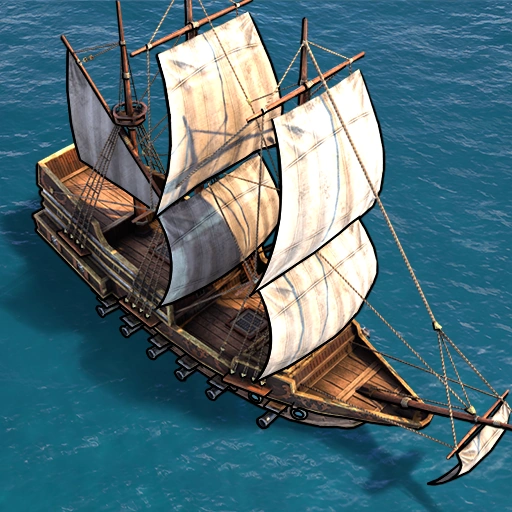
Recorded values
- Available
- Commerce Age · European Dock
- Training
- 40 sec · 60 XP per train
- Durability & mobility
- 1,500 hit points · 75% ranged resistance · 8.5 speed · 26 line of sight
- Ranged attack
- 50 base damage · range 20 · attack interval 2.0 · area of effect 1 · bonus damage: 0.5x vs. Artillery
- Ability
- Transports land units; Trains infantry and cavalry (only if close to shore)
Role & counters
A Galleon can transport land units across navigable water and attack opposing ships or eligible land targets. Its cost and exposure make it a significant investment; smaller ships, defenses and naval counters can punish it when unsupported.
When to field it
Use Galleons to move an army across water or secure a coastline, and coordinate the landing with ground forces. Protect the fleet from enemy warships before committing transported units to a contested shore.
Availability and ship statistics
The Galleon is a Commerce Age warship trained at the Dock by most European civilizations and by the Indians. The Dutch use the Fluyt instead, and Italians use the Galleass. The standard Definitive Edition Galleon costs 300 Wood and 300 Coin, takes 40 seconds to build and has a limit of three. It has 1,500 hit points, 75% ranged resistance, speed 8.5, 50 transport capacity and 26 line of sight. Its ranged attack deals 50 damage at range 20 every two seconds, with a one-point area and half damage against Artillery. It awards 60 XP for training and killing in the current profile; an earlier value was 80 before update 13.58326. Coin cost also changed across updates, so older build orders may show a higher price.
Mobile production and landing troops
The Galleon’s defining feature is its ability to train infantry and Cavalry near a shore, effectively carrying a Barracks and Stable across the water. It can also transport land units, with capacity for 50. When it is training or landing troops, it cannot move or fire its cannons. The ship must be close to a valid shoreline, and trained units appear on the land beside it. This lets an army establish a beachhead or reinforce an island without first constructing a land production building. It also creates a vulnerable pause: protect the ship while it produces, and avoid starting the process while hostile warships can attack. A narrow or walled shore can prevent the Galleon from finding a legal space for units to appear.
Combat role and resistance
Galleons are durable main battle ships with a siege classification. Their resilience makes them effective against defensive structures whose attacks are reduced against them, but the classification does not make them invulnerable. Their cannon output is lower than a Caravel’s in some matchups, so the Galleon often serves as a frontline tank while Caravels deal damage. They are slower than some specialized vessels and have shorter range than long-range ships. A Galleon can threaten troops and buildings near the coast while surviving ordinary defensive fire, but should not chase mobile ships that can kite it or outrange its guns.
Training roster by civilization
The Galleon can train the land units normally available to its civilization, subject to Age and card restrictions. European rosters include common options such as Crossbowmen, Pikemen, Musketeers and Hussars, followed by Fortress Age units such as Halberdiers, Skirmishers and Dragoons. Civilization-specific choices include British Longbowmen, German Uhlans, Ottoman Janissaries, Russian Strelets, Portuguese Cassadores, Spanish Rodeleros and Indian Sepoys or Sowars. Some armies can add Grenadiers after sending Grenade Launchers. Because training uses the unit’s normal resource cost and population, this ability does not make troops free; it relocates production. Review the roster for the current civilization rather than assuming every Galleon trains the same units.
Civilization and Home City variations
Some civilizations change the Galleon’s available roster through technologies or cards. British Galleons can train Rangers after the Queen’s Rangers technology replaces Longbowmen. Germans can substitute Prinz Chevaulegers for War Wagons after Princely Bavarian Chevaulegers. Mexicans can receive Captured Galleons and train their own infantry and Cavalry; after the Texas revolution, they can train Regulars. Swedish ship rosters vary with Home City Cards and may include mercenaries. Spanish Galleons are especially durable when supported by their cards, but Definitive Edition removed their former ability to train Pirates. These differences make the ship’s value civilization-specific and version-specific.
Shoreline tactics and counterplay
Use a Galleon to pressure a coast, protect troop landings or draw an opponent’s army away from the main land battle. Keep the ship within range of friendly vessels and avoid placing it where Culverins or other artillery can fire safely from shore. Enemy Frigates, Caravels, Tekkousen, Fuchuan, long-range canoes, Monitors and Ironclads can exploit its limited reach or mobility. Fire Ships become dangerous in groups, especially with upgrades. A defender can also wall the coastline: leaving only a one- or two-tile gap permits only a few troops to land, and units will not appear behind the wall. Protect both the landing point and the water approach when using Galleons as mobile production.
Planning a naval landing
Before moving a Galleon toward shore, scout the coastline for walls, defensive buildings and enemy artillery. Choose a landing area with room for the planned unit group and a route into the interior. Keep the ship’s crew producing only when its cannons can safely pause; if enemy warships arrive, cancel or delay production and restore the ship’s ability to fight. Use the transport capacity for troops that can protect the beachhead, then train reinforcements as needed. A successful landing can force the opponent to split attention between land and sea, but an unsupported Galleon is an expensive target and a blocked shore can waste the entire timing.
Transport capacity and beachhead defense
The Galleon’s 50-unit transport capacity lets it move a substantial land force across water, while its production ability can add more troops after landing. Use the carried army to protect the ship and secure the first patch of coast; do not unload every unit far from the intended route, where they can be defeated before the Galleon starts producing. A beachhead needs enough space for units to emerge and a protected path inland. If the opponent has built a wall along the shore, a gap only one or two tiles wide restricts how many units can be delivered, and they will not appear on the far side of the wall. Clear or bypass the obstruction before investing time in the landing.
Spanish durability and ship matchups
Spanish Galleons can become exceptionally durable when their Home City Cards are used, making them effective damage sponges in Age of Empires III and The WarChiefs. Their strength is not universal across expansions: in The Asian Dynasties, a Spanish Frigate or a Chinese-allied Fuchuan can exceed them in hit points under the relevant shipment conditions. Even a card-supported Galleon remains vulnerable to ships that can outrange it, including Monitors and Ironclads, and to artillery such as Culverins when attacking a shoreline. It is also less agile than Tlaloc Canoes. Use its durability to occupy a close coastal fight, but withdraw when the opponent’s range or speed prevents the Galleon from answering effectively.
A ship is also a production site
The Galleon is valuable when the sea route gives it a safe position to produce land units. It still needs the same resources and population as ordinary production, and it loses its cannon attack while training. Treat that pause as part of the cost: escort the ship, choose a clear landing space and stop production if an enemy fleet closes in.
Warship that doubles as a forward production site
The Galleon is a powerful military ship that can train infantry and Cavalry while at sea, letting an army arrive on foreign shores with a mobile production point. It cannot fire its cannons while training, so choose a sheltered staging position and protect it from enemy ships during the queue. Compared with the Caravel, the Galleon is more durable and resistant, though a Caravel can deliver higher sustained cannon damage in some profiles. Use the Galleon to support a landing or maintain a coastal reinforcement route, not as an immobile target under fire.
Transport, coastal pressure and naval counters
A Galleon can carry troops and project force along a coastline, but it remains vulnerable to a concentrated naval response. Keep warships nearby, avoid sailing alone into a defended harbor and time troop production so the ship is not disarmed during a critical fight. Naval access varies by civilization and map; on land-only maps its cost may be better spent elsewhere. Coordinate the landing with an army on shore so units produced aboard can reinforce a real objective instead of arriving without support.