Ironclad
Ironclad is Federal Americans, Revolutions naval unit in Age of Empires III, available from the Industrial Age (Federal Americans) ; Revolution (Europeans); obtained through European Dock. Its listed ability is Transports land units.
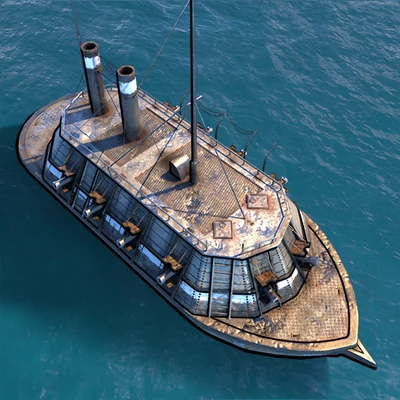
Recorded values
- Available
- Industrial Age (Federal Americans) ; Revolution (Europeans) · European Dock
- Training
- 40 sec · 110 XP per train
- Durability & mobility
- 2,000 hit points · 75% ranged resistance · 7.5 speed · 34 line of sight
- Ranged attack
- 115 base damage · range 30 · attack interval 2.0 · area of effect 1 · bonus damage: 0.5x vs. Artillery
- Long-range attack
- 200 base damage · range 80 · attack interval 0.5 · area of effect 6 · bonus damage: 5.0x vs. Building; 0.5x vs. Artillery; 0.2x vs. Villager; 0.2x vs. Dock and Port
- Ability
- Transports land units
Role, availability & values
Production is available through European Dock. It has 2,000 hit points and 75% ranged resistance. It moves at 7.5 speed. Training costs 500 Wood and 600 Coin; it takes 40 seconds to train. Attack profile: Ranged attack: 115 damage at range 30; every 2.0 seconds; area of effect 1. Long-range attack: 200 damage at range 80; every 0.5 seconds; area of effect 6. Special ability or role: Transports land units.
Matchup & timing
Use this transport for a planned crossing or landing rather than sending it alone into contested water. Its listed speed is 7.5, so load the army before the route becomes unsafe and allow time for the return trip. The page also records a ranged attack at 30 range; use that profile as support, not as a substitute for a protected landing. Unload where the force has room to form up, keep an escort near the ship, and protect the shore while the last units disembark.
Availability by version and civilization
The Ironclad first appears in The WarChiefs as an advanced ship available to European civilizations after they revolt. In that release, it is shipped from the Home City and cannot be produced as an ordinary Dock unit. Definitive Edition gives Federal American civilizations, including the Mexicans and United States, a different route: they can train Ironclads at the Dock after reaching the Industrial Age. In these Federal American rosters the Ironclad fills the role that would otherwise be served by the Monitor. These access rules are not interchangeable. A European revolution needs the correct shipment and commitment to the Revolution system, while a Federal American player can invest in Dock production. The civilization and game version therefore determine whether the ship is a one time shipment or a repeatable naval investment, subject to its production limit.
Statistics and weapon roles
The current Definitive Edition profile lists a cost of 500 Wood and 600 Coin, a 40 second training time, a limit of one, 2,000 hit points, 75 percent ranged resistance, speed 7.5, line of sight 34, and room for 50 garrisoned units. Its standard ranged attack deals 115 damage at range 30 every two seconds, with an area of effect of one and half damage against Artillery. Its Long-range attack deals 200 damage at range 80, has an area of effect of six and a 60 second cooldown. That bombardment carries five times damage against Buildings, half damage against Artillery in the current patch, and reduced damage against Villagers and Docks or Ports. This split gives the ship two different jobs: its ordinary weapon participates in local naval fighting, while the long-range shot threatens a selected coastal structure from far away. The attack is not an unlimited ordinary cannon volley; the cooldown makes target choice important.
Siege, transport, and battlefield use
The Ironclad combines armor, long reach, and transport capacity. Its garrison capacity of 50 can move a land force across water, but a ship carrying troops is still exposed to enemy warships and should use a protected crossing. For shore bombardment, approach only as far as needed for the target and time Long-range attack against a valuable building, such as a Fort or Dock, while keeping a route to withdraw. The special attack's high building multiplier rewards a deliberate shot, but its cooldown means it cannot replace a group of conventional siege ships for continuous pressure. Against enemy ships, use the normal ranged attack and account for its artillery penalty. Its high ranged resistance and hit point pool let it absorb substantial fire, but 75 percent ranged resistance is not immunity: focused fire, countering ships, and poor positioning can still destroy a costly Ironclad. Keep land units or naval allies ready to cover it, and do not strand its transport force after the vessel is damaged.
Economy and tactical tradeoffs
The resource cost is high enough that an Ironclad represents a major decision. A Federal American player must weigh it against other Industrial Age production and the cost of controlling the sea; a revolutionary European civilization must decide whether the ship shipment fits the permanent economic and military changes caused by the revolt. Its speed and durability make it flexible, but those qualities do not make it the best answer to every naval threat. The 115 damage standard attack is useful in ship combat, while its 0.5 multiplier against Artillery and the long cooldown of the bombardment make it an inefficient response to a concentrated artillery target. Its strength is the combination of survivability, transport, and a long range building threat. Use that combination to support a coastal push or to make the opponent defend valuable infrastructure, rather than chasing every enemy unit across open water.
Patch context
The Ironclad's current listed limit is one, with three recorded before update 23511. Its Coin cost was 500 before that update and is now 600. The current training and kill experience values are 110, previously 100 before update 23511. The long range multiplier against Artillery changed to 0.5 in update 23511, and a hotfix later set its Villager multiplier to 0.2. These values illustrate why older strategy notes may disagree with a current Definitive Edition stat card. The unit's WarChiefs revolution shipment rule remains distinct from Federal American Dock production. Check the edition, civilization, and patch before applying any older Ironclad cost or limit to a current match.
Using the long-range shot
The bombardment's 80 range is a tactical window, not permission to leave the Ironclad unescorted. Scout the shoreline and identify a structure whose loss would disrupt production or defense; then bring the ship into position, fire the cooldown based attack, and use its speed to retreat or shift targets while it recovers. The area of effect can punish clustered buildings, but the five times building multiplier is the reason to reserve the shot for structures. The normal attack remains the tool for nearby naval combat. Because the Ironclad can carry 50 units, a player may combine a landing with coastal pressure, yet the transport plan should not rely on the bombardment alone. Unload troops only where they can reach the objective and where allied ships or land forces can prevent the Ironclad from being surrounded.
A hybrid warship between Frigate and Monitor
Ironclads combine aspects of a Frigate and a Monitor. In the documented comparison, they move faster and fire more quickly than Monitors but have less range, line of sight and hit points than a fully upgraded Monitor. They therefore occupy a middle ground rather than replacing either specialist: a Frigate or Monitor can outperform them in its own role. Use an Ironclad where mobility and firing cadence matter, and avoid relying on its reduced range to duel a Monitor from a safe distance.
Position and naval support
Because an Ironclad must close more distance than a Monitor, escort it with other ships and avoid sailing into concentrated coastal fire. Its durability and mixed profile can make it useful in a flexible fleet, but a single ship should not be expected to control the whole sea. Keep fishing and transport vessels behind the combat line, scout the enemy fleet before committing and withdraw for repairs when the opponent has a specialized naval advantage. Exact access and statistics depend on civilization and version.