The Asian Dynasties
The Asian Dynasties is the second Age of Empires III expansion. It adds the Chinese, Indians and Japanese, three story campaigns, Asian Wonders, Consulates and Export.
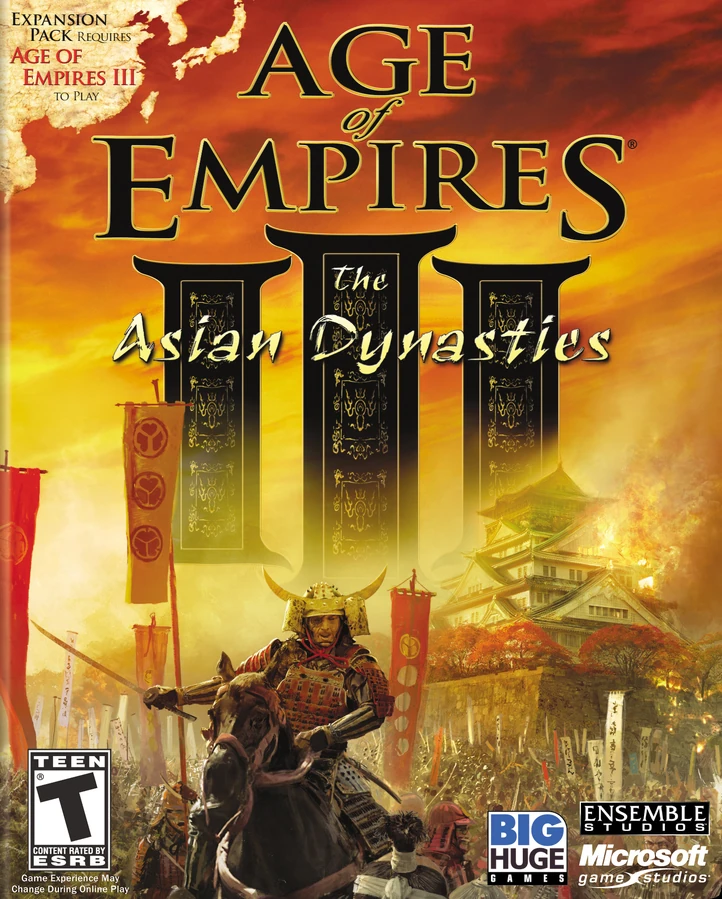
Included content
The three civilizations use distinct systems: China fields Banner Armies, India trains Villagers with Wood as part of their cost, and Japan builds Shrines and selects Wonders for age advances. Consulate allies provide additional units and technologies using Export. The expansion also adds maps and naval options.
Version boundary
Use the correct civilization’s rules when reading an Asian technology tree; European age-up politicians, Houses and unit production do not apply uniformly. The three campaigns can be played as separate stories with mission-specific objectives.
What the expansion adds
The Asian Dynasties is the second expansion for the original Age of Empires III. It adds the Chinese, Indians and Japanese as playable civilizations, along with an East Asian and an Indian architectural style, new maps, minor civilizations, campaign acts and game modes. Unlike the European age-up through a politician, these Asian civilizations advance by constructing a Wonder and choosing its associated reward. This makes the age transition a visible investment that must be defended. The expansion is a separate content package for the original game; Definitive Edition later incorporated revised content and balance, so numbers, card availability and interface details should be checked against the edition being played.
Three civilizations with distinct economies
The Japanese, Chinese and Indians do not share one generic Asian economy. Japanese play emphasizes shrines and disciplined unit choices, with restrictions and bonuses that shape which map resources can be used. The Chinese organize military production around Banner Armies, combining unit types through their buildings and shipments. The Indians use Villagers that cost Wood rather than the usual Food and build around sacred-field and livestock systems; their economy therefore values Wood differently from a standard European opening. Each civilization’s Home City and age-up options change the timing of its army. New players should learn the cost structure before copying a European build order, because a familiar resource plan can leave an Asian economy unable to train workers or complete its next Wonder.
Wonders and age advancement
To advance, an Asian player assigns Villagers to construct one of the available Wonders. Each Wonder gives an immediate reward and a continuing civilization benefit, and the player selects the desired age when starting the construction. More builders complete it faster, but every assigned Villager stops gathering until the Wonder is finished. This creates a real tradeoff: a large builder group shortens the period before the next-age units and technologies unlock, while a smaller group protects the economy at the cost of a slower transition. Wonders can be attacked and, under the rules described for the expansion, a destroyed Wonder cannot simply be rebuilt. Place it where the Town Center and army can respond, and avoid sending every available Villager away from resource gathering.
Consulates, Export and alliances
Asian civilizations can construct a Consulate and choose a foreign power or an isolation movement. The alliance provides access to selected units, technologies, buildings or shipments, and its purchases use Export rather than the ordinary three-resource economy. Export is generated through civilization-specific means and is spent on the consular options, so it is a separate strategic budget. The choice should support the army or map plan: a player expecting a cavalry-heavy opponent may value a different alliance than one seeking a timing attack or economic support. Switching or investing in an alliance has an opportunity cost, and the Consulate does not replace ordinary military production. Asian players should check which ally benefits are unlocked at the current age and preserve enough Export for the option they actually intend to use.
Campaigns and narrative structure
The expansion returns to civilization-centered historical campaigns, with one act associated with each new civilization. The Japanese act follows Sakuma Kichiro amid the political struggle leading toward Tokugawa rule and the Battle of Sekigahara. The Chinese story follows Jian Huang and Lao Chen on a voyage connected to the Ming dynasty, combining a fictional adventure with the historical setting. The Indian act concerns Nanib Sahir and the Sepoy uprising against the British East India Company. These narratives use invented protagonists and dramatized events, so they are best read as campaign stories set against historical references rather than documentary accounts. Missions provide scripted objectives and controlled forces that differ from the open-ended skirmish economy.
Maps and water play
The new map set includes varied Asian environments such as Borneo, Ceylon, Deccan, Himalayas, Indochina, Honshu, Siberia, Mongolia, Silk Road and Yellow River. Their geography affects scouting, access to trade routes, native settlements and safe resource gathering. Ceylon separates starting areas from the main island, making movement and expansion important; Siberia centers play around a frozen river and a southern trade route; Silk Road variants place guarded Trading Posts on the map that can be captured by force rather than built in the usual way. Water Treasures also appear in this expansion and are collected by naval units. On water maps, protect the Dock and scout shore approaches so that a sea investment supports the land economy instead of leaving it exposed.
Game modes and practical learning
The expansion introduced Treaty and Treaty – No Blockade alongside Supremacy and Deathmatch. Treaty changes when direct combat can begin, while the no-blockade variant modifies how players can interfere before that point; these rules change the value of early defense, economic cards and long-term scaling. Deathmatch begins from a resource-rich setup and rewards rapid production, unlike a standard Supremacy opening. When testing a civilization, use the same mode and map settings for comparisons, since Wonder timing and Consulate choices behave differently when the match has a long peace period. Start by learning one Wonder path, one Consulate alliance and the unit production cycle, then adapt to the opponent and map rather than trying to use every new feature in one build.
Planning the opening around the civilization
An Asian opening begins by accounting for its special costs before selecting the first military timing. Japanese players should consider shrine placement and the limits that shape their gathering choices. Chinese players should decide which Banner Army production pattern fits nearby resources and the expected counter-units. Indian players must include Wood for Villagers in the budget, since spending it all on buildings can interrupt worker production. Each civilization still needs enough Food and Coin for age advancement and troops, but the relative importance of the three resources differs. Scout first, then assign gatherers with the next Wonder and first production cycle in mind. If the plan needs a Consulate, reserve the resources and time to build it without stopping the core economy.
Protecting a Wonder and exploiting its reward
A Wonder is both an age-up mechanism and a valuable target. Before assigning builders, clear nearby threats, choose a site that can be covered by the Town Center or army and leave enough Villagers gathering to sustain production. Select a Wonder whose bonus contributes to the plan: an immediate unit or resource reward can stabilize a pressured opening, while a lasting effect can support a longer match. The construction count controls the tradeoff between speed and lost gathering time, so add builders only when the earlier age is worth the economic pause. When the Wonder completes, use the arrival of new-age access promptly: queue the relevant unit, research its prerequisite or send the shipment that the opponent must answer. Leaving the benefit unused gives the enemy time to recover.
Matchups, counters and army support
The expansion’s units are strongest when combined to cover each other’s weaknesses. A Banner Army can provide a planned mix, but its selected components still need to answer the enemy’s actual cavalry, ranged infantry and artillery. Japanese forces can bring powerful specialized units, yet costly troops should not be traded into counters without support. Indian armies benefit from matching ranged units with protection against cavalry and siege. Consulate units and minor-civilization troops can fill a roster gap, but their cost and availability depend on alliance, map and age. Keep the Explorer active to find treasures and settlements, and use the Home City to reinforce a composition at the right time. Do not assume that a unit listed for one expansion map is available on every random map.
Expansion ownership and version distinctions
The Asian Dynasties was designed for the original Age of Empires III and is commonly encountered in the Complete Collection. Definitive Edition contains updated versions of many of its civilizations, maps and systems, with rebalanced values and altered content over time. A description of the original campaign, Home City level or unit statistic may therefore differ from the current Definitive Edition interface. Record which release a strategy uses, especially when discussing Wonder costs, card shipments, Treaty rules or unit counters. The broad design remains recognizable—three Asian civilizations, Wonder advancement, Consulate alliances and new campaign content—but precise values and availability belong to a specific release and patch.
Three Asian civilizations and distinctive age advancement
The Asian Dynasties expansion adds China, India and Japan as playable civilizations, each with an economy and age-up system that differs from the European baseline. China advances through Wonders and uses Banner Armies and Export; India has a worker system and units that use Influence; Japan uses Shrines and age-up Wonders. Those differences affect production, resource planning and Home City choices, so an Asian civilization should be read through its own roster rather than treated as a visual variant of an older faction.
Consulates, Export and Native relationships
Asian civilization mechanics also include systems such as the Consulate, where an alliance can provide units or technologies in exchange for Export, and Native settlements that can supply units or improvements. These options create a second set of choices alongside ordinary Food, Wood and Coin gathering. Their value depends on the map and the chosen ally: a Consulate purchase can fill a roster gap, while a Trading Post or Native alliance needs a defensible position. The expansion’s campaigns, maps and historical content use scripted rules that should be kept separate from standard skirmish play.
Version and content context
The Asian Dynasties is an expansion for Age of Empires III and later content was incorporated into Definitive Edition, where balance and presentation may differ from the original release. When comparing unit costs, age rewards or card effects, identify which version the page describes. The three civilizations retain their defining systems, but individual values and available content have changed through updates. Follow the linked entries for China, India, Japan, Wonders, Banner Armies, Shrines and the Consulate for unit-level details.