The Thirty Years’ War
The Thirty Years’ War is a multiplayer-only Historical Map from Knights of the Mediterranean. Players command smaller armies and compete to capture 20 villages spread across the map; the player with the most captured villages wins.
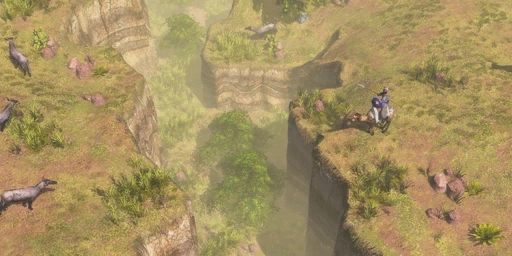
Historical setting & objective
Village control is the scoring objective, so the match rewards keeping units in several places rather than relying only on a single base assault. Scout the village locations, capture reachable points early, and retain mobile troops to retake a village when the opponent moves elsewhere.
Map control & approach
Do not leave every unit in one battle while the opponent captures unattended villages. Divide the force only when each group can hold its position, and use reinforcements to contest the score rather than pursuing an army away from the objective.
Scoring villages instead of chasing armies
The 20-village limit makes the score visible in the landscape: a successful army must take positions and keep them, not simply win one large engagement. Before the first split, identify which villages can be reinforced from the same route and which would leave a small detachment isolated. Early captures matter because they establish a score and force the opponent to respond, but an undefended village can be lost again. Use mobile units to contest points that change hands while the main force protects the most valuable cluster. When behind, attack the opponent’s control pattern rather than following its army away from villages. This multiplayer-only map is part of Knights of the Mediterranean, so its small starting forces and objective should guide the opening more than a standard base-focused build order.
Manage a twenty-village score race
The scenario’s 20 villages are spread across the map, and the player with the most captured villages wins. This creates a distributed control problem: a single concentrated army can win battles yet lose the score while villages elsewhere are left unattended. At the start, scout a group of nearby villages that can be reinforced along the same route. Capture the safest points first, then use mobile troops to contest isolated villages or respond to a changing lead. Keep defenders at a position that the opponent can retake, and avoid sending reinforcements on a long chase that leaves the scoring area open. As the match develops, compare the score with the cost of each fight; retaking a village may be more valuable than pursuing an enemy army away from the objectives.
Civilization roster and Command Post rules
This Knights of the Mediterranean map is multiplayer-only. Its listed civilizations are Dutch, French, Germans, Italians, Spanish and Swedes. The game starts with a timer, and the player with the most captured villages wins; the broader map overview describes twenty villages across the field. Players begin with a Command Post rather than the ordinary Town Center and can use scenario technologies that affect mercenaries, loot and military production. Opportunity of Contracts enables Fortress Age mercenaries in the Commerce Age with reduced attack and hit points until the player advances; Wedding of Magdeburg improves the yield from looted village buildings; Rapid Deployment increases military-building work rate. Captured villages can be kept for small resource trickles and population or looted for immediate income. That choice links the score objective to the economy: loot when a short-term force is needed, keep buildings when a held position can support a longer match.
Capture villages, then decide whether to hold or loot
The match is decided when the Peace Negotiations timer ends: the player controlling more than half the villages wins. Villages are capturable positions guarded by defenders; defeat the guardians to take control. Once captured, each village creates a strategic choice. Keeping its houses preserves a small resource trickle and population support, while looting them yields faster income for an immediate army or upgrade. Holding villages therefore helps both the victory count and the economy, while looting trades part of that long-term value for short-term resources. Do not loot a position that must remain under your control unless the immediate resource gain is worth conceding its continued support.
Command Post technologies shape a mercenary opening
Players start with a Command Post instead of the usual Town Center. Opportunity of Contracts costs 500 Food and 350 Coin and makes mercenaries cheaper; Fortress Age mercenaries can be trained in the Commerce Age, but have lower attack and hit points until the player advances. Wedding of Magdeburg costs 400 Coin and increases the extra resources obtained from looted village buildings. Rapid Deployment costs 600 Wood and raises military-building work rate. The available mercenaries include Jaegers, Black Riders, Swiss Pikemen, Landsknechte, Highlanders and Harquebusiers. Select units that can clear village guardians and still defend a site from recapture. The scenario also permits temporary alliances that can be established or broken, so a diplomacy change can shift who is safe to attack and who contributes to the village majority. Coordinate an alliance with the timer and objective rather than treating it as permanent.