Trabant
The Trabant is a population-free House of Wettin native Infantry unit that protects nearby allies by taking part of the damage aimed at them. Its charged pistol provides a periodic burst against Cavalry and Shock troops. Keep Trabants near the units they are meant to shield and away from artillery and Light Infantry.
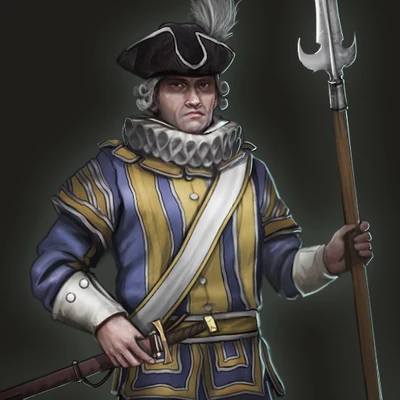
Recorded values
- Available
- Commerce Age · Trading Post or Tambo on a House of Wettin palace; Native Embassy
- Training
- 33 sec · 13 XP per train
- Durability & mobility
- 180 hit points · 4.25 speed · 12 line of sight
- Siege attack
- 20 base damage · range 6 · attack interval 3.0
- Hand attack
- 22 base damage · attack interval 1.5 · bonus damage: 2.0x vs. Cavalry; 1.6x vs. Shock troops
- Pistol attack (charged)
- 30 base damage · range 12 · attack interval 3.0 · bonus damage: 1.34x vs. Cavalry; 1.2x vs. Shock troops · recharge 60
Role, availability & values
Production is available through a Trading Post or Tambo on a House of Wettin palace, or through a Native Embassy where that roster is available. The native unit has 180 hit points, speed 4.25 and no population cost; it costs 60 Food and 70 Coin and trains in 33 seconds. Deflection transfers 25% of damage aimed at nearby allied units to the Trabant within radius 12, except for artillery. Its charged pistol deals 30 damage at range 12, has bonuses against Cavalry and Shock troops, and recharges every 60 seconds. Keep it close enough to protect the intended allies, and screen it from Light infantry and artillery.
Matchup & timing
Keep Trabants beside the units they protect so damage deflection and their House of Wettin role can support the formation. Their charged pistol adds a timed answer to Cavalry and Shock troops, but it recharges for 60 seconds. Because Trabants use no population and have a limited train cap, preserve each one rather than treating them as expendable infantry.
Base profile and damage deflection
The Commerce Age Trabant costs 60 Food and 70 Coin, trains in 33 seconds and is limited to ten per House of Wettin palace. It has 180 hit points, 20% siege resistance, speed 4.25 and line of sight 12. Its hand attack deals 22 damage every 1.5 seconds, with a 2.0 multiplier against cavalry and 1.6 against shock troops; its siege attack deals 20. The native version uses no population. Its defining passive, Deflection, absorbs 25% of damage inflicted on nearby allied units within radius 12, except artillery. This makes the Trabant a protective unit as well as an anti-cavalry melee fighter: keep it among vulnerable troops so its area protection is active, while maintaining a separate screen against ranged counters.
Charged pistol attack
Since update 13.18214, the Trabant can use a charged pistol attack automatically while fighting. The shot deals 30 ranged damage at range 12, with a 1.34 multiplier against cavalry and 1.2 against shock troops, and recharges over 60 seconds. It gives the unit a way to contribute before reaching melee, but it is a periodic special attack rather than a normal ranged weapon. The Trabant remains hand infantry and should not be used as a ranged skirmisher. Earlier balance values differ: the old hand attack was 15 with stronger cavalry and shock multipliers, and the pistol attack was not part of the original profile. When comparing versions, keep the current melee numbers and the later charged shot together.
Deflection as a formation tool
Deflection makes nearby non-artillery allies take 25% less of the damage directed at them by transferring that portion to the Trabant. Its radius is 12, so formation spacing matters: units spread too far apart may not receive the protection. This is not a broad aura that makes the whole army invulnerable, and the Trabant’s own hit points can be depleted while it protects the line. Place it near high-value infantry or other units that need to survive, and monitor its health during concentrated attacks. Because artillery is excluded, do not rely on Deflection to protect nearby guns. Rotate the Trabant out if it becomes the focus of fire, and use its own melee multipliers when cavalry or shock troops approach.
Access and training limits
The native Trabant is trained from a Trading Post or Tambo on a House of Wettin palace. More than one palace site increases the available production, and cards such as Native Alliance or TEAM Native Weapon Trade can raise the effective limit. Germans have a Royal Embassy route after sending Prince-Electors and choosing the Wettin alliance; that version costs one population, has a limit of 20 and can receive Veteran and Royal Guard upgrades. Revolutionary France can receive Trabants through the Sister Republics random native-warrior shipment. These routes differ in whether the unit is population-free, how many can be trained and which upgrades apply. Check the exact access method before treating the unit as a permanent part of the roster.
Matchups and support
The Trabant is effective against cavalry and shock troops and can damage buildings, but it is vulnerable to light infantry, counter-skirmishers and artillery. Its siege resistance does not make it a strong answer to artillery, and its speed is too low to chase skirmishers safely. Pair it with Hussars or another mobile unit that can reach the light infantry and guns threatening the formation. The Trabant protects nearby allies while the cavalry handles those counters. Against a cavalry charge, keep Trabants close to the army and allow the hand multiplier and pistol shot to contribute; do not send them far ahead where their Deflection radius cannot protect anyone.
Age upgrade path
Veteran Wettins costs 125 Wood and 125 Coin in the Commerce Age and adds 20% hit points and damage. Royal Guard Wettins costs 350 Wood and 350 Coin, requires Veteran and adds 40%. The Imperial native-warrior upgrade adds 50% hit points and damage for 1,500 Food and 1,500 Wood through the appropriate civilization technology. These age upgrades are separate from Deflection, which remains the unit’s support identity. The pistol shot’s damage follows relevant damage increases, but its cooldown remains a separate constraint. Invest in upgrades when the group can remain alive and protect a meaningful portion of the army; a small force near its cap may instead benefit from immediate reinforcements or a counter-unit.
Using a Trabant formation
A practical Wettin force places one or more Trabants near the units most exposed to attack, with ranged infantry behind and mobile cavalry ready to intercept skirmishers. The unit’s no-population native version allows a player to add protection without crowding the army cap, but its Food and Coin cost still competes with ordinary production. The German Embassy version consumes population and has a larger limit, so calculate army space accordingly. Use the charged shot during the approach, then let the Trabant hold the melee line. Pull it back if its health begins falling faster than the protected units can benefit.
Why its role differs from Papal Guard
The Trabant and Papal Guard both provide early durable infantry that can protect nearby allies, but their access and combat profiles are distinct. The Trabant is a Commerce Age House of Wettin native warrior with a training cap and a charged pistol attack; the Papal Guard belongs to a separate Italian system. The Trabant resembles an early Halberdier in its anti-cavalry role, but its no-population native version, Deflection aura and limited site production change how it fits into an army. Use it as a protective supplement rather than assuming it can be massed like ordinary Barracks infantry.
Current and earlier combat values
Update 13.18214 changed the Trabant’s profile. The current hand attack is 22 with a 2.0 cavalry multiplier and 1.6 shock multiplier; earlier values were 15 damage with 3.0 and 2.2 multipliers. The same update introduced the charged pistol attack. Food cost also changed from 50 to 60, while XP for training and killing rose from 12 to 13. Older descriptions may therefore overstate the unit’s direct anti-cavalry melee damage even as they omit its pistol shot. Keep these version changes together when using a legacy build order.
Supporting an army without overextending
Deflection gives the Trabant a reason to stay close to allied units rather than charging forward alone. Place it in the center of a small formation so several units can benefit from the radius, and keep cavalry or ranged units ready to intercept counters. If the army spreads out across two fronts, one Trabant cannot protect both groups. The ability excludes artillery, and ranged attacks can still bring the Trabant down as it absorbs redirected damage. Move it with the main army and avoid using the protection radius as a reason to stand under enemy artillery fire.
Limit and reinforcements
The native cap applies per Wettin palace. Add another site or a card-based limit increase before expecting more native Trabants; the Embassy route has its own population and cap rules.
Protection in motion
Keep the Trabant within twelve range of the units it is meant to protect as the formation moves. The passive deflection effect does not follow allies outside that radius.
Commerce Age melee screen against Cavalry
The Trabant is melee Heavy Infantry suited to fighting Cavalry and Shock Infantry. It offers an early answer similar in purpose to a Halberdier, appearing in the Commerce Age with a build limit rather than a standard population cost in the documented profile. Use it to protect ranged units and artillery from mounted attacks, or to intercept Shock Infantry before it reaches the back line. Its limits mean it should complement, not replace, ordinary production.
Keep it away from light infantry and guns
Trabant units are vulnerable to artillery and light infantry, so send them only when a protected approach or favorable target exists. Their lower durability and attack compared with later anti-Cavalry units make them a timing tool, not a permanent front line. Increase access only through the applicable buildings or cards and scout whether the opponent is already massing counters. Pair them with ranged units that can remove light infantry while the Trabants hold Cavalry away.