Captured Mortar
Captured Mortar is a long-range artillery unit available through Native Embassies or the Maya Artillery Foundry. Its Bombard attack reaches very far, while Barrage provides a separate wider-area attack at closer range.
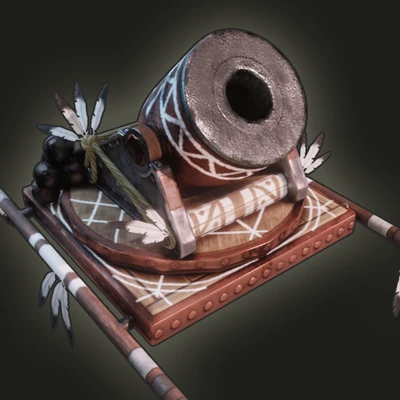
Recorded values
- Cost
- 450 Coin
- Available
- Industrial Age* · Native Embassy (Native Americans) ; Artillery Foundry (Maya)
- Training
- 50 sec · 6 population · 45 XP per train
- Durability & mobility
- 250 hit points · 75% ranged resistance · 3.0 speed · 44 line of sight
- Bombard attack
- 416.67 base damage · range 4-40 · attack interval 6.0 · area of effect 1 · bonus damage: 1.25x vs. AbstractWall; 0.75x vs. Ship
Role, availability & values
The unit has 75% ranged resistance and a six-population cost in its recorded profile. The Bombard attack reaches 40 range; Barrage reaches less far but affects a larger area. Access is restricted by civilization and age.
Matchup & timing
Use Bombard to work on distant structures and Barrage against a grouped target inside its range. Keep the Mortar behind a protective force and avoid allowing cavalry to reach it during a transition between positions.
Two firing modes and restricted availability
Captured Mortar is a Definitive Edition artillery unit added through the United States update. Native American civilizations can train it at a Native Embassy in the Industrial Age after researching Gun Running; Maya can obtain it from the Artillery Foundry through their revolution. Its current listed cost is 450 Coin, training time 50 seconds, six population, 250 hit points, 75% ranged resistance, speed 3, and line of sight 44. The Bombard attack deals 416.67 siege damage at range 4–40 every six seconds and targets buildings and ships. The separate Barrage attack deals 25 damage at range 4–30 in an area of four, with reductions against Artillery, Cavalry, Shock troops and Villagers. This division of roles matters: use Bombard to pressure a distant structure or ship, and Barrage against a group of other unit types, but do not expect either mode to serve every target equally. Its large vision range helps it position behind the army, while its slow movement and six-population cost make an exposed retreat difficult. Cavalry can exploit that mobility gap, so provide a screen and avoid placing it where a flank can reach it. The unit’s classification changed in later updates: it is an Outlaw in current rules, whereas earlier versions treated it as a Native warrior and used a different age and access requirement. It can also appear through Lakota outlaw shipments and the Maya or Argentina revolutions. Age upgrades improve its health and damage; Gun Running and Advanced Captured Mortars affect access and cost for the relevant civilization. Use the current game version when applying these values, since older patches changed cost, population, health and damage.
Upgrades and tactical trade-offs
Captured Mortars are expensive strategic artillery rather than routine battlefield units. Their Bombard attack has a long 4–40 range and focuses only buildings and ships; Barrage is the mode for other targets, with a four-point area but comparatively modest base damage. The mortar’s exceptional vision can reveal distant structures and help the player choose a firing position, but it does not make the slow unit safe. Keep it behind a screen and move it before enemy Cavalry or counter-artillery reaches the firing line. In current rules, Native American access requires the Industrial Age and Gun Running, while Maya access comes through the revolution’s Artillery Foundry; Lakota can also receive the unit through outlaw shipments and a dedicated card. Industrial and Imperial Age outlaw upgrades increase its statistics, and the Advanced Captured Mortars card changes Coin and population cost for its intended access path. The current profile is six population, so include that cap usage when comparing it with other artillery. Values in older source material may show five or eight population, a Coin cost of 500, and a different age requirement because updates changed the unit. Its wall multiplier was also modified in a later update. Check the current version’s displayed statistics before making a direct comparison with a standard Mortar or Howitzer. Choose the Bombard mode for a siege objective and Barrage when the opponent’s units are the immediate threat; changing the target type changes which attack profile is relevant.
Two firing profiles for buildings and field units
The Captured Mortar has separate Bombard and Barrage attacks with different target restrictions. Its Bombard attack deals 416.67 damage at range 4–40 every six seconds and can attack Buildings and Ships only; it gains 1.25× damage against walls and deals 0.75× against Ships. Barrage instead deals 25 damage at range 4–30, with area 4 and the same six-second interval, against targets other than Buildings and Ships. It uses six population, costs 450 Coin, trains in 50 seconds, and has 250 hit points with 75% ranged resistance. This split means that the Mortar can contribute to a field fight, but the Barrage profile is not the building attack. It is available through specific Native American access and the Maya Revolution, so verify the faction and Industrial Age prerequisite before planning for it. Keep it screened because its siege range does not protect it from Cavalry.
Maya and Native access, population and siege revisions
Captured Mortar is a special artillery unit obtained through Maya or Native-related access, including Gun Running in the applicable setup. Its current profile costs 450 Coin, has 250 hit points and uses six population; before update 13.18214 its Coin cost was 500 and it used eight population, while earlier versions used five. Before update 13.12327 it required 150 Food and was Imperial Age; its current listed profile is Industrial Age and has no Food cost. Its siege attack is listed at 416.67 damage, down from 500 before update 13.38085, and its current ship modifier is 0.75× rather than 0.5× before update 14.43676. The current profile also has a 1.25× wall modifier since update 13.58326. Its large siege value suits a planned push, but the population commitment and limited durability make protection essential.