Federal State
The age-up choice used by the United States and Mexico in place of a standard European politician.
How it works
A selected state grants a reward and can change the Home City deck or later options. The two federal civilizations have different state rosters.
Player decision
Read the reward and subsequent cards before aging; a state choice should support the next phase of the economy or army.
Age advancement and card access
Federal States are the age-up choices for the United States and Mexicans in Definitive Edition. Like a Politician, a selected state advances the civilization to the next Age and grants a reward, but it also unlocks two Federal Home City Cards associated with that state. The cards are listed as cards from the previous Age: cards unlocked by a Commerce Age state count as Exploration Age cards for deck construction. This matters when organizing a Home City deck and when comparing the timing with cards that require a later Age. Federal States are not a single shared list: the United States and Mexico have different choices and effects, so the name of a state should always be read with its civilization.
Experience included in the reward
In standard game modes, Federal State rewards include a Tome of Experience in addition to the listed resource or unit effect. The Experience values rise with the destination Age: 200 for the Commerce Age, 300 for the Fortress Age, 400 for the Industrial Age and 500 for the Imperial Age. A state reward may therefore have both an immediate economic or military component and progress toward the next Home City shipment. Account for the Experience when estimating the next shipment timing, but do not mistake the Tome for the state’s only reward. Each selection has its own listed delivery and Federal Cards.
Read the whole state before aging
A state can change the player’s immediate army, economy or later deck options. Examples in the United States list include military deliveries, Food crates, Home City shipments, Minutemen and state-specific card benefits. Some rewards arrive quickly, while others create units or effects through Town Centers and Command Posts. The correct decision depends on what the match needs at that moment: a wagon or units may strengthen a timing, crates may help pay for production or an Age, and extra shipments matter only if the deck contains useful cards and the player can earn the needed Experience. Look at the state’s reward and its two Federal Cards together, rather than choosing by state name or by resource amount alone.
Independence mode changes the system
Independence removes Experience and the Home City, so Federal States cannot use the ordinary card-and-shipment structure in that mode. Instead, each state provides mode-specific resources or units. The standard-mode Experience totals and Federal Home City Cards do not describe this version of the reward. Confirm the match mode before reading a state’s card text or calculating shipment timing. This distinction is especially important when using older strategy notes, which may list only the standard game or assume that every state unlocks cards.
Civilization-specific planning
The Federal State is a timing decision rather than a purely economic bonus. Before selecting one, compare its delivery with the next production cycle and the army that the opponent can field during the age-up. If the reward adds a unit or wagon, ensure population space and a safe arrival point; if it adds resources, check whether the immediate resource is actually limiting the next build. Review the unlocked cards before finalizing a Home City deck, since an attractive reward can be less useful when neither Federal Card supports the intended plan. For Mexico, consult the Mexican state list and its separate Revolution choices; do not transfer United States state effects to the Mexican civilization.
Distinguishing Federal Cards from ordinary shipments
Federal Cards are tied to the chosen state and are made available for the player’s Home City deck; selecting the state is not the same as automatically receiving every unlocked card in the field. The player must build a deck that includes the card and satisfy its own shipment timing. In standard modes, the state also supplies its one-time reward and Experience. This creates two layers of planning: select a state for what it delivers now, and consider whether its Federal Cards improve the deck for later shipments. If the intended card is not included in the deck, the state’s unlock does not put that card into the shipment queue by itself. Review deck composition before starting the match when a specific Federal Card is central to the plan.
Timing the one-time reward
A reward should be read for what it actually delivers, where it appears and when it arrives. A wagon can place a production or economic building, but it does not itself pay for repeated unit queues. Food or Coin crates add a fixed amount to the inventory and may bridge a short resource gap; they do not provide continuing income. Minutemen and other unit rewards add immediate defense but are a limited force, so use them to buy time or protect a key site rather than treating them as an ongoing army. A reward that causes Town Centers or Command Posts to spawn units can have continuing implications while those buildings remain, but the effect is linked to the listed structure and the specific state. Keep that condition visible when expanding or replacing buildings.
Population, arrival points and follow-up
Some state rewards add units or wagons to the map. Before advancing, leave enough population capacity for the delivery and make sure the arrival point is safe from an enemy force. A unit reward that appears during an active raid can be valuable if it reaches the fight, but a vulnerable arrival can be lost before it contributes. Building rewards should be placed where the resulting production or resource collection can be protected and supplied. After the delivery, update the army plan: a reward may cover one matchup and leave another unanswered. Federal State choices should therefore be evaluated as part of a force composition, alongside the other units the player expects to train, rather than as a standalone bonus.
How to compare two choices
Compare state options by immediate value, timing, follow-up and deck impact. Immediate value asks whether the reward covers a current shortage or threat. Timing asks whether the delivery arrives before the opponent’s likely attack. Follow-up asks whether the resulting building, unit or resource can be used more than once. Deck impact asks whether the unlocked cards fit the intended shipment sequence. A state with the largest crate count may still be weaker when the player needs defensive units; an extra shipment may be less useful than a unit delivery when the player lacks Experience or has no appropriate card in the deck. The correct choice changes with the map and opponent, which is why the Federal State list should be read entry by entry.
Keep mode and version labels attached
Federal State values belong to specific game modes and versions. The ordinary Home City mode includes the Experience reward and Federal Card unlocks, while Independence substitutes a mode-specific resource and unit reward because Experience and Home City mechanics are absent. The United States and Mexico each have their own set of states, and their choices are not interchangeable. Expansion content can also add or change available state effects. When reading a build-order note, confirm its civilization, destination Age, mode and Definitive Edition update before copying the selection. This avoids treating an old United States example as a Mexican reward or using an Independence value in a standard match.
Commerce Age examples and how to read them
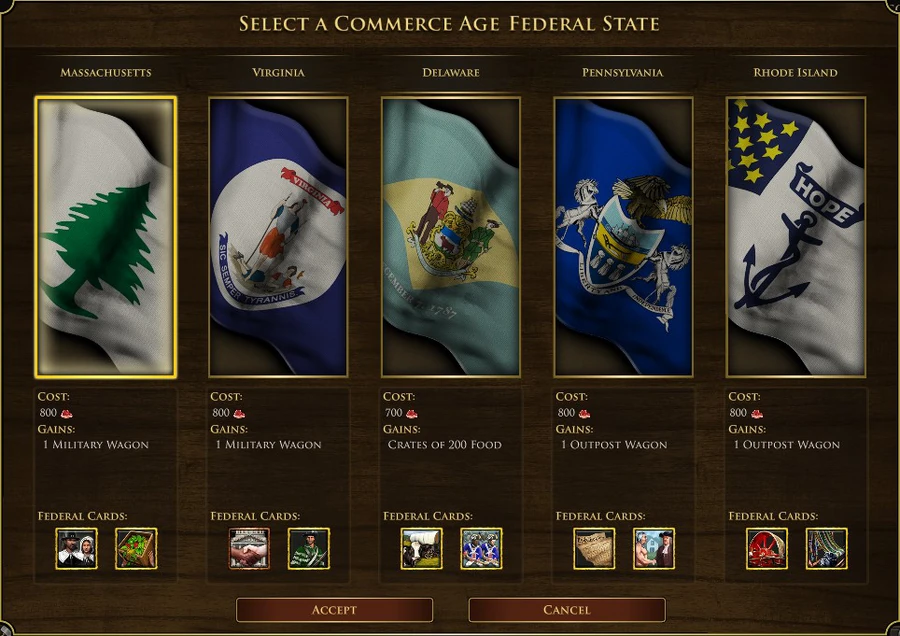
The United States Commerce Age list demonstrates that one destination Age can lead to very different plans. Massachusetts and Virginia share a Military Wagon delivery but pair it with distinct Federal Cards: Plymouth Settlers provides Food crates and a Native Scout and gives Town Centers and Command Posts a Pilgrim spawn effect; Boston Tea Party is a fast-arriving Coin reward that exchanges current Food at the listed rate. Virginia Plan grants two Home City shipments, while Culpeper Minutemen changes Minutemen behavior and adds a spawn effect to Town Centers and Command Posts. Delaware provides Food crates. These rewards affect different resources, timings and future options. When a card or conversion is conditional, read the full tooltip and current patch rather than comparing only the headline delivery.
State reward versus permanent civilization identity
A state is a selected age-up path, not a permanent replacement of the civilization’s entire technology tree. Its immediate delivery can alter the next few minutes, and the unlocked Federal Cards can influence later Home City shipments, but the player continues to use the chosen civilization’s normal buildings and unit roster unless a separate rule says otherwise. Keep these scopes distinct when planning: a single resource grant is temporary, an unlocked card is a deck option, a production building changes where units can be made, and a Town Center spawn effect depends on maintaining the specified structure. This helps prevent the common mistake of treating a one-time state reward as a permanent bonus for every future unit or shipment.
Age-up choice as a response to matchup
Use the state menu after checking what the opponent is producing and what the map allows. A military delivery can buy time against pressure or add a needed frontline; it is less useful if it arrives far from the fight or duplicates a role the army already has. A resource choice is strongest when that resource is the bottleneck for a concrete queue, not merely because it looks largest in isolation. A shipment-oriented choice can accelerate the next card, but only if the Home City deck contains useful shipments and Experience is available. A building or unit unlock is more valuable when the player can afford repeated use. These comparisons turn the state choice into a response to the game state rather than a fixed build-order step.
Check the UI before relying on older notes
Federal State data has evolved with Definitive Edition updates and the addition of Independence mode. Some cards have undergone balance changes, and the same named state may appear in multiple civilization trees with separate effects. Read the current tooltip for the destination Age, reward amount, arrival timing and any conversion rule. For an older guide, compare its update era with the active build and verify whether the listed card still unlocks at the same state. In Independence, ignore standard Experience and card timing assumptions and use the resources or units shown by that mode. This version check is essential when an apparently small reward detail changes the resource budget or timing of an entire opening.
Quick comparison checklist
Before confirming a Federal State, note four things: the one-time reward, the reward arrival timing, the two Federal Cards unlocked for the deck, and the Experience granted for the destination Age in standard play. Then verify which of those benefits you will actually use. If a Town Center spawn effect is part of the reward, plan to keep the required Town Center or Command Post active. If a resource conversion is involved, check the exact rate against the current inventory. If the choice is made in Independence, replace this checklist with the mode-specific resources or units and disregard Home City shipment assumptions. These checks make the state choice concrete and prevent a reward from being valued for a card, unit or building that the player cannot use.
Summary of the decision
A Federal State combines age advancement, an immediate reward and two deck unlocks in standard play. Its value comes from the reward that fits the current match and the cards the player can later send. In Independence, the Home City components are replaced by mode-specific resources and units. Keep the civilization and ruleset attached to every state comparison.
Keep unlocks distinct from deliveries
Unlocking a Federal Card makes it eligible for the deck; it does not automatically send that card or guarantee that it appears next. The immediate state reward and a later card shipment are separate benefits.
Unlock cards when the age-up resolves
Federal State choices advance the United States or Mexicans in Definitive Edition, but each civilization has a separate state list and reward. A chosen state grants an immediate benefit and unlocks two Federal Home City Cards associated with it. Those cards are treated as cards from the previous Age for deck construction: a state selected on the way to Commerce Age unlocks cards classified for Exploration Age. This affects when the cards can be added to a deck and when they can be shipped. Prepare the deck before the match with the states and Federal Cards that support the intended sequence; do not expect a reward to make every card immediately available in the current game.
Compare reward, next cards and army
A Federal State is both an age-up reward and a deck-building decision. Read its resource or unit effect, then check which two cards it unlocks and whether their requirements fit the coming plan. A military state may create a timing, while an economic or building reward can support a longer transition; the best choice depends on the opponent and the map. The United States and Mexico use different state rosters, card unlocks and follow-up mechanics, so an entry for one must not be used as a build order for the other. Federal progression is also distinct from a Revolution: selecting a state advances the current civilization, whereas a Revolution changes the nation and may replace its economy or army.
Mexico Federal State card changes
The Knights of the Mediterranean update 13.58326 changed three Mexico Home City Cards tied to Federal State choices. Michoacán Fishermen (Commerce Age) originally sent two Dock Wagons and now sends one. San Luis Patriots (Fortress Age) now has a limit of eight Chinacos. Zacatecas Silver (Fortress Age) originally delivered two Prospector Wagons on every shipment after the first and now delivers one per later shipment. These are card effects attached to particular Mexican state choices, not global rules for every Federal State. When following an older build order, check the current card text before budgeting for extra Dock or mining infrastructure.