Flying Crow
Flying Crow is Chinese artillery produced through the Confucian Academy, tying its availability to the Chinese Wonder system. It moves slowly at 1.2 speed, occupies seven population and attacks at a range of 18 with area damage. The long reach lets it contribute from behind an army, but its slow movement and large population cost make it a deliberate investment. It is a siege unit that needs a protected approach and enough space to fire effectively.
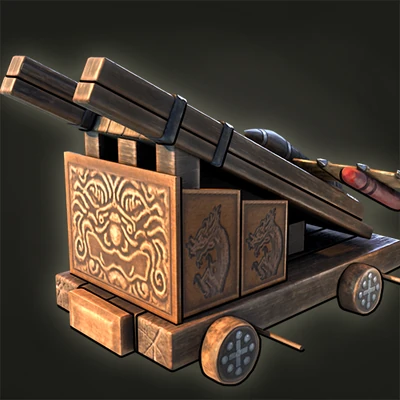
Recorded values
- Available
- Commerce Age · Confucian Academy
- Training
- 240 sec · 7 population
- Durability & mobility
- 225 hit points · 75% ranged resistance · 3.0 / 1.2 speed · 32 line of sight
- Bombard attack
- 190 base damage · range 18 · attack interval 5.0 · area of effect 3 · bonus damage: 2.0x vs. Ship; 2.0x vs. Building; 0.5x vs. Cavalry; 0.5x vs. Shock troops; 0.5x Arrow Knight, 16
Role, availability & values
Position Flying Crows behind the frontline and move them with a force that can stop cavalry or other attackers from reaching the artillery. Their area attack can punish clustered enemies and their siege role supports pressure against structures, but the slow movement makes it difficult to retreat after an exposed advance. Preserve a clear firing line and avoid blocking the guns with friendly units.
Training & availability
Chinese; produced through the Confucian Academy; 1.2 movement speed; seven population; 18 attack range; area damage.
Matchup & timing
Use Flying Crows when the Chinese army can protect slow, high-population artillery and needs long-range area or siege pressure. They are more valuable in a planned push than in a rapid raid. Before producing them, confirm that seven population per unit will not prevent essential frontline reinforcements.
Chinese rocket artillery and age scaling
The Flying Crow is Chinese rocket artillery produced by the Confucian Academy Wonder or provided through Home City shipments. The Confucian Academy can make it available from the Commerce Age, but the Wonder takes four minutes to produce one, about twice as long as a Heavy Cannon’s training time. The unit costs 100 Wood and 500 Coin, takes 240 seconds to train, occupies seven population and has 225 hit points with 75% ranged resistance. Its Bombard attack deals 190 siege damage at range 18 every five seconds in an area of three. The attack has 2× damage against Buildings and Ships but only 0.5× against Cavalry and Shock troops, so it is not a safe answer to a cavalry charge. It also has a substantial modifier against Arrow Knights as listed in its profile. In limber mode it moves at speed 3; in bombard mode it slows to 1.2. These speeds create a clear choice between repositioning and firing. Keep it behind Chinese units that can protect the firing line, and deploy it when the army can prevent fast enemies from reaching it. Its 32 line of sight helps it contribute at long distance, but the seven-population cost can displace several frontline units. The Flying Crow automatically upgrades as the Chinese player ages up, which means its value can rise without a separate unit upgrade. Its area attack can punish a compact formation and pressure structures, but spacing out the opponent reduces the damage it can deliver. Treat it as a planned siege and area-damage investment rather than a quick-response unit. The Flying Crow is available in The Asian Dynasties and Definitive Edition, and its Home City shipment may change when it enters the game; check current civilization options before assuming an early Wonder-produced unit.
Firing mode and target selection
The Flying Crow’s two movement speeds reflect its limber and bombard states. Use its faster limber speed of 3.0 while relocating behind the army, then allow it to deploy at 1.2 speed to fire. At 190 siege damage, area three and range 18, it can punish formations that remain clustered and pressure buildings or ships with its 2× bonus. Its reduced damage against Cavalry and Shock troops means a frontline screen is essential. Do not let friendly units obstruct the approach or crowd the firing position; the rocket needs a clear line to its target. Its four-minute production time at the Confucian Academy means it cannot be summoned quickly in response to a sudden attack. Plan it with the age-up and protect its population allocation.
Shipment and support
The Confucian Academy can create the unit as part of its Wonder function, while Home City shipments provide an alternative route where the deck permits. A shipment can change the timing but does not remove the need to budget seven population and protect the gun after arrival. Keep a screen of units between it and cavalry, and retreat in limber mode if the enemy can reach the deployed artillery.
Confucian Academy artillery investment
The Flying Crow is Chinese artillery produced through the Confucian Academy, the Chinese Wonder that controls its availability. Its 18-range area attack allows it to threaten clustered units and support a siege from behind the main line, while its 32 line of sight helps it operate at a distance. The unit moves at only 1.2 speed and takes seven population, making it one of the most deliberate pieces in a Chinese army. It should advance with an escort and a clear firing lane rather than travel alone. A cavalry raid or a blocked route can turn its high resource and population investment into a loss before it fires effectively.
Timing, protection and population planning
The listed price is 100 Wood and 500 Coin, and the production time is 240 seconds. This long queue makes it important to begin production before the moment when the army needs artillery, while also ensuring the Confucian Academy can be defended. Check the seven-population commitment against the units needed to screen the gun; an army with artillery but no protective force is vulnerable to a fast dive. Move the Crow behind infantry or cavalry that can intercept threats, keep enemy units within its area attack and avoid crossing narrow routes where friendly troops block its shots. Its strongest role is planned range pressure in a protected push, not a quick response to an attack on the opposite side of the map.