Heavy Cannon
The Heavy Cannon is a powerful Industrial Age artillery unit produced at a Factory for most civilizations that have access to it. Its large-area bombard attacks threaten armies, ships and buildings at long range.
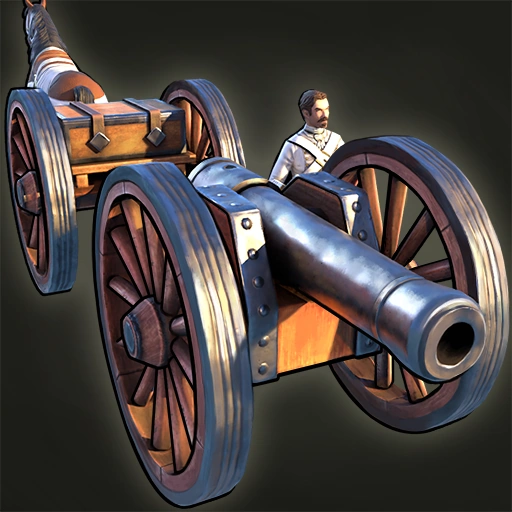
Recorded values
- Available
- Industrial Age · Factory; Palace (Hausa)
- Training
- 115 sec · 7 population · 80 XP per train
- Durability & mobility
- 475 hit points · 75% ranged resistance · 3.5 / 1.4 speed · 32 line of sight
- Bombard attack
- 200 base damage · range 28 · attack interval 6.0 · area of effect 4 · bonus damage: 3.0x vs. Infantry; 3.0x vs. Ship; 2.0x vs. Building; 1.5x vs. Fixed Gun, 16; 0.75x vs. Artillery; 0.5x vs. Arrow Knight, 16
- Case shot attack
- 20 (7) base damage · range 14 · attack interval 6.0 · area of effect 6 · bonus damage: 3.0x vs. Infantry; 1.5x vs. Fixed Gun, 16; 0.75x vs. Artillery; 0.5x vs. Cavalry; 0.5x vs. Shock troops; 0.5x vs. Arrow Knight, 16 · requires Case Shot card
Role & counters
The cannon has a high resource and population cost, but its range and area damage can reshape a fight. Other artillery can damage it and Culverins are a direct counter; Cavalry can also reach the slow gun if its screen is broken.
When to field it
Use Heavy Cannons to support a protected advance or bombard fixed positions, not as an unsupported army. Screen against Cavalry, scout for Culverins and avoid clustering several guns where one counterattack can reach them.
Bombard modes and battlefield purpose
The Heavy Cannon is a high-cost Industrial Age artillery piece designed to inflict heavy area damage from behind a protected army. It costs 200 Wood and 600 Coin, takes 115 seconds to train and uses seven population. Its Bombard attack deals 200 damage at range 28, with an area radius of four and a six-second interval. The attack carries 3× damage against Infantry and Ships, 2× against Buildings, 1.5× against Fixed Guns, 0.75× against Artillery and 0.5× against Arrow Knights. Case shot provides a close-range attack profile against units approaching the gun; it can punish grouped Infantry but is not a replacement for a screen against Cavalry. The cannon moves at 3.5 in Limber mode and only 1.4 when deployed, so it must be positioned ahead of time and re-limbered when the army advances. It has 475 hit points and 75% ranged resistance, yet enemy artillery, Culverins and a cavalry flank remain serious threats. Its long range and high damage are most valuable when the gun is able to fire repeatedly from behind a stable frontline.
Production, counters and investment
Most eligible civilizations obtain Heavy Cannons from a Factory in the Industrial Age; Hausa can produce them from the Palace. Civilization access has exceptions, and some alliances, revolutions or campaigns provide a related cannon through special rules. The standard unit is thus not available to every roster simply because it is an Industrial Age artillery piece. Its long training time and seven-population cost make each loss expensive. Protect the Factory and the cannon itself, and include units that can stop Cavalry from reaching the deployed guns. Culverins are the most direct artillery answer, while enemy artillery can also trade damage at range. Do not leave the Heavy Cannon isolated to duel without support: its large bombard damage is offset by a slow firing interval, and incoming guns may destroy it before it can fire again. Use Bombard mode against clustered Infantry, Ships or Buildings; switch to the close defense profile if enemies have already entered its near range, and limber to relocate before a flank arrives. The Factory’s continuous production can be convenient, but it commits resources over time, so pause or redirect it when the army needs immediate units. Heavy Cannon upgrades and shipment effects can add hit points or attack, but depend on civilization and deck. A protected pair can anchor a late-game push; one exposed cannon can become a costly target.
Industrial Age profile and availability
The Heavy Cannon is a late-game artillery unit trained at a Factory in the Industrial Age and at the Hausa Palace under its special access. Its base cost is 200 Wood and 600 Coin, with a 115-second train time and seven population. It has 475 hit points, 75 percent ranged resistance, speed 3.5 while limbered and line of sight 32. The bombard attack deals 200 damage at range 28 every six seconds, with a 3 times multiplier against Infantry and Ships, 2 times against Buildings and 0.75 against Artillery. This profile combines long range, high durability and area damage, but the unit is costly and slow to replace.
Siege and anti-infantry role
Heavy Cannons are designed to remove infantry groups and structures from long range. Their area of effect and infantry multiplier make them dangerous to tightly packed forces, while the building multiplier allows them to reduce a defensive position. Their range 28 lets them fire from beyond many ordinary buildings and units, but line of sight and the front line still determine what they can target. Keep the cannon protected and provide vision from units or structures ahead. A Heavy Cannon can contribute to siege without moving close, but a long firing interval means every shot should target a valuable group or structure.
Counter artillery and Great Bombard comparison
The Heavy Cannon can fight other artillery and has a better rate of fire than the Great Bombard in the source comparison, though the result depends on who fires first, line of sight and upgrade state. It is not safe to expose a Heavy Cannon to Culverins or a Great Bombard without support. Use artillery counters to clear enemy guns and protect the cannon with infantry against cavalry. Its seven population cost makes a lost duel especially expensive. The correct choice depends on the civilization’s access, upgrades and the enemy’s counter force, not on nominal hit points alone.
Factory production has an economic cost
A Factory can train Heavy Cannons using resources it would otherwise generate over time. The source analysis notes a base resource value of 632.5 for one cannon at the listed production rate, with upgrades changing the amount spent. Engineering School cards reduce train time and therefore the resources consumed during the queue, but the effect differs for Heavy Cannons and ordinary artillery. This hidden cost matters in the Industrial Age, when a Factory may be the economy’s most valuable long-term building. Choose a Heavy Cannon when its battlefield impact justifies pausing resource production, and compare it with a shipment or other Factory output.
Use the army to protect the firing position
Heavy Cannons move slowly and take time between shots, so establish a protected firing line before deploying them. Keep infantry and mobile cavalry between the guns and any flank route. Use scouts to reveal enemy artillery and avoid advancing into an unseen Culverin. If the opponent attacks from another direction, limber the cannons and retreat with the screen rather than leaving them behind. The large range supports long siege, but a cannon without vision may be unable to exploit that range.
Civilization and version differences
The Heavy Cannon is the standard Industrial Age artillery for many civilizations, but the British, Italians and Ottomans use different artillery arrangements in the current profile. Hausa have a Palace route, while other civilizations rely on Factories or shipments. Cards, technology and Factory improvements alter training time and performance. Check the civilization and version page before assuming that every player can train Heavy Cannons from the same building or at the same timing.
Attack values and area damage
The Heavy Cannon bombard attack deals 200 damage at range 28 with an area of effect of 4 every six seconds. It deals triple damage to Infantry and Ships, double damage to Buildings, and reduced damage to Artillery. The optional Case Shot attack deals less damage at range 14 over a wider area, with strong infantry damage but reduced results against Cavalry and Shock troops. Choose the attack based on what is approaching and keep the cannon behind a screen.
Factory queue and opportunity cost
A 115-second Factory queue occupies production that could otherwise generate resources. Engineering School improvements reduce the time and therefore lower the hidden resource value of the cannon, but the effect is smaller for Heavy Cannons than for ordinary artillery in the source comparison. Check the Factory’s current output and the improvement cards before calculating the cost. A Heavy Cannon is worthwhile when its range and siege damage decide the match, not simply because the Factory can queue one.
Counter threats before they reach the gun
Cavalry can exploit the Heavy Cannon’s slow movement and long reload. Keep infantry in front, watch for Culverins and use mobile units to reach the enemy artillery. Limber and retreat when the position becomes unsafe rather than sacrificing a seven-population unit.
Set the firing line before advancing
The Heavy Cannon’s range 28 can threaten from a protected distance, but it needs vision and a safe approach. Clear enemy artillery, screen cavalry and move only when the army can hold the ground.
Deployment, counterplay and replacement planning
The Heavy Cannon is a powerful but deliberately slow commitment. It takes 115 seconds to produce, costs 200 Wood and 600 Coin, occupies seven population and fires only once every six seconds. Losing one can leave the army without its main long-range siege weapon for a substantial period. Protect it with Heavy Infantry against cavalry and use mobile units to pressure Culverins before those artillery counters can establish a firing position. The cannon has range 28 and sight 32, but line of sight still controls whether it can acquire a target; scouts and the front line help reveal targets without exposing the gun. Limbering gives speed 3.5 for relocation, but a limbered cannon cannot contribute its bombard attack until deployed again. Plan the firing position before the engagement and move the unit when the battle line shifts. Its area damage rewards shots into dense formations, while isolated low-value targets may not justify the long reload. Factories can keep producing it, but every queue occupies time that could generate resources, so account for that cost when planning the late-game economy. A replacement is most useful when the army can protect it and exploit its range.
Selecting targets for the long reload
A 200-damage area shot is most valuable when it hits several Infantry or a high-value structure, thanks to the class multipliers. The six-second interval gives the opponent time to scatter or counterattack, so avoid wasting volleys on units that can leave the firing area before impact. Keep the cannon deployed only while the front line can protect it; limber and reposition if the enemy gains a flank.
European artillery against infantry and guns
The Heavy Cannon is a major artillery piece used by several European civilizations, including the Dutch, French, Germans, Maltese, Portuguese, Russians, Spanish and Swedes in the documented profiles. It is effective against infantry and enemy artillery, and its firing cadence is slightly faster than that of the Great Bombard. Unlike some artillery, it does not suffer a cavalry damage penalty in the cited comparison. Bring it behind a front line: enemy Cavalry can still close the distance, and a gun that loses its screen is quickly exposed.
Siege pressure and counterplay
Heavy Cannons can break buildings and punish concentrated formations, but their slow movement makes positioning important. Escort them with Musketeers, Dragoons or other units that can intercept cavalry, and avoid firing from a location where the opponent can flank. Against a Heavy Cannon, use mobile Cavalry or dedicated anti-artillery units to force it to pack up or retreat. The unit’s cost and population mean that losing several guns can cripple an attack; keep a retreat route and add replacements only when the economy can support both artillery and its escorts.