Home City Card
A Home City Card is a selectable shipment effect chosen from a civilization’s pre-game deck. Cards can send units or resource crates, unlock new options, improve units and buildings, or change how an economy works.
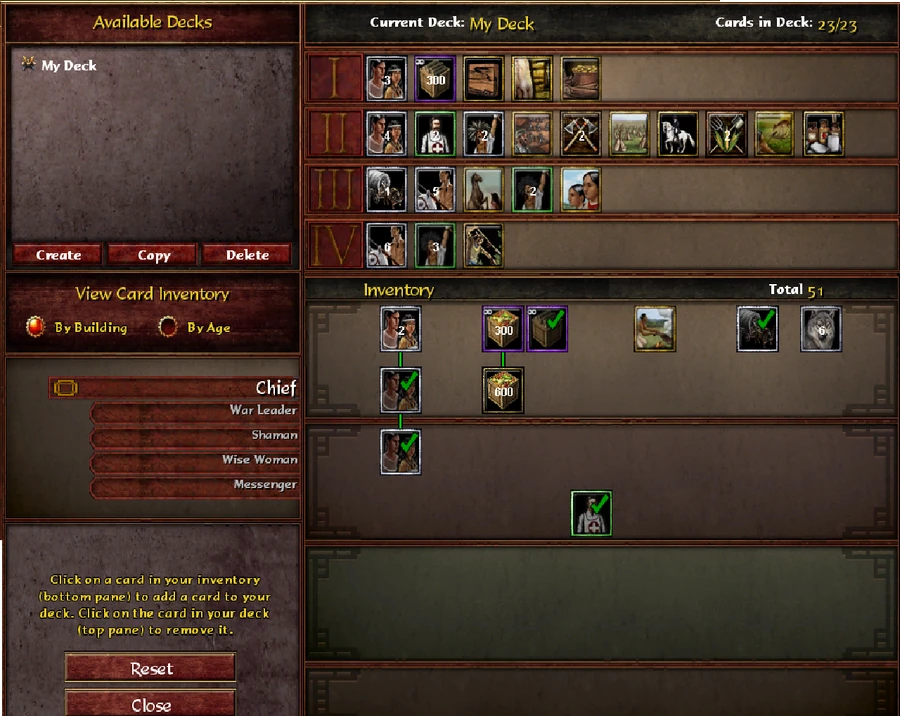
How it works
The deck is assembled before the match, while Experience earned in play unlocks shipments. Cards have Age and civilization conditions; some are team cards or have repeat limits. A shipment’s arrival time and effect depend on the card and current game version.
Player decision
Choose cards that support the opening and retain options for the army or economy expected later. Send a card when its immediate value fits the game state, and account for the Experience needed before the next shipment.
Deck size, Age rows and civilization limits
A deck is prepared before the match and is limited by both its total card count and the Age row in which each card is placed. The original game allows up to 20 cards; the expansions raise the deck ceiling to 25. The United States and Mexicans have a 21-card deck limit, with additional choices supplied through Federal States and, for Mexico, Revolution options. Older Home City progression could unlock extra deck slots as the city gained levels; that historical rule should not be confused with the match-time shipment requirement. Check the selected civilization’s deck screen and current edition for the available slots, since a card can still be absent even when its Age condition is met.
Shipment types, arrival time and repeat rules
Cards deliver several kinds of effects: a unit shipment or resource crate arrives as cargo, while a technology card unlocks research, an upgrade card improves a listed unit or building, an ability card adds a specific action, and a wagon card converts into a structure. Cards can also send animals, affect the whole team, or combine more than one category. A red repeat marker identifies a card that can be sent twice; an infinity marker identifies one with no send limit. Most shipments take about 40 seconds to arrive, Mercenary shipments take 60 seconds, and a small number of cards arrive in about five seconds. Treat those as general timings: the individual card and game version determine its actual effect and delivery.
Choose where shipments arrive
Unit and resource shipments normally arrive at the starting Town Center. A player can select a different valid drop point at buildings such as a Town Center, Fort or Outpost; a mobile Japanese Daimyo or Shogun can also serve as a unit delivery point. Definitive Edition lets players choose separate destinations for economic and military shipments, so crates can go to the safe base while reinforcements gather near a forward Fort. Water units use a movable naval drop point in revealed water. Set the destination before relying on a shipment for defense: troops arriving at an exposed forward position may be lost before they can join the army.
Send cost-reduction cards in the useful order
Cost effects do not always combine by applying each percentage to the current price. For Estates, Land Grab reduces the current cost by 40%, while Advanced Estate lowers the base cost by 31%. At a 600-Wood base price, sending Land Grab first reduces the price to 360; Advanced Estate then subtracts 186 Wood from the original base, leaving 174. Reversing the order first changes 600 to 414, then Land Grab removes 40% of that current price, leaving 248. The difference matters when a player is planning a large Estate investment. Do not assume all discounts use the same calculation; the individual upgrade or card behavior determines whether it applies to the base or current cost.
Build a deck around the shipment schedule
A deck has to cover both the moment each shipment becomes available and what the colony can use after it arrives. Early resource crates can bridge a shortfall, unit shipments can protect an exposed economy or reinforce a push, and later upgrades are strongest when the affected unit line is already being produced. A card that grants research may still require the specified building and resources, so it is not always an immediate battlefield effect. Team shipments should be judged by the value they provide to allies as well as their own cost. Before adding a card, compare its Age requirement, repeat limit, arrival delay, landing point and opportunity cost against the other cards competing for that slot.
Age row limits in different modes
The total deck limit is separate from the number of cards that can sit in an individual Age row. Under the documented Skirmish and Supremacy rules, each Age row can hold up to ten cards; the single-player campaign layout allows nine per row. Plan a deck across its Ages instead of filling one row and assuming unused total slots will bypass that row’s limit. Mode and version can affect deck construction, so the in-game deck screen is the final check for the selected match.