Sudanese Dervish
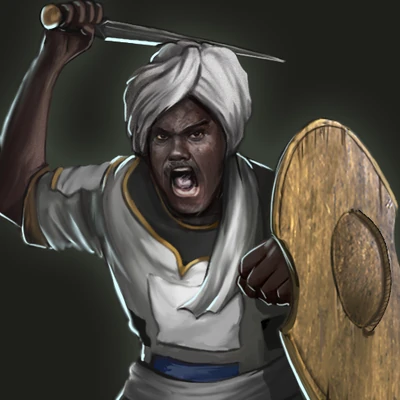
Sudanese Dervish is ranged infantry in Age of Empires III, available from the Commerce Age; obtained through Trading Post or Tambo on a Sudanese kingdom, Native Embassy.
Recorded values
- Available
- Commerce Age · Trading Post or Tambo on a Sudanese kingdom; Native Embassy
- Training
- 30 sec · 10 XP per train
- Durability & mobility
- 110 hit points · 15% ranged resistance · 5.0 speed · 16 line of sight
- Ranged attack
- 12 base damage · range 4-13 · attack interval 2.5-1.0 · bonus damage: 2.5x vs. Heavy infantry; 0.5x vs. Heavy cavalry; 0.5x vs. Hand shock trooper
- Siege attack
- 8 base damage · range 6 · attack interval 3.0
- Hand attack
- 12 base damage · attack interval 1.0 · bonus damage: 3.0x vs. Heavy infantry; 0.5x vs. Heavy cavalry; 0.5x vs. Hand shock trooper
Role, availability & values
Production is available through Trading Post or Tambo on a Sudanese kingdom or Native Embassy. It has 110 hit points and 15% ranged resistance. It moves at 5.0 speed. Training costs 50 Food and 50 Wood; it takes 30 seconds to train. Attack profile: Ranged attack: 12 damage at range 4-13; every 2.5 seconds-1.0. Siege attack: 8 damage at range 6; every 3.0 seconds. Hand attack: 12 damage; every 1.0 seconds.
Matchup & timing
Keep this ranged unit behind a screen and let it fire before melee troops can reach it. Its listed attack reaches 4-13 range and is especially useful against Heavy infantry. If Heavy infantry close in, use the hand-attack bonus while the rest of the formation protects the line.
Native warrior access and cost
The Sudanese Dervish is a Commerce Age ranged Light Infantry native warrior in The African Royals and Definitive Edition. It costs 50 Food and 50 Wood and takes 30 seconds to train under the current profile. A Trading Post or Tambo must be built on a Sudanese kingdom, or the unit can be produced from a Native Embassy. The limit is 15 per Sudanese kingdom, so the settlement controls the available force and replacement ceiling. Ethiopians can gain Dervishes by choosing the Sudanese alliance when advancing to the Fortress, Industrial or Imperial Age; those age-up choices ship seven, ten or twenty and unlock Palace and Native Embassy training. Alliance shipments are a civilization-specific route, not universal access.
A ranged skirmisher with variable reload
The Dervish is unusual because it is a melee-style Skirmisher that attacks at range. Its basic damage is 12, with a 2.5× ranged multiplier against Heavy Infantry, half damage against Heavy Cavalry and 0.5× against hand shock troops. Attack range extends from four to thirteen, and the reload changes from 2.5 seconds at longer distance down to one second as the enemy approaches. In practice, the unit fires faster at close range, so its damage output improves when opponents press into it. This is the reverse of a simple keep-away plan: it can be effective when a target closes, but its 110 hit points still make direct exposure risky.
Melee, siege and defensive values
At close quarters the Dervish has a 12-damage hand attack that reloads every second. It deals three times normal damage to Heavy Infantry, half damage to Heavy Cavalry and half to hand shock troops. Its siege attack is eight damage at range six every three seconds. The unit has 15% ranged resistance, speed 5.0 and line of sight 16. Earlier profiles show different values: resistance was higher in older updates, speed was lower and the Heavy Infantry multiplier was smaller before balance changes. Use the current figures when evaluating its role, particularly because the resistance change affects how safely it can hold an exposed position.
Target selection and counters
The Dervish’s strongest targets are Heavy Infantry and Light Cavalry, as described by its native-warrior role. It should avoid Heavy Cavalry and shock troops that can exploit its reduced multipliers or low durability. Because its ranged reload accelerates at shorter range, do not automatically retreat from every approaching enemy; first consider whether the target is one the Dervish can punish and whether supporting units can prevent a surround. Against a dangerous composition, hold the line behind sturdier troops and use the Dervish’s range to contribute without being the first unit contacted. Its low siege damage means it is not a substitute for dedicated building attackers.
Settlement planning and upkeep
The fifteen-per-kingdom limit rewards protecting the Trading Post or Tambo that supplies access. A second Sudanese settlement can broaden the available native force, but its cost and map position should justify the expansion. Training consumes both Food and Wood, which may compete with age advancement and other units; track the queue rather than spending the whole reserve on Dervishes. Native improvements and civilization technologies can change the unit over time, so check the available upgrades before committing to a large group. The Dervish fits a force that needs a flexible anti-Heavy-Infantry option, with other troops covering its Cavalry and durability weaknesses.
Ranged attack changes by distance
The variable firing interval is central to the Dervish’s identity. It can attack from four to thirteen range, but the interval shortens from 2.5 seconds at the far end to one second as the target gets close. Rather than treating maximum range as its only strength, use it as a unit that becomes more dangerous during a controlled approach. Let friendly units prevent a flank while the Dervishes hold a compact front; if they are surrounded, the fast close-range attack may not compensate for 110 hit points. Their ability to hit from range while fighting like a melee Skirmisher is particularly useful when a target advances into their preferred distance.
How to use the kingdom limit
The 15-unit limit is tied to each Sudanese kingdom, not a universal army cap. A well-placed Trading Post or Tambo therefore supports a limited native detachment, while a second kingdom can provide another production pool if the map supports it. Protect the settlement and avoid building the whole strategy on one contested site. The Native Embassy gives an alternative production route where available. Ethiopians have their own alliance timing and age-up shipments, which can deliver a group immediately and then allow continued training. That option can shift a Dervish force from a map-dependent native purchase to a planned age-up composition.
Coordinate with the African army
The Dervish’s anti-Heavy-Infantry role can complement African ranged units and Cavalry, but its low hit points mean another unit must hold the line. Use the Dervishes to punish enemy troops as they approach, then let sturdier units protect them from Heavy Cavalry and shock attacks. If the Sudanese alliance came from an age-up, use the delivered group to stabilize the army before investing in the settlement needed for replacements.
Read the distance before retreating
Because its reload accelerates as enemies approach, a Dervish may deal more damage by holding a protected line than by running at maximum range. Judge the approaching target first: punish Heavy Infantry or Light Cavalry when allies cover the flank, but retreat from Heavy Cavalry and shock troops that the Dervish cannot trade with efficiently.
Preserve the native unit cap
Because the cap is tied to each Sudanese kingdom, a lost Dervish can be replaced only while the settlement and production access remain available. Protect the site, and use the limited force where its Heavy Infantry multiplier has a clear target.
Sudanese ranged Native skirmisher
The Sudanese Dervish is a Commerce Age Native ranged Infantry unit recruited from a Trading Post or Tambo on a Sudanese kingdom, or a Native Embassy where available. It costs 50 Food and 50 Wood, takes 30 seconds to train and is limited to 15 per kingdom. Its profile has 110 hit points, 15% ranged resistance, speed five and sight 16. The ranged attack deals 12 damage at range 4–13; its firing rate increases as range closes, from a slower long-range interval toward a faster short-range rate. It has a 2.5× bonus against Heavy Infantry but reduced damage to Heavy Cavalry and Hand Shock troops. The hand attack has similar target strengths and weaknesses. This is a close-range skirmishing unit that needs protection from its poor matchups.
Manage range and target class
The Dervish benefits from closing enough to increase its rate of fire, but that also brings it closer to Cavalry and Shock troops that counter it. Keep a screen in front, focus Heavy Infantry and use the unit’s speed to reposition before the enemy reaches melee. Do not use it as the only answer to mounted units, and withdraw when its target class changes. The settlement limit of 15 gives room for a meaningful force but still makes replacement dependent on Native access. A Trading Post on the kingdom also opens its technology options, so balance unit training against research. The Dervish’s mixed Food and Wood cost can complement a Coin-heavy army plan, provided the economy retains enough Wood for buildings and other production.
Mobility and attack-role revisions
The Sudanese Dervish is a mobile Native warrior with hand and ranged combat profiles. It currently moves at 5.0, has 15% ranged resistance and costs 50 Wood; before update 15.59076 its speed was 4.5 and resistance 20%, while earlier profiles recorded 4.75 speed and 30% resistance. Its current anti-Heavy Infantry modifiers are 3.0× in the listed third attack and 2.5× in the ranged attack. Those ranged values were 1.75× before update 13.18214 and 1.5× before update 13.58326; the current third-attack value also reflects a historical increase from 1.75× and 1.5×. Hand damage is now 12, compared with 14 before update 15.59076 and 9 before update 19.18309. The Dervish can exploit its movement to engage the right Infantry targets, but current resistance is lower than in older profiles, so avoid exposing it to sustained ranged fire.