Tatar Archer
Tatar Archer is mobile ranged cavalry recruited through a Tengri Shrine alliance or Native Embassy. Its long-range attack lets it pressure targets while staying away from direct melee contact.
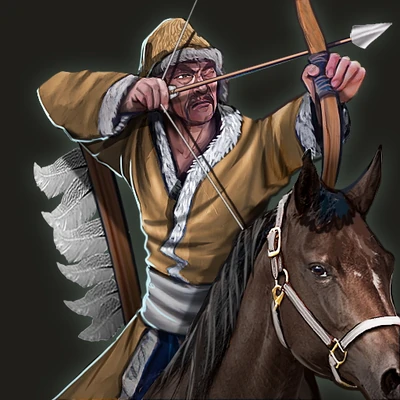
Recorded values
- Available
- Commerce Age · Trading Post or Tambo on a Tengri Shrine holy site; Native Embassy
- Training
- 35 sec · 15 XP per train
- Durability & mobility
- 155 hit points · 20% hand resistance · 7.25 speed · 15 line of sight
- Ranged attack
- 5 base damage · range 13 · attack interval 1.2 · bonus damage: 4.5x vs. Cavalry; 3.5x vs. Shock troops; 2.5x vs. Artillery; 0.5x vs. Light ranged cavalry; 0.5x vs. Ranged shock trooper
- Siege attack
- 7 base damage · range 6 · attack interval 1.25
- Hand attack
- 7 base damage · attack interval 1.2 · bonus damage: Same as ranged attack
Role, availability & values
Its recorded ranged attack has 13 range and a fast attack interval, but the unit has only 155 hit points and no listed ranged resistance in the profile. It is a fragile skirmishing unit rather than a front-line cavalry fighter.
Matchup & timing
Use range and movement to fire from a safe position, then withdraw before heavy cavalry or melee troops reach it. Protect it with units that can hold the frontline, and avoid exchanging its low health for a direct attack.
Fast Commerce Age mounted archer
The Tatar Archer is a Commerce Age ranged Cavalry Native warrior in Definitive Edition, recruited at a Trading Post or Tambo on a Tengri Shrine holy site. The unit costs 90 Food and 55 Wood, takes 35 seconds to train and is limited to 14 per shrine. It has 155 hit points, 20 percent hand resistance, speed 7.25 and sight 15. Its low-damage ranged attack deals five damage at range 13 every 1.2 seconds. The base number is misleading: it deals 4.5 times damage against Cavalry, 3.5 times against Shock troops and 2.5 times against Artillery. It also deals only half damage to Light Ranged Cavalry and Ranged Shock troops. The fast attack cycle and high class bonuses make it a dedicated counter unit that can fire and move quickly rather than a general-purpose damage dealer.
Hit-and-run and hand attack mode
Tatar Archers are faster than many foot units and fire at a rapid cadence, making hit-and-run tactics their natural use. Their hand attack deals seven damage every 1.2 seconds and shares the ranged attack multipliers. The 20 percent hand resistance helps them survive melee contact longer than a typical ranged Cavalry unit, and their hand attack can snare Villagers or other targets that try to escape. Against Cavalry, the large 4.5 multiplier makes repeated attacks effective; against Light Ranged Cavalry, the combined class tags still give a useful 2.25 multiplier. This is a specialist advantage, not a reason to engage every ranged Cavalry unit directly. Keep them moving between volleys and avoid Light Infantry, which can exploit the Archer’s weakness.
Artillery and raiding targets
The Tatar Archer deals 2.5 times damage against Artillery in the current profile and has the mobility to approach guns from a flank. Its low base attack means that the multiplier and firing cadence do most of the work; focus fire on one gun and retreat if the enemy screen closes. The unit also lacks a reduced ranged multiplier against Villagers, making it more effective at raiding exposed workers than some ranged Cavalry. Its siege attack deals seven damage at range six every 1.25 seconds, but should be treated as a small bonus rather than a structure-breaking tool. Use speed and sight to choose isolated targets, then disengage before the opponent’s Light Infantry arrives.
Tengri upgrades and civilization variants
A Tengri Shrine settlement supports up to 14 Tatar Archers in the native training route. Native warrior technologies and Home City cards can improve their hit points or attack depending on the civilization. The Definitive Edition also has a mercenary form available to the Ottomans, Russians and Tatars through different routes. Tatars can train the unit at a Stable, while Russians can access it through the Bashkir Rebellion card at a Trading Post or Native Embassy. The mercenary profile may have a different health value from the native unit, so do not combine those records when calculating a force. The unit’s Commerce Age access gives it an early timing, but its local cap makes multiple shrines or shipment access relevant for a larger army.
Changes across recent patches
The Tatar Archer’s attack speed and multipliers have changed across Definitive Edition updates. Its ranged and hand attack interval is now 1.2 seconds, compared with 1.25 before update 15.59076 and 1.0 before patch 15.30007. The Artillery multiplier is currently 2.5, increased from two in patch 15.30007 and later adjusted. Hit points changed from 140 to 155 in update 19.18309, after earlier values of 150 in an intervening period. Wood cost was 60 before update 13.27885 and is now 55. Older descriptions may give a different attack rate or say it has no area-specific bonus. Use the current values for modern play and treat mercenary and native health separately.
Weaknesses and army composition
Tatar Archers are not durable like Heavy Cavalry: they have 155 hit points and no ranged resistance. Light Infantry can damage them efficiently, while their half-damage multipliers against Light Ranged Cavalry and Ranged Shock troops make those matchups unfavorable. Use a frontline or a unit that can chase Skirmishers, then let the Tatars attack Cavalry and Artillery from a safe angle. Their speed can pull an enemy army out of position, but do not let a small group be surrounded. The unit’s value comes from mobility and specialized bonuses, not from standing and trading against every ranged force.
Mercenary route and army access
The Tatar Archer also exists as a mercenary in Definitive Edition, available to Ottomans, Russians and Tatars through faction-specific access. Tatars can train it at a Stable, while Russian access uses the Bashkir Rebellion card at a Trading Post or Native Embassy. The mercenary is not limited by the native Tengri Shrine cap and is not selected with locally trained Tatar Archers. Some mercenary profile values, including hit points, differ from the native unit, so keep the two versions separate when reviewing a shipment. The native form costs 90 Food and 55 Wood and takes 35 seconds to train; a mercenary route has its own shipment and production rules.
Reading its multipliers correctly
The Tatar Archer’s low five-damage shot is balanced around an unusually high 4.5 Cavalry multiplier and a rapid 1.2-second interval. Its bonus against Heavy Cavalry is therefore much stronger than its base number suggests. Its 3.5 Shock troop multiplier also makes it useful against melee shock units, and the Artillery multiplier gives it a niche against guns. The half-damage multipliers against Light Ranged Cavalry and Ranged Shock troops are important: an opponent can use those units to trade efficiently. Do not send the Tatar Archer into a direct ranged duel simply because it is Cavalry. Use another unit to screen those threats and exploit the Tatar’s mobility to attack its preferred targets.
Tengri site cap and training decisions
The native Archer is limited to 14 per Tengri Shrine and takes 35 seconds to train. Its 90 Food and 55 Wood cost uses no Coin, which can help a civilization that needs to preserve Coin for age-ups or Mercenaries. The site cap still prevents a single shrine from supplying a large mounted army. Protect the Trading Post and consider a second route only if the map and civilization provide it. When the opponent shifts to Light Infantry, pause production and use Tatar Archers for scouting or a Cavalry counter rather than continuing to invest in a poor fight.
Hand resistance and close contact
The 20 percent hand resistance is useful when a Tatar Archer is caught by Heavy Infantry or when it switches to hand attack against a nearby target. It does not make the unit a melee Cavalry fighter: its base hand attack is only seven, and the value comes from the same multipliers as the ranged mode. Keep distance when possible, use the hand mode to snare or finish a target and pull away before the group takes sustained damage. The unit has no ranged resistance, so foot archers and Skirmishers remain dangerous.
Improving a limited mounted force
Native warrior rank technologies add hit points and attack, helping Tatar Archers stay useful when standard Cavalry receives later upgrades. Home City cards can also ship Tatar Archers or improve their Cavalry and native warrior statistics, but the available cards differ between Ottoman, Russian and Tatar decks. Since the native force has a 14-unit Tengri Shrine cap, improvements have greater value when the player intends to keep the same group alive. Avoid replacing losses by repeatedly sending units into Light Infantry fire. Use speed to choose fights, and let the high multipliers against Cavalry and Artillery justify the resource cost.
Reposition before the counter arrives
Tatar Archers have no ranged resistance and only 155 hit points, so use their 7.25 speed to leave a fight before Light Infantry or Ranged Shock troops can close. A quick volley against Heavy Cavalry or Artillery is valuable, but the unit should not remain stationary after the target changes. The hand resistance helps if caught by melee units, yet it is a fallback; preserve range and use the map to avoid a direct counter.
The local training role
The native Tatar Archer is best treated as a limited counter group tied to a Tengri Shrine. Fourteen per site and a 35-second queue make it difficult to replace heavy losses. Keep the force mobile, use its Cavalry and Artillery bonuses, and pause production if the opponent commits to Light Infantry that counters it.
Affordable mounted archer from the Commerce Age
The Tatar Archer is a mounted ranged unit available from the Commerce Age. It costs less than many other mounted archers and resembles the Chinese Keshik, but uses Wood as part of its cost. Compared with a typical Dragoon, it has fewer hit points and lower attack but fires more quickly in the documented profile. Use it for mobile harassment and to pressure vulnerable targets, while keeping it away from concentrated ranged fire.
A light cavalry role with careful target selection
Tatar Archers can reposition quickly, but their low durability makes a direct fight risky. Use them to support the main force, screen a flank or force the opponent to protect exposed units. They should not replace a Dragoon when the army needs a durable anti-Cavalry line. Wood spent on Tatar Archers also competes with housing and production, so keep the queue proportional to the opponent’s composition and maintain a route to reinforcements.