Chief Gall
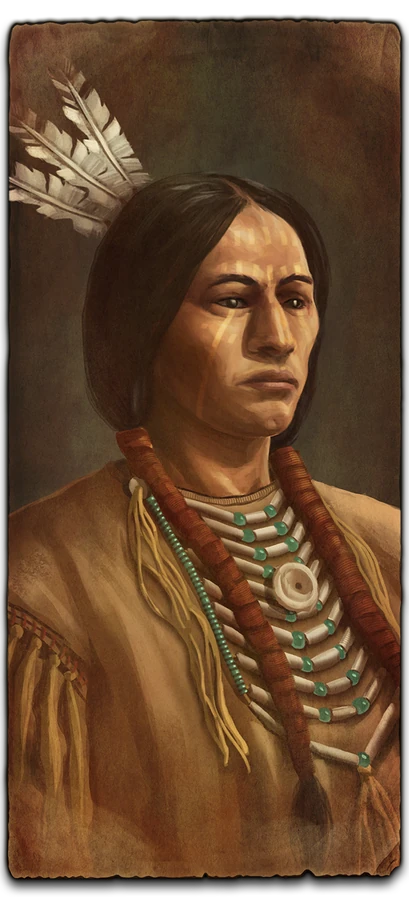
Chief Gall is the Lakota skirmish AI personality. His profile emphasizes early military pressure and mobile raids, often investing in a fighting force before reaching the Fortress Age. This behavior makes exposed workers and distant resource sites frequent targets.
AI identity & army profile
From the Commerce Age onward, his attacks can include Cetan Bowmen, Wakina Rifles, Rifle Riders, Bow Riders and Axe Riders. The exact mix varies, but the combination can threaten both ranged units and gatherers. Repeated production may delay his own later Age advance.
How to prepare
Scout early and protect the routes between the Town Center and resource sites. Keep a force that can answer both cavalry and ranged infantry, and avoid chasing fast units so far that the base becomes exposed. Use the pauses between raids to expand or advance once the immediate threat is contained.
Recognizing and answering Gall’s AI pattern
Chief Gall is the Lakota AI personality in The WarChiefs. Definitive Edition uses the Lakota name for the civilization previously labelled Sioux, so older scenario or strategy references can use different terminology. The character’s historical namesake was a Hunkpapa Lakota military leader who fought in the conflict with the United States and participated in the Battle of Little Bighorn. In game, Gall is identified as a military leader and voiced by Gregory Cruz. His encyclopedia entry describes both this campaign-era character and the behaviour of his AI opponent; those are related topics but should not be confused with a player-controlled unit. Gall’s strategy favors fast military investment over a broad economic build. He commonly begins attacking during the Commerce Age and continues sending forces through later ages, using Cetan Bowmen, Wakina Rifles, Rifle Riders, Bow Riders and Axe Riders, with Club Warriors and Dog Soldiers appearing as occasional additions. The composition can shift between ranged infantry, cavalry and melee pressure, so scouting the actual force matters more than assuming a single counter will work. Rifle Riders and Bow Riders can threaten exposed villagers and ranged units; Axe Riders and Club Warriors can punish a weak frontline; Cetan Bowmen and Wakina Rifles create ranged pressure behind them. The army-first approach uses resources that could have gone toward aging, so Gall may reach the Fortress Age later than a more economy-focused opponent. His repeated attacks can also interrupt gathering and reduce his own income, but that should not be mistaken for a guaranteed collapse: the military remains sizable, and another wave can arrive while the player is recovering. Protect vulnerable gatherers, keep a mobile reserve near likely raid routes and maintain enough production to replace defenders. A static wall or isolated ranged group is not a complete answer to cavalry and infantry approaching from several directions. Once Gall’s army is beaten, his base is comparatively small and has limited defensive structures, which creates a window to counterattack. Use the time after a major fight to scout his production and resource sites, then pressure the settlement before he rebuilds. Avoid chasing a retreating force deep into enemy territory if the next wave is already forming; stabilize the economy and preserve units first. In team games, coordinate with an ally so one player can screen raids while the other attacks Gall’s exposed base. The right response is to absorb the opening pressure efficiently, trade favorably against the observed unit mix, and exploit the delayed age-up only when the immediate threat has been cleared. Gall also comments on treasures, age progress, trading posts and battles, reflecting his aggressive view of map control. Treasure gathering can give the player an early resource or vision advantage, but collectors should be protected because Gall is likely to punish a distant group. A Trading Post may be valuable for long-term support, yet its workers and position need an army nearby. Treat Gall as a pressure-oriented AI personality rather than as a special ruleset: normal Lakota units, counters and map systems still determine the battle, while his tendency to keep a large army shapes the tempo.
Using the breathing room after a raid
Because Gall spends heavily on troops, the best response is often to trade a compact defense for his extended army rather than mirror every unit immediately. Keep villagers spread away from the first obvious raid path, use buildings and terrain to limit cavalry approaches, and scout to distinguish Rifle Riders or Bow Riders from infantry arriving behind them. After defeating a wave, use the interval to restore villager production, replace the units that counter the next visible group and check how close Gall is to the Fortress Age. His base has fewer defensive structures than many opponents, but attacking too early can expose a damaged army to another rush. If the defense holds and his economy appears behind, pressure his production and resource sites with a force that can retreat. This turns his military focus into a timing window without assuming the AI will stop attacking.
Lakota AI personality and military emphasis
Chief Gall is the Lakota AI personality in Age of Empires III: The WarChiefs and is voiced by Gregory Cruz. Historically, he was a Hunkpapa Lakota military leader and one of the commanders at the Battle of Little Bighorn. In gameplay, his AI tends to prioritize military mobilization over economic development and can launch early Lakota attacks. The tendency is not a fixed script: difficulty, map resources and player pressure change the timing and composition.
Prepare for a Commerce Age rush
Scout the Lakota base early and watch for Cetan Bowmen, Wakina Rifles and Rifle Riders as the force develops. Protect nearby hunts and mines, build the appropriate counter before the army reaches the base, and avoid chasing fast units into open ground. If Gall is an ally, support his early push with a unit that covers his army’s weakness rather than expecting his dialogue to coordinate the attack. Campaign and AI-personality appearances should remain distinct from ordinary Lakota civilization rules.