Labrador
Labrador stretches a Trade Route along the map and separates approaches with defensive cliffs. Inuit and Stuart settlements, plus Harpooner and Qivittoq outlaws, create several neutral choices. The long route can be valuable but also difficult to defend end to end.
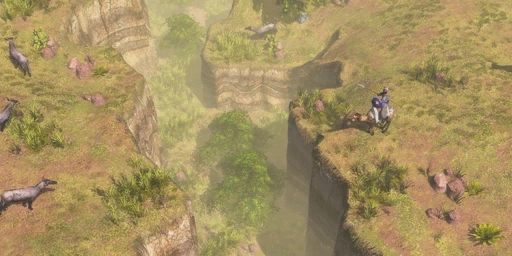
Terrain, routes and neutral sites
- Trade Route
- Runs along the map
- Terrain
- Cliffs divide the approaches
- Native settlements
- Inuit · Stuart
Map character
Scout the Trading Post sites and cliff passages before placing a forward post. Compare Inuit and Stuart benefits with the distance and exposure of each settlement. Keep a mobile force near the route so the economy is not left unsupported.
What to scout
Secure a route segment your army can reinforce rather than trying to hold the entire length immediately. Use cliffs to limit approaches, but check the actual path before moving Villagers or siege around them.
Contest a useful section of the Trade Route
Labrador’s Trade Route runs across a long map, so controlling every site at once can stretch the army too far. Scout the Trading Post locations and select a segment that supports the next shipment or economic plan and can be reinforced from the base. Claiming a site is only the first step: keep troops close enough to answer a raid and check whether the opponent can approach from another direction. If the route’s far end is hard to hold, build pressure around a safer segment rather than sending Villagers along the entire length. Expand route control as the front moves and the army can protect more ground.
Use the cliffs to read movement, not to guess it
The defensive cliffs divide approaches, but they do not guarantee that the shortest line is passable or that a position has only one entrance. Reveal the actual paths with the Explorer before moving Villagers, siege or the main army. A narrow approach can help a smaller force guard a resource or Trading Post, while an unseen bypass can leave it trapped or exposed. Keep an alternate route in mind for reinforcements and retreat. If workers are gathering beyond a cliff line, place production or a reserve where it can reach them instead of assuming the terrain itself will protect them.
Balance settlement access against route defense
Inuit and Stuart settlements offer alliance choices, while Harpooner and Qivittoq are the listed outlaw options. Compare those neutral investments with the cost of defending the long Trade Route: one useful alliance may be easier to support than several distant posts and camps. Check the settlement entries for their available rosters and technologies, then choose what complements the units already in production. Keep enough mobile troops near the route to protect the alliance and the workers who reach it. If an outlaw camp or Trading Post lies beyond a cliff passage, secure the passage before committing builders.
Stuart units can guard a route from different distances
The House of Stuart settlement adds fast hand shock troops and ranged infantry to Labrador’s long front. A Commerce Age Clansman costs 70 Food and 40 Wood, trains in 30 seconds and has 140 hit points, 15% hand resistance and speed 6.5. Its mobility helps it move between a threatened Trading Post and a cliff passage, but it should not be left alone against a formed army. The Commerce Age Lowlander costs 50 Food and 40 Coin, takes 26 seconds to train and has 135 hit points with 30% hand resistance. Its ranged attack deals 19 damage at range 12, and its hand attack has multipliers against Cavalry and Shock troops, so it can anchor a route defense while the Clansman responds to movement. Both have a limit of 15 per Stuart palace. The choice depends on whether the route needs fast pursuit or a ranged line that can discourage mounted attacks.
Compare those units with Inuit timing
The Inuit site offers a different timing from the Stuart roster. An Inuit Hunter is a Commerce Age specialist against Pets, Mercenaries, Outlaws and Native warriors, while the Inuit Qamutik arrives in the Fortress Age with 420 hit points, speed 7.25 and a ranged attack of 15 at range 14. The Qamutik costs 110 Food and 110 Wood, so it is a later investment rather than an opening unit. When the long Trade Route is contested early, choose between the Stuart units and the Inuit Hunter based on the enemy force; do not plan around a Qamutik before the Fortress Age. Keep the Trading Post close enough to a route segment that the chosen unit can reinforce it, and avoid spreading both alliance armies across cliffs that slow support.