Mantlet
Mantlet is Haudenosaunee ranged infantry available from the Fortress Age at the Siege Workshop. It combines a ranged attack with unusually high siege damage, making it a specialist for attacking structures while contributing to a protected formation.
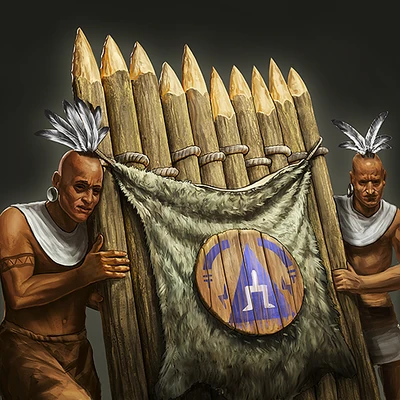
Recorded values
- Available
- Fortress Age · Siege Workshop
- Training
- 45 sec · 2 population · 16 XP per train
- Durability & mobility
- 400 hit points · 50% ranged resistance · 3.5 speed · 12 line of sight
- Hand attack
- 10 damage · 1.5 attack interval
- Ranged attack
- 25 damage · 10 range · 3.0 attack interval
- Siege attack
- 50 damage · 6 range · 3.0 attack interval
Role, availability & values
It has 400 hit points, moves at 3.5 speed and has 50% ranged resistance. It costs two population, 80 Wood and 80 Coin, and takes 45 seconds to train. Its listed attacks are 10 hand, 25 ranged and 50 siege damage. Its low speed makes it vulnerable if separated from support.
Matchup & timing
Use Mantlets when enemy structures or dense formations justify siege support. Keep them behind a frontline and protect them from fast units that can close the distance. Their ranged resistance helps against ranged attacks but does not make them immune to melee or artillery.
Role and access
The Mantlet is a Haudenosaunee ranged infantry siege unit introduced in The WarChiefs. It is trained at the Siege Workshop from the Fortress Age and costs 80 Wood and 80 Coin in the current Definitive Edition profile. It takes 45 seconds to train, occupies two population, has 400 hit points, 50 percent ranged resistance, speed 3.5, and line of sight 12. Its ranged attack deals 25 damage at range 10 every three seconds, while its melee attack is only 10 and its siege attack deals 50 at range 6. The unit's defensive profile is unusual: it can absorb a large amount of ranged fire, but it moves slowly and must approach buildings before its siege attack can contribute. This makes it a mobile shield and assault support unit rather than a general purpose skirmisher. Native Mantlet variants such as the Huron Mantlet are separate units with their own availability and statistics.
Siege and screening functions
Mantlets help compensate for the relatively low siege output of much of the Haudenosaunee roster. They can move toward walls or fortifications while Forest Prowlers and Musket Riders continue attacking from behind the protected line. Their high hit points and ranged resistance make them effective at absorbing ordinary ranged fire, especially in a chokepoint where slow movement is less costly. A Mantlet screen can also allow fragile long range units to remain in firing position instead of repeatedly retreating. Their range of 10 is shorter than that of many ranged infantry, however, so they should not be sent ahead without support. A group of Mantlets advances gradually; cavalry can move around the screen, and artillery can punish a dense formation. Use them when the army needs a durable front to cover a push, protect guns, or bring siege pressure to a fixed position.
Counters and weaknesses
The Mantlet is an infantry siege unit, not an invulnerable wall. Artillery remains a strong answer because it can deal heavy damage from a distance. Cavalry can bypass its short ranged fire and exploit its slow speed, with lance cavalry especially dangerous if the Mantlets are isolated. Abus Gunners are another serious threat. Grenadiers and Flamethrowers can also pressure them, though those matchups are less decisive than artillery or cavalry. The unit's siege classification creates both protection and vulnerability: some defensive structures deal reduced damage to siege units, while effects that counter siege troops can punish the Mantlet. Keep mobile anti-cavalry units beside the screen and use ranged support to remove artillery before it can fire repeatedly. If the opponent has already built a hard counter, Mantlets should not lead the assault merely because they have high hit points.
Shipments and upgrades
The Beaver Wars shipment improves Mantlet survivability against siege and ranged damage, helping the unit perform as a screen in a focused push. Siege Discipline lowers its population cost to one, which changes the economics of mass production and makes it easier to field Mantlets alongside a full army. These cards address different constraints: one improves endurance, while the other frees population space. The current unit costs 80 Wood and 80 Coin; before update 13.18214 it cost 75 Wood and 125 Coin. A player should use the current cost when budgeting, since older references overstate the Coin commitment and understate Wood. Build at the Siege Workshop when the army can protect a slow advance, and use a shipment when the chosen tactic depends on the Mantlet's screen or population efficiency rather than treating every card as an automatic upgrade.
Positioning and army mobility
The main tactical cost of Mantlets is the pace they impose on an army. Their speed is only 3.5, so a group of Forest Prowlers or cavalry that waits for them may lose the initiative elsewhere. They are most useful when the route is constrained, when a fixed target must be assaulted, or when a ranged formation needs a moving barrier. Keep the rest of the army close enough to stop melee attackers, but do not force all units to advance at the Mantlet's pace if the opponent is raiding elsewhere. In an open field, spread out and let faster units scout; gather the force at a pass, wall, or defensive line before bringing the Mantlets forward. This preserves their strength as a protected screen without allowing their slow movement to dictate every engagement.
Choosing a siege approach
A Mantlet assault should begin with a target and a protected path. Send scouts ahead to identify artillery or cavalry before the slow unit leaves the safety of the main force. If the enemy has a strong ranged line but few counters, the Mantlet can advance at the front and draw fire while allied ranged units attack. If the opponent can flank, keep the Mantlets close to terrain or friendly structures that limit approach angles. Their siege attack has short range, so they must reach the wall or building before contributing; arrange the screen to prevent defenders from attacking the supporting units while the Mantlets close. After the breach, reassess the formation rather than continuing to walk them into a fresh army. Their purpose is to create a safe firing window and add siege pressure, not to absorb every threat indefinitely.
Haudenosaunee mobile shield and siege unit
The Mantlet is a Fortress Age Haudenosaunee Infantry and siege unit trained at a Siege Workshop. It costs 80 Wood and 80 Coin, takes 45 seconds to train, uses two population and has 400 hit points. Its 50% ranged resistance makes it unusually suited to advancing under ranged fire, though its speed is only 3.5 and sight 12. The ranged attack deals 25 damage at range 10 every three seconds; its Siege attack deals 50 damage. These attacks give the Mantlet a dual role: it can absorb ranged pressure while contributing damage to troops or structures. The unit is slow and expensive relative to its speed, so build it when the formation benefits from a durable approach rather than adding it automatically to a fast army.
Advance with a protected siege line
Move Mantlets with Infantry and artillery so the opponent must choose between firing at the resistant shield unit or engaging the rest of the army. Its ranged resistance helps against ordinary projectiles, but does not make it immune to melee units, Siege attacks or focused damage. Cavalry can exploit its slow movement if it becomes separated from the army. Use the Mantlet to close distance on a defended position and then let other siege units do the main structural damage; its own 50-damage Siege attack is support rather than a replacement for heavy artillery. Keep enough population for units that protect its flanks, since the two-population cost can quickly crowd the army. If the opponent has little ranged fire, its defensive benefit may not justify its cost and slow movement.