Mill
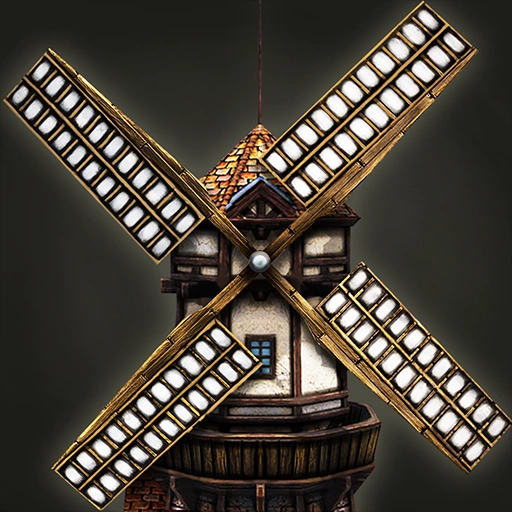
The Mill is a renewable Food gathering building used by civilizations with access to the standard European-style farm economy. Settlers work at it instead of exhausting a finite hunt.
Recorded values
- Cost
- 400 Wood
- Available
- Exploration Age
- Builder
- Settler and its counterparts, Mill Wagon, Homestead Wagon
- Function
- Infinite source of food; Trains Settler Wagons
- Construction
- 20 sec · up to 10 builders
- Structure
- 2,500 hit points · 12 line of sight · 3x3; 7.5x7.5 (placement obstruction) footprint
Function
Mills cost Wood and take time to repay, but their Food supply does not run out like a herd. The gathering rate can be improved through technologies and cards; other civilizations may use Rice Paddies, Haciendas, Kanchas or other systems.
Placement & timing
Transition to Mills when nearby Hunts are depleted or unsafe and the match will last long enough to recover the investment. Keep enough Villagers working there to justify the construction cost.
Food economy and transition timing
The Mill provides an infinite source of Food for civilizations using the standard Mill economy. A Settler or compatible builder can construct it in the Exploration Age for 400 Wood; construction takes 20 seconds, the structure has 2,500 hit points and line of sight 12. Its footprint is 3-by-3, but the placement obstruction reaches 7.5-by-7.5, so leave space for nearby buildings and Town Center expansion. Unlike a Hunt, a Mill does not run out of animals, which makes it a dependable late-game food source. Its main disadvantage is the initial Wood investment and the time required to repay that investment through gathering. Natural Hunts often support a faster early economy, while Mills become valuable when Hunts are depleted, distant or unsafe. Use enough Settlers on the Mill to keep production moving, but avoid moving every worker at once if doing so interrupts unit production or an age-up. Technologies such as Steel Traps and Artificial Fertilizer and civilization cards can improve gathering, so their value increases when many Villagers will remain on the building for a long time. Some civilizations have different economic structures: Asian Rice Paddies, Spanish or Mexican Haciendas, and Inca Kanchas do not share the exact Mill role or upgrades. Mill Wagons and Homestead Wagons provide alternate construction access for relevant civilizations. A Settler Wagon can be trained from the Mill where the listed function applies, but it is not a general unit-production replacement. Place Mills inside a protected economy and near available defensive structures, since a raid against exposed gatherers can offset the benefit of unlimited Food. Compare the 400-Wood cost with the expected duration of the match before transitioning, then research gathering upgrades when the expected future collection can repay them.
Gatherer upgrades and safety
The Mill’s value grows with both the number of workers assigned and the time they continue gathering. Research a Food upgrade when the expected collection can repay its price; an upgrade is less useful if the match is ending or the workers must soon move elsewhere. Keep Villagers within reach of a Town Center or defensive support because the building’s health does not protect its gatherers from a raid. Wagons can provide a faster or civilization-specific construction option, but the same resource and placement trade-offs still apply. Mills are a planned transition from Hunts, not a requirement for every early build order.
Economic alternatives
A Mill is not the only way to secure renewable Food in Age of Empires III. Rice Paddies, Haciendas and Kanchas belong to civilization-specific economies and may provide different upgrades, livestock or secondary functions. Compare the building listed for the current civilization instead of assuming Mill gathering rates and cards apply to every faction.
When renewable Food pays off
Mills become more attractive as the game lengthens and natural Hunts become harder to reach. Move workers in stages so Food income does not collapse during the transition, then add gathering upgrades only when enough Villagers will benefit from them.
Renewable Food and the transition from Hunts
The Mill provides an infinite Food source for civilizations that use the standard farm economy. It costs 400 Wood and takes about 20 seconds to build, so the investment is most useful after nearby Hunts are depleted, unsafe or too far from the base. Unlike a Hunt, the Mill does not run out, but its gathering rate and resource return must repay the building cost. Villagers work at the Mill to gather Food, and technologies or Home City Cards can improve the rate. Other civilizations may rely on Rice Paddies, Haciendas, Kanchas or other economic systems instead, so the Mill is not a universal food building.
Worker allocation and defensive placement
A Mill can also train Settler Wagons in its listed profile, and Mill Wagons or Homestead Wagons provide alternative construction routes where available. Place it near protected workers and away from a route that an enemy army can raid easily. Move gatherers to it when a natural source is depleted, but keep enough workers on Wood and Coin to sustain houses, military buildings and age-up costs. Building several Mills too early can delay the army; building too late can leave the economy without a safe source of Food. Consider how long the match is likely to continue and choose the transition point when the renewable supply can support the next production phase.