Settler Wagon
Settler Wagon is Germans, Maltese, United States, Chile economic unit in Age of Empires III, available from the Exploration Age; obtained through Mill (Germans, United States, and Chile), Commandery (Maltese). Its listed ability is Gathers resources; Builds buildings; Claims treasures.
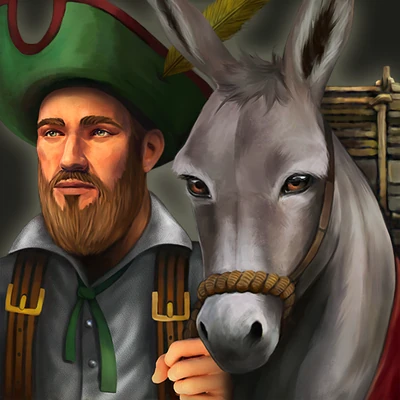
Recorded values
- Available
- Exploration Age · Mill (Germans, United States, and Chile) ; Commandery (Maltese)
- Training
- 25 sec · 2 population · 20 XP per train
- Durability & mobility
- 300 hit points · 30% ranged resistance · 4.0 speed · 14 line of sight
- Hand attack
- 10 damage · 3.0 attack interval · bonuses: 5.0x vs. Llama, 16
- Ranged attack
- 3 damage · 2-12 range · 3.0 attack interval · bonuses: 5.75x vs. Huntable; 2.0x vs. Pet; 2.0x vs. Artillery; 0.5x vs. Villager
- Siege attack
- 10 damage · 6 range · 3.0 attack interval · bonuses: 3.0x vs. Resource enclosure
- Ability
- Gathers resources; Builds buildings; Claims treasures
Role, availability & values
Production is available through Mill (Germans, United States, and Chile) or Commandery (Maltese). It has 300 hit points and 30% ranged resistance. It moves at 4.0 speed and uses 2 population. Training costs 100 Food and 100 Wood; it takes 25 seconds to train. Attack profile: Hand attack deals 10 damage. Ranged attack deals 3 damage. Siege attack deals 10 damage. Hand attack bonuses: 5.0× against Llama, 16. Ranged attack bonuses: 5.75× against Huntable, 2.0× against Pet, 2.0× against Artillery, and 0.5× against Villager. Siege attack bonuses: 3.0× against Resource enclosure*. Special ability or role: Gathers resources; Builds buildings; Claims treasures.
Matchup & timing
Hand attack is especially effective against Llama, 16 (5×). Ranged attack is especially effective against Huntable (5.75×), Pet (2×), Artillery (2×). Siege attack is especially effective against Resource enclosure (3×). Its reduced multipliers against Villager (0.5×) make it less suitable for those targets. Use ranged fire to focus Huntable, Pet, and Artillery before they can close; hold the melee attack for Llama, 16 when they enter contact; reserve the siege attack for Resource enclosure. Keep a frontline between this unit and threats that can reach it safely.
Gathering output and resource efficiency
Settler Wagons gather at roughly twice the rate of ordinary Settlers but cost more and consume two population. Current listed rates include 4 Food per second from herded animals, 1.7 from hunted animals, 1.34 from Berry Bushes, Cherry Orchards or Mills, and 1.0 from Farms, Rice Paddies, Fields or Haciendas. They gather Wood at 1.0 per second from Trees, Mango Groves or Haciendas, and Coin at 1.2 from Mines, Tribal Marketplaces and Mountain Monasteries. Estates produce 1.0 Coin per second; some slower Field and Hacienda rates are 0.68. Crates are gathered at 20 resources per second. These values explain why a wagon can repay its high initial cost if it survives and gathers for a long time. Its opportunity cost includes two population slots and the shipment or production resources used to obtain it. Avoid replacing an ordinary Settler with a Wagon late in the match unless the remaining time is long enough to recover the expense. Researches that improve the relevant natural or building-based gathering source can raise the value of an existing Wagon, but access depends on civilization and technology.
Durability, construction and self-defense
A Settler Wagon has 300 hit points, 30 percent ranged resistance, speed 4.0, sight 14 and uses two population. Its weak ranged attack deals three damage, with bonuses against huntable animals, Pets and Artillery, but only half damage against Villagers. The musket is for self-defense and should not be treated as a military weapon. A Wagon builds structures 100 percent faster than an ordinary Settler, a major advantage when a building must finish quickly. Adding a second Settler to a normal construction job reduces its completion time by only about 25 percent, so two ordinary Settlers build roughly 33 percent faster than one; a Wagon can therefore finish much sooner than a small group of workers. Its 30 percent ranged resistance also makes it more durable against ranged raids than the standard Settler, but it is somewhat more exposed to hand attacks because its resistance type differs. Keep Wagons away from Oprichniks and dedicated raiders, retreat them early and do not count their hit points as permission to fight. The longer each Wagon remains alive and working, the more its gathering advantage contributes to the colony.
Access through Germans and other civilizations
Germans begin a standard random map with three Settler Wagons instead of ordinary Settlers. Their normal additional access is through Home City shipments until Germantown Farmers is sent, after which the Mill can train them. Maltese can train Wagons at the Commandery after the German Tongue card, with a limit of six. United States obtains them through German Immigrants, which spawns a Wagon at each new and existing Mill and unlocks Industrial Age Mill training with a limit of five. The Chile revolution can ship two Wagons and unlock slower Mill production through German Settlements; other German-based revolutions can use Citizenship after Germantown Farmers. These cases have their own prices, limits and timing. They do not change the standard German starting count or make Settler Wagons a generally trainable unit for all civilizations. A Settler Wagon also does not replace a French Coureur des Bois: the French worker is a distinct civilization unit, while German Wagons supplement ordinary Settlers and have a smaller training limit.
Shipment economy and the German opening
The German opening trades a large ordinary Settler count for three high-output Wagons and resource crates. Early Home City shipments can add two Settler Wagons in the Exploration Age and three in the Commerce Age, while Germantown Farmers later unlocks Mill production. Shipment timing therefore influences both worker growth and the military Uhlans that accompany most non-team German shipments from the Commerce Age onward. A Wagon shipment is not simply an economic card: the additional cavalry can raid or reinforce a defense, but Germans need more experience to earn successive shipments. Protect the initial Wagons because losing one removes two-population gathering capacity and a large part of the early economy. At the same time, avoid sending every available card for Wagons if the army needs immediate protection. A shipment that arrives after a raid has already killed the workers does not recover the lost gathering time.
Production routes outside the German base civilization
Several civilizations and revolutions have limited Settler Wagon access, but their rules differ. Maltese use the German Tongue card to unlock Commandery training with a six unit limit. The United States German Immigrants card spawns a Wagon at each existing and newly built Mill and permits Industrial Age training with a limit of five. Chile receives two through German Settlements and can train them at Mills for 100 Wood and 70 Coin, with a fixed 40-second queue. German-based revolutions such as Argentina, Gran Colombia and Hungary can use Citizenship after Germantown Farmers to gain Mill production. Revolutionary United States has a European Immigrants shipment of four. These route-specific details are useful because the ordinary German shipment-only rule no longer describes every possible civilization. Check the required card, age, building, cost and count limit before treating a Wagon as repeatable production.
Protect an investment rather than a combat unit
The Wagon has 300 hit points and 30 percent ranged resistance, but its attack is weak and it is listed as weak against everything. Keep it away from frontline combat and especially from fast raiders that can destroy economic units. Its doubled gathering and rapid construction reward survival over time: an early Wagon that works throughout the match contributes far more than a newly trained Wagon near the end. Retreat to a Town Center or garrison when attacked, use walls and Outposts to protect distant mines, and spread production so a single raid cannot reach every high-value worker. When selecting a construction task, use the Wagon for a building that must finish quickly, then return it to the best resource source rather than leaving it idle at the site.
Compare population efficiency with ordinary Settlers
The Wagon gathers roughly twice as fast as a Settler but consumes two population, so its output per population slot can be similar rather than twice as efficient. Its advantage is concentrated gathering power and faster construction, while the cost is a higher resource investment, smaller unit cap and reduced flexibility in army population. A group of Wagons can make an early economy strong without filling the population count with workers, leaving more room for military units. The same arrangement becomes risky if raids kill the Wagons or if the match requires a large army before they repay their cost. Track how many resources each shipment Wagon gathers over time and compare that with the next military shipment. Because the Wagon does not replace ordinary Settlers, the German economy can field both kinds; the mix can smooth worker growth while keeping the special units protected.
Gathering improvements and late-game use
Settler Wagons can use the same broad classes of gathering improvements that apply to ordinary workers, including hunt bonuses, natural resource bonuses and upgrades for Mills, Farms, Estates or Haciendas. The practical gain depends on the source where the Wagon is assigned. A hunt upgrade has little value once the local herd is gone, while a farm improvement is relevant only if the colony has shifted to a permanent Food source. Use their high base rates to take advantage of the best natural sources first, then research upgrades that match the expected long-term economy. Wagons can also gather Coin from Mines faster than from Estates, so a safe mine can support an age advance more efficiently. In the late game, preserve existing Wagons as high-output workers and construct protected economy around them; do not expose them to raid routes simply because their 300 hit points exceed a Settler.
Construction speed at a critical moment
Use the Wagon build bonus on a building whose completion changes the timing, such as an Outpost needed to protect a mine or a production structure required before an attack. Then return it to gathering. The faster construction saves time, but leaving the Wagon at an unnecessary site wastes its unusually high economic output.
Decide whether another Wagon can repay itself
Estimate the time remaining before spending on a new Wagon. Its faster gathering is strongest early, while its 100 percent construction bonus is most valuable when a building must complete immediately. A late Wagon shipment may use a card that could have delivered military support, so compare the extra economic output with the army timing it delays.
Hold the Wagon reserve for productive years
The unit works best when it can gather for an extended period. Preserve its training limit and keep existing Wagons alive through the age transition; a protected group can continue producing Food, Wood or Coin while the military population grows around it.
Respect the lower train limit
Wagons are capped below ordinary Settler production, so plan the economy around both worker types and do not expect unlimited Wagon replacement.
Reassign workers when sources change
Move Wagons from depleted hunts or mines to a safer resource before their gather time is lost.
Use the group with a protected economy
Keep production Wagons inside defended resource zones.
Keep the special unit productive
Return each Wagon to gathering promptly after construction.
A large worker with civilization-specific limits
Settler Wagons gather resources, build structures and claim Treasures, but their costs and population use distinguish them from ordinary Villagers. A wagon costs 100 Food and 100 Wood, takes 25 seconds to train and occupies two population. It has 300 hit points, 30% ranged resistance and speed 4. Germans and Chileans can have up to 20, Maltese up to six, and the United States up to five. Germans, Americans and Chileans train them at a Mill; Maltese train them at a Commandery. Those limits and access routes are civilization-specific, so do not apply the German maximum to every faction that can receive the unit. Their durability helps them survive incidental pressure, but the two-population cost means a wagon is not automatically twice as productive as two ordinary workers in every situation.
Resource output, production and protection
A Settler Wagon’s main value is combining worker utility with a substantial health pool. It can move between Food, Wood and Coin as the economy changes, build the structures its civilization needs and secure Treasures alongside a Hero. The wagon is not a military substitute: its attacks are modest, and its larger model can be easier to catch near an exposed resource line. Queue one when the long-term worker capacity or a shipment-driven build plan supports its higher Food and Wood investment; keep Town Center production and housing in view because its two population can delay other units. Use the extra hit points to retreat from a raid, not to leave the wagon fighting. Germany’s larger train limit supports an economy built around more wagons, while Malta and the United States have smaller limits and should treat each wagon as a selective addition to the worker roster.