Nootka Clubman
Nootka Clubman is Heavy infantry in Age of Empires III, available from the Commerce Age; obtained through Trading Post or Tambo on a Nootka settlement, Native Embassy.
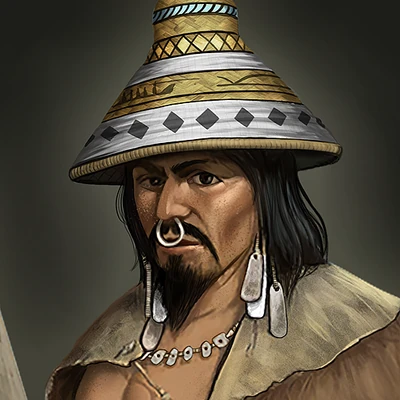
Recorded values
- Available
- Commerce Age · Trading Post or Tambo on a Nootka settlement; Native Embassy
- Training
- 30 sec · 10 XP per train
- Durability & mobility
- 200 hit points · 10% hand resistance · 5.0 speed · 12 line of sight
- Hand attack
- 12 damage · 1.5 attack interval · bonuses: 2.0x vs. Cavalry; 1.5x vs. Shock troops
- Siege attack
- 28 damage · 6 range · 3.0 attack interval
Role, availability & values
Production is available through Trading Post or Tambo on a Nootka settlement or Native Embassy. It has 200 hit points. It moves at 5.0 speed. Training costs 85 Food and 15 Wood; it takes 30 seconds to train. Attack profile: Hand attack deals 12 damage. Siege attack deals 28 damage. Hand attack bonuses: 2.0× against Cavalry and 1.5× against Shock troops.
Matchup & timing
Use Nootka Clubmen as Commerce Age melee support against Cavalry, then turn their 28 siege damage on a building when the approach is clear. They have no ranged attack, so pair them with archers or other troops that can pressure enemies before contact. The Nootka settlement and Potlatch timing make this a map-dependent option rather than a universal infantry queue.
Melee profile and native production
The Nootka Clubman is a Commerce Age Native warrior trained at a Trading Post or Tambo on a Nootka settlement, or at a Native Embassy where available. It costs 85 Food and 15 Wood, trains in 30 seconds and is limited to 16 per settlement in Definitive Edition. Its 200 hit points, 10 percent hand resistance, speed 5 and sight 12 make it a durable melee unit, but it has no ranged attack. The hand attack deals 12 damage every 1.5 seconds with twice damage against Cavalry and 1.5 times damage against Shock troops. The siege attack deals 28 damage at range six every three seconds. It uses no population as a Native warrior, making it a useful addition when population is tight. Since update 14.43676, it can be trained in groups of ten, and Nootka Potlatch can shorten its production time. The combination supports fast replacement and a strong native rush when the settlement is safely accessible.
Cavalry counter and building pressure
The Clubman performs a role similar to a Pikeman: it threatens buildings and discourages Cavalry from entering the army. Its Cavalry multiplier is two, lower than many dedicated anti-cavalry units, but its 200 hit points and high base siege attack help it survive close combat and damage structures. It also deals 1.5 times damage against Shock troops. The unit’s main limitation is its melee-only attack, so Light Infantry and Artillery can harm it before it reaches a target. It can also be less efficient than a standard Pikeman at destroying buildings or stopping Cavalry, but its population-free status and stronger durability offer other advantages. Use it to protect Skirmishers or rifle Infantry from melee pressure, or send it against a structure after the defenders have moved away. It is especially useful when the army already has ranged anti-Infantry damage but needs a low-population body to hold the line.
Nootka Potlatch and native rush timing
Nootka Potlatch is a key technology because it reduces the Clubman’s train time by 50 percent. The unit can then be produced quickly enough to replace losses or create a concentrated push, particularly from a Native Embassy placed near the opponent. A forward Embassy provides a shorter reinforcement path than training across the map, but it must be protected from raids. Definitive Edition made Trading Posts available before Commerce Age without tying up Settler build time in the same way as earlier versions, which can support an early native rush when the civilization’s build order allows it. The Clubman’s resource mix favors Food over Wood, and the source notes that hunting Food can be gathered faster than Wood from trees without additional upgrades or cards. Coordinate the technology, settlement access and resource flow before committing to continuous production; the speed bonus is strongest when a nearby training point can deliver reinforcements immediately.
Upgrades and late-game utility
Nootka Warrior Societies upgrades Clubmen to Elite with 25 percent more hit points and damage. It costs 100 Wood and 75 Coin in Definitive Edition, compared with 200 of each resource before that edition. Champion Nootka requires the first technology and costs 400 Wood and 300 Coin, adding 35 percent in the current profile compared with 40 percent earlier. Legendary Native Warriors or Exalted Natives adds another 50 percent to native hit points and damage where available. These upgrades strengthen both its combat and siege value. In later Ages, the Nootka Clubman can remain useful as a population-free alternative to Pikemen, especially in armies that spend population on expensive Cavalry and Artillery. It is not limited by the standard Pikeman upgrade path, but it still needs to reach melee and remains vulnerable to ranged counters. Use the native rank ladder to maintain the unit’s durability rather than expecting its base Commerce Age profile to remain competitive without support.
Civilization access and matchups
Native Treaties can ship five Nootka Clubmen to eligible civilizations that have a Trading Post or Tambo on a Nootka settlement. Native Alliance, Native Warriors, Native Warrior Combat, Blood Brothers, Liberation March and Fencing School cards have civilization-specific availability and may add other native access or bonuses. The British and French can obtain a Native American Allies card after revolting to Canada, which enables training at Native Embassies. These alternatives matter when the map settlement is remote or contested. The Clubman is strong against Cavalry, Shock troops and buildings, but weak against Light Infantry, counter-skirmishers and Artillery. Screen the unit as it advances, use terrain to shorten the approach and avoid a direct march through an enemy firing line. Its value comes from being a durable native melee body that can reinforce quickly, not from being immune to ranged damage.
Current and earlier values
The Nootka Clubman’s modern profile differs from both the original release and older strategy guides. Its original attack was ten damage, siege damage was 30, build limit was 15 and training time was 20 seconds. Definitive Edition changed those values to 12 hand damage, 28 siege damage, a limit of 16 and 30 seconds. Update 14.43676 added the ability to train in groups of ten. The unit still costs 85 Food and 15 Wood in the current profile, which is only modestly more expensive than a Pikeman in raw resources, while its higher hit points and native population rules give it a different role. Use current damage and production values when comparing it to standard anti-Cavalry Infantry. Group training and Potlatch can make its practical reinforcement time much shorter than the listed base queue, but neither removes the settlement cap.
Production speed and group training
The listed 30-second train time is not the whole story for Nootka production. Since update 14.43676, Clubmen can be trained in groups of ten, and Nootka Potlatch cuts their training time by 50 percent. Combined, these mechanics make it possible to build or replace a large force much faster than the base queue suggests. Use the group option when resources are ready and the settlement or Embassy is protected; otherwise, a large batch can be lost before it contributes. A forward Native Embassy can reduce travel time and supply reinforcements near the enemy, but the opponent may raid it. The Nootka settlement remains useful as the source of the native cap and cards. Match production to the enemy’s timing so the Clubmen arrive when Cavalry or buildings are exposed.
Comparison with standard Pikemen
Nootka Clubmen are an alternative to Pikemen rather than an exact copy. Their 12 base hand damage and two-times Cavalry multiplier produce 24 damage per attack before other bonuses, while their 200 hit points give them more staying power than many basic anti-Cavalry Infantry. Their 28 siege damage is useful against buildings, though lower than the original 30. They cost 85 Food and 15 Wood, slightly more total resources than a Pikeman in the source comparison, but do not consume population as Native warriors. They also follow a native upgrade path that can differ from the standard Infantry upgrades. This trade is particularly useful for armies that spend population on Ruyters, Cuirassiers, Skirmishers or Artillery. Ranged counters remain dangerous, so the Clubman should protect a composition rather than be expected to defeat every army alone.
Holding an army together
Nootka Clubmen work best when they are used as a screen or a short-range counter rather than sent ahead alone. Their 200 hit points and speed five let them stay near many Infantry formations, and their one-population-free native status can protect units that would otherwise be exposed to Cavalry. They do not have a ranged attack, so Skirmishers and Artillery can damage them while they approach. Keep them behind terrain or buildings until the enemy commits, then bring them into melee. If the opposing army is retreating, use their 28 siege damage to threaten a structure instead of chasing into a ranged formation. A fast train time from Nootka Potlatch can restore a defensive line, but only if the production site survives. Protect the settlement or Embassy and use group training when the reinforcement route is safe.
The population advantage in practice
The Clubman’s Native warrior classification makes its population use zero, allowing a player to preserve space for artillery, ranged Infantry or Cavalry. It still consumes resources and is restricted by the Nootka settlement cap, so population-free does not mean unlimited. The unit is most valuable when it fills a specific frontline or siege role while the main population remains devoted to damage dealers. Keep it protected from ranged counters and use Potlatch or group training to maintain its numbers.
Protecting a forward Native Embassy
A forward Native Embassy can turn Nootka Potlatch into rapid reinforcements near the opponent, but it is also exposed to raids. Keep the Clubmen close enough to defend the building and use their siege attack only when the enemy army is displaced. If the Embassy falls, the lost reinforcement point can matter more than the small resource cost of replacing the structure.
Heavy club infantry for siege and screening
Nootka Clubmen fill a role similar to Pikemen: they help destroy buildings and fight Cavalry. Their multipliers make them less efficient than a Pikeman at those specialized tasks, but their higher base damage and substantially greater hit points let them defeat enemy Pikemen and engage Musketeers more effectively. This makes them useful as a screen for archers and riflemen, especially when the opponent’s army tries to rush the ranged line.
Choose targets rather than charging a gun line
Clubmen must reach melee range, so light infantry and artillery can punish them before their attack lands. Use terrain, cover from ranged units and a clear target to bring them into combat. They can add siege pressure after the enemy front is occupied, but are less efficient against buildings than dedicated siege units. Keep the Nootka settlement or training source protected if the army depends on them; their value comes from the combination of durability, melee defense and a secondary siege role.