Privateer
Privateer is naval unit in Age of Empires III, available from the Commerce Age; obtained through European Dock (Asians, Europeans, Federal Americans, and Native Americans), Port (Africans). Its listed ability is Transports land units.
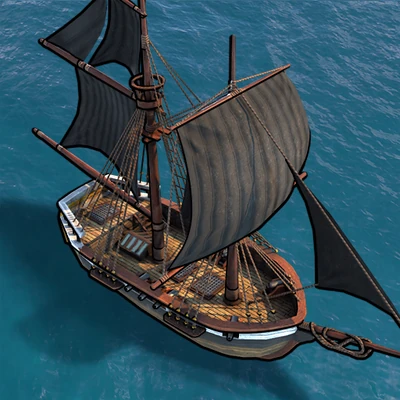
Recorded values
- Cost
- 500 Coin
- Available
- Commerce Age · European Dock (Asians, Europeans, Federal Americans, and Native Americans) ; Port (Africans)
- Training
- 40 sec
- Durability & mobility
- 900 hit points · 50% ranged resistance · 5.5 speed · 34 line of sight
- Ranged attack
- 100 base damage · range 20 · attack interval 2.0 · area of effect 1 · bonus damage: 0.5x vs. Artillery
- Broadside attack
- 30 (2) base damage · range 30 · attack interval 0.05 · area of effect 1 · bonus damage: 3.0x vs. Ship
- Ability
- Transports land units
Role, availability & values
Production is available through European Dock (Asians, Europeans, Federal Americans, and Native Americans) or Port (Africans). It has 900 hit points and 50% ranged resistance. It moves at 5.5 speed. Training costs 500 Coin; it takes 40 seconds to train. Attack profile: Ranged attack: 100 damage at range 20; every 2.0 seconds; area of effect 1. Broadside attack: 30 damage (2) at range 30; every 0.05 seconds; area of effect 1. Special ability or role: Transports land units.
Matchup & timing
Use this transport for a planned crossing or landing rather than sending it alone into contested water. Its listed speed is 5.5, so load the army before the route becomes unsafe and allow time for the return trip. The page also records a ranged attack at 20 range; use that profile as support, not as a substitute for a protected landing. Unload where the force has room to form up, keep an escort near the ship, and protect the shore while the last units disembark.
Commerce Age ship with a transport role
The Privateer is a mercenary Warship that becomes available in the Commerce Age. The standard Definitive Edition profile costs 500 Coin, takes 40 seconds to train and is limited to three through its normal mercenary access. It has 900 hit points, 50% ranged resistance, speed 5.5, line of sight 34 and can carry up to 50 land units. Its ordinary ranged attack deals 100 damage at range 20 every two seconds, with half damage against Artillery. Its 30-damage Broadside Attack has range 30, hits ships for three times damage and then enters a 60-second cooldown. That special volley makes the ship a serious naval threat, while its transport capacity can move a large land force across water.
Broadside timing and naval fights
A Privateer should use Broadside when the target is valuable and the fleet can exploit the temporary damage spike. The attack's 3.0× Ship multiplier makes it particularly dangerous to an enemy warship, but the long cooldown means it cannot repeat the burst immediately. Keep it with supporting ships so the opponent cannot isolate it after the ability is spent. Its regular attack is useful against ships, nearby infantry and coastal buildings, though the low 0.5× multiplier against Artillery makes dedicated guns a poor target. Enemy Culverins and defensive structures are listed weaknesses. Use scouting to identify those hazards before moving close enough to provide a transport or shoreline attack.
Availability and civilization-specific limits
The ship can arrive from a Home City shipment, be selected as an Age-up reward, or be trained through qualifying mercenary access. Asian, European, Federal American and Native American civilizations use a European Dock; African civilizations use a Port. In African maps, a Trading Post or Tambo on an African Kingdom can unlock its mercenary route. The Gentleman Pirate age-up option supplies a Privateer to Germans, Swedes, French, Italians and Russians, while Italians can receive two with Advanced Politicians. These routes explain why the ship can appear earlier or in a different quantity than ordinary Dock production suggests.
Revolution versions and historical variants
Several revolutions alter the normal training rules. Barbary States and Haiti can train Privateers at Docks with a limit of five; Barbary States' ships can train units normally associated with Galleons plus Falconets and Culverins, while Haiti's can train the Galleon unit roster plus Pirates. Mexico's Baja California revolution raises the limit to five and can send the ships with the infinite Recruit Privateers card, but Baja California cannot train them directly. Separate Intrepid Privateers can appear as starting units on some water maps. They have 1,000 hit points, speed 6.7 and line of sight 40, but a much weaker attack and temporary damage penalties during the Exploration Age. The Algiers Historical Battle uses another profile with 1,000 health, speed 7.5 and a limit of four.
Comparisons, economy and improvement cards
In the base game the Privateer is one of the strongest Commerce Age ships, but its relative standing depends on expansion and civilization. The WarChiefs introduced the Spanish Galleon, which can surpass it in durability, and later ship choices such as Frigates change the comparison again. Two Privateers can overwhelm a lone Galleon if the ships are able to focus fire, while the resource cost and shipment rules determine whether that exchange is favorable. Home City cards such as Improved Warships, Naval Gunners, Offshore Support and Admiralty can improve naval strength, with availability varying by civilization. Armor Plating raises ship hit points, and Carronade boosts attack; Percussion Lock specifically adds 50% Broadside damage. Plan those cards around an actual naval strategy rather than the Privateer's transport ability alone.
Use transport capacity without exposing the fleet
A 50-unit garrison capacity gives the Privateer a second job beyond fighting for water control. It can carry an army across a channel, bypass a defended land approach or reinforce a coastal position. Loading troops still costs travel time and temporarily removes them from land defense, so escort the ship and choose a landing point that avoids Culverins and strong shoreline defenses. Its broadside is strongest against ships, while the transported army may be better suited to clearing coastal structures and guns. Combining these roles can force an opponent to defend both the sea and the landing zone, but sending the ship alone risks losing a costly 500-Coin investment before the army unloads.
A practical naval composition
The Privateer's high ranged resistance and health let it trade well with many early ships, but it remains vulnerable to focused artillery and coastal defense. Pair it with another warship that can continue firing while the Privateer waits for Broadside to recharge. If the opponent commits several ships, avoid spending the ability on a low-value target just because it is in range: focus the strongest enemy vessel, then withdraw or keep the rest of the fleet between the Privateer and a counterattack. Against a shoreline base, use regular attack only when allied units can remove defensive guns. The 0.5× damage against Artillery makes a Privateer a poor answer to Culverins, so bring a land force or a dedicated ship that can safely pressure them.
Decide between shipment and direct production
A Home City shipment or age-up reward can put a Privateer on the water before a Dock economy is ready, which is often its main strategic advantage. Direct production through the mercenary route requires planning for 500 Coin and a 40-second queue, while the shipment also consumes a card opportunity. A Trading Post or Tambo on an African Kingdom creates a map-dependent route, so its value depends on access and whether the post can be protected. Consider what the ship must accomplish: a fast naval defense, a transport landing, or a broadside against enemy warships. If a match has little useful water or no safe landing, the cost and shipment slot may be better spent on land forces.
Merchant ship, hired warship and force multiplier
A Privateer combines the roles of a warship and a transport, so its value depends on what the sea route enables. In a water-heavy match, it can defend fishing or shipping lanes, use Broadside against enemy ships, and then carry an army to a second front. The 50-unit capacity is large enough to move a complete force, but the ship must survive while loading and crossing. Keep it within support range and plan a landing route before embarking. A landing behind the enemy can draw defenders away from the main fight, while an exposed beach may lose the ship before its cargo contributes. Its standard 500 Coin price and long cooldown make careful use more important than simply keeping it near the Dock.
Mercenary warship and transport
The Privateer is a Commerce Age naval unit available through European Docks for Asians, Europeans, Federal Americans and Native Americans, or through African Ports in the recorded profile. It transports land units and carries a 100-damage ranged attack plus a Broadside. With 900 hit points and 50% ranged resistance, it can support a crossing, but its 5.5 speed makes it slower than many ships and its transport load makes it valuable to protect.
Coin cost and safe deployment
A Privateer costs 500 Coin and takes 40 seconds to train. Scout the water and keep other ships nearby before using it to ferry troops. Its broadside can support a coastal attack, but do not expose it to a stronger fleet. Choose an unloading point where troops can reach land and form safely, then withdraw or reposition the ship. The high Coin cost competes with mercenary and cavalry production, so build it when transport or naval pressure has a clear purpose.