Flail Elephant
Flail Elephant is Indians Heavy cavalry in Age of Empires III, available from the Commerce Age; obtained through Indian Castle, Agra Fort (with the Red Fort upgrade).
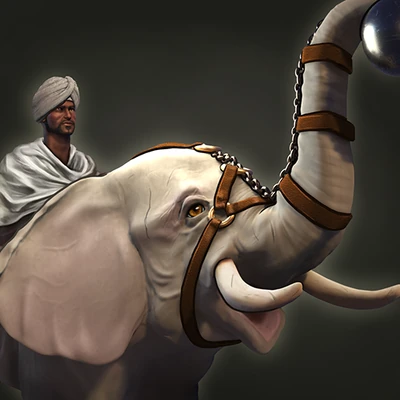
Recorded values
- Available
- Commerce Age · Indian Castle; Agra Fort (with the Red Fort upgrade)
- Training
- 43 sec · 3 population · 25 XP per train
- Durability & mobility
- 325 hit points · 50% ranged resistance · 4.0 speed · 15 line of sight
- Hand attack
- 10 damage · 1.5 attack interval · bonuses: 4.0x vs. Artillery; 1.5x vs. Infantry; 1.0x vs. Villager; 0.67x vs. Heavy infantry
- Siege attack
- 80 damage · 1.5 attack interval
Role, availability & values
Production is available through Indian Castle or Agra Fort (with the Red Fort upgrade). It has 325 hit points and 50% ranged resistance. It moves at 4.0 speed and uses 3 population. Training costs 125 Food and 125 Coin; it takes 43 seconds to train. Attack profile: Hand attack deals 10 damage. Siege attack deals 80 damage. Hand attack bonuses: 4.0× against Artillery, 1.5× against Infantry, 1.0× against Villager, and 0.67× against Heavy infantry.
Matchup & timing
Hand attack is especially effective against Artillery (4×), Infantry (1.5×). Its reduced multipliers against Heavy infantry (0.67×) make it less suitable for those targets. Hold the melee attack for Artillery and Infantry when they enter contact. Keep a frontline between this unit and threats that can reach it safely.
Current statistics and Indian access
The Flail Elephant is an Indian Commerce Age Heavy Cavalry and siege unit introduced in The Asian Dynasties. It costs 125 Food and 125 Coin, takes 43 seconds to train, and uses three population in the current Definitive Edition profile. It has 325 hit points, 50% ranged resistance, speed 4.0, and line of sight 15. The Indian Castle can train it after reaching Commerce Age. The Agra Fort can also train it after receiving the Red Fort upgrade. Its short-range mace attack deals 10 damage every 1.5 seconds in an area of two, while its siege attack deals 80 damage every 1.5 seconds. The unit is therefore more specialized in destroying buildings than in defeating a normal army. Its high ranged resistance and low population cost for an Elephant make it a useful screen when properly supported.
Building damage and anti-Artillery use
The 80-point siege attack is the Flail Elephant's main reason to exist. It can destroy a Town Center, Fort, or other building quickly if it reaches the target, and its hand attack deals four times damage against Artillery. It also has a 1.5 multiplier against Infantry, but only 0.67 against Heavy Infantry. The Elephant moves at speed 4.0, so it is slower than most Cavalry and can be intercepted before reaching a building. Use it with a force that can clear Pikemen, Dragoons, and ranged Cavalry from its path. If Artillery is exposed, the Flail Elephant can charge it and remove it rapidly, but protect the unit from anti-Cavalry troops during the approach.
Durability and counter relationships
The Flail Elephant's 50% ranged resistance and 325 hit points let it absorb ranged fire better than a fragile raider, but it is not a heavy combat Elephant on the scale of larger Indian units. Heavy Infantry and Ranged Cavalry can exploit its vulnerabilities, while its slow speed makes disengaging difficult. Its broad hand area helps against clustered units, but the low base damage means it should not be sent to fight an Infantry army unsupported. Use it as a damage sponge in front of ranged units or as a siege threat that forces the opponent to respond. After Professional Handlers is sent, the Flail Elephant becomes more population-efficient as a durable screen, making it useful for protecting the Indian ranged line without consuming as much population as a larger Elephant.
Disciplined, Honored, and Exalted upgrades
The Flail Elephant has a three-stage upgrade path. Disciplined Flail Elephant costs 200 Wood and 100 Coin and adds 20% hit points and damage. Honored Flail Elephant costs 600 Wood and 600 Coin, requires Disciplined, and adds 30%. Exalted Flail Elephant costs 1,500 Wood and 1,500 Coin, requires Honored, and adds 50%. These upgrades apply to regular and Mansabdar Flail Elephants. They improve both its siege damage and durability, which is valuable when the unit is expected to keep attacking buildings. The cost is significant, so research the stages when multiple Flail Elephants are already in the army or when their siege role is central to the match. The current three-population cost is lower than older versions, another reason to check which version a guide describes.
Mansabdar Flail Elephant and aura
The Mansabdar version is trained from the Charminar Gate Wonder and costs 250 Food and 250 Coin. It has 650 hit points, twice the durability of a regular Flail Elephant, while keeping the same core attack profile and three population. Its Imperial Service aura increases the hit points and damage of nearby Flail Elephants by 10% within radius 24. This makes it a durable leader for a group that is moving toward buildings or absorbing fire. The Mansabdar is more expensive than the ordinary unit, so field it when the aura will affect several Flail Elephants or when a stronger anchor is needed. Keep it close enough for the passive aura to cover the group while avoiding direct engagement with its Heavy Infantry counters.
Using the Elephant in an Indian composition
The Indian army does not rely on a massable standard Artillery piece in the same way as many European armies. The Flail Elephant can partially fill that gap by providing anti-Artillery damage and durable siege pressure, especially when the player needs to break a defensive structure. Pair it with ranged Infantry and Cavalry that can handle enemy Heavy Infantry and Ranged Cavalry. The Elephant's job is to absorb attention, threaten buildings, and punish Artillery that cannot retreat quickly. If the opponent's army contains many Pikemen or Dragoons, do not send the Flail Elephant ahead alone; use ranged support to clear its counters before committing. It is a middle ground between a fragile siege unit and a more expensive Elephant, but its damage against ordinary units remains limited.
Training location and age-up planning
A Castle is the normal production point, so the player must have access to one and reach Commerce Age before training Flail Elephants. The Agra Fort route depends on the Red Fort upgrade, which adds another way to produce them from the Wonder. This gives the Indian player flexibility when the chosen age-up and map favor a forward Agra Fort, but it does not make the unit available from any military building. Consider the route before spending the age-up choice: a forward Fort can threaten buildings, while a safer Castle supports repeat production behind the base. Keep a replacement route available if the first building is exposed, since a slow siege unit cannot always retreat from a failed push.
Practical siege sequence
Bring Flail Elephants with a screen of Infantry, identify the enemy Artillery or anti-Cavalry units, and clear those threats before sending the Elephants onto a building. Once the siege begins, concentrate their attacks on a valuable Town Center, Fort, or production building rather than splitting damage. If enemy Cavalry engages, let the screen intercept while the Elephants withdraw or continue only if the target is close to falling. Their high ranged resistance helps against ordinary ranged attacks but does not protect them from melee counters. When the building is destroyed, regroup before moving to the next target so the Elephants do not become isolated. Upgrades are most effective when the same group can survive several sieges.
One-line tactical summary
Use Flail Elephants to absorb ranged fire, punish exposed Artillery, and demolish a high-value building. Keep them screened from Heavy Infantry and Ranged Cavalry; their slow speed and low damage against those targets can turn a siege push into an expensive loss.
Separate the anti-Artillery strike from its siege attack
The Flail Elephant’s 10-damage hand attack fires every 1.5 seconds. Before resistance and upgrades, its 4.0× bonus produces 40 damage against Artillery, 15 against Infantry, 10 against Villagers and about 6.7 against Heavy Infantry. That last comparison matters: Heavy Infantry is a poor target even though ordinary Infantry is vulnerable. The separate 80-damage siege attack is the structure-pressure tool; do not treat it as a stronger version of the hand attack against troops. With three population and a 125 Food plus 125 Coin cost, the Elephant earns its place by surviving ranged fire, clearing exposed guns and turning on valuable buildings while a screen handles Heavy Infantry and ranged counters.
Indian elephant cavalry against artillery
The Flail Elephant is Indian Heavy cavalry available from the Commerce Age through an Indian Castle or an Agra Fort with the Red Fort upgrade. Its hand attack gains a 4× bonus against Artillery and 1.5× against Infantry, making it a powerful way to threaten guns or vulnerable foot troops. It has 325 hit points and 50% ranged resistance, but moves at only four speed. That slow pace makes it difficult to pursue targets and leaves it vulnerable to opponents who can kite or focus fire. Use it as a durable force that advances with support, not as a fast raider.
Siege investment and production
Each Flail Elephant costs 125 Food and 125 Coin, takes three population and requires 43 seconds to train. Its 80-damage siege attack can pressure structures, though the 1.5-second interval means the unit must remain close and protected. Keep anti-cavalry support nearby and target artillery when the enemy cannot screen it. The Agra Fort route is conditional on Red Fort, so confirm the upgrade before relying on that production path. The elephant’s high resource and population cost means a lost unit is difficult to replace; plan the engagement and retreat before the opponent surrounds it.