Gatling Gun
Gatling Gun is a multi-target artillery unit used by the United States and several Revolution or Asian paths. Its rapid Coffee Mill attack gives it a distinct firing profile from a cannon that delivers one slow bombard shot.
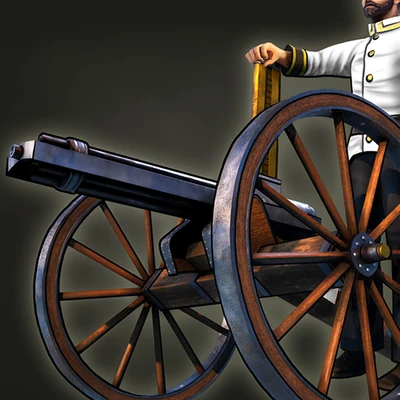
Recorded values
- Available
- Fortress Age (United States) ; Revolution (revolutionary) · Artillery Foundry; Fort; Steamer (United States and Meiji Japan) ; American Citadel; Consulate; National Government (Meiji Japan)
- Training
- 38 sec · 4 population · 35 XP per train
- Durability & mobility
- 150 hit points · 75% ranged resistance · 4.0 / 1.6 speed · 26 line of sight
- Bombard attack
- 30 (6) base damage · range 24 · attack interval 4.0 · area of effect 2 · bonus damage: 2.5x vs. Fixed Gun, 16; 0.75x vs. Building; 0.5x vs. Artillery; 0.5x vs. Ship; 0.5x vs. Arrow Knight, 16; 0.25x vs. Cavalry; 0.15x vs. Shock troops
- Coffee Mill attack
- 30 base damage · range 24 · attack interval 0.5 · area of effect 2 · bonus damage: Same as bombard attack · requires Coffee Mill Guns card
Role, availability & values
The unit can be produced through an Artillery Foundry, Fort, Steamer, American Citadel or Consulate, depending on civilization. Its recorded profile includes a 24-range bombard attack and a rapid Coffee Mill attack with multiple hits; it occupies four population.
Matchup & timing
Deploy it behind a screen where its repeated attack can stay on a target. Keep it away from cavalry and avoid placing it in front of the army; its speed and setup make protection important when the battle line shifts.
Current statistics and firing modes
The Gatling Gun is four-population Artillery with 150 hit points and 75% ranged resistance. Its current cost is 100 Wood and 250 Coin, and its training time is 38 seconds. In limber mode it moves at speed 4.0; in bombard mode it moves at 1.6. Line of sight is 26. Its standard Bombard attack deals 30 damage every four seconds at range 24 with an area effect of two. The Coffee Mill Guns card replaces that attack with a rapid firing mode that attacks every half second at the same listed range and area. The gun is built to damage Infantry quickly, but its class multipliers reduce its effectiveness against structures and several other targets. Treat it as a specialized anti-Infantry artillery piece rather than a general replacement for Falconets or Mortars.
What its target multipliers mean
The Bombard attack has a 0.75 multiplier against Buildings, 0.5 against ordinary Artillery, Ships, and Arrow Knights, and 2.5 against Fixed Guns. Its Cavalry multiplier is 0.25 and its Shock troop multiplier 0.15 in the current profile. That damage pattern rewards firing into Infantry, not dueling Cavalry or trying to destroy a Fort by itself. A group can still damage a low-priority target through its rate of fire, but that is a less efficient use of the unit than targeting Infantry. Culverins, Cavalry, Shock troops, and Arrow Knights are listed threats. Keep a screen between them and the Gatling Guns, and use other Artillery or siege units to handle the structures that the Gatling Gun damages poorly.
Coffee Mill Guns and massed fire
Coffee Mill Guns changes the Gatling Gun's firing behavior: the ordinary Bombard attack is replaced by a rapid Coffee Mill attack that does not pause for the usual reload. This turns a group into a serious threat to Infantry formations, since repeated volleys can overwhelm units that remain in the firing lane. The shipment is most valuable when the player can field several Gatling Guns and protect them from Cavalry or counter-Artillery. The card does not remove their class multipliers, so concentrated fire remains inefficient against Cavalry, Shock troops, and buildings. Keep the guns together enough to focus fire, but not so close that one area attack or flank catches all of them. The continuous volley should be used to punish a committed army, not as a reason to expose the artillery before the opponent's counters are known.
Civilization access by version
In the original release and The WarChiefs, Gatling Guns were associated with European Revolutions. Definitive Edition changed the ordinary access rules: the United States can train them from the Artillery Foundry upon reaching Fortress Age and can research their unit upgrades. The revolutionary United States can also train them from Forts, but cannot improve them through the same upgrade line. Some South American revolutionary states cannot train Gatling Guns normally, although Home City shipments can still deliver them. Japan has a special route after selecting Japanese Isolation and researching Meiji Restoration: Gatling Guns can be trained at the Consulate and National Government for 100 Wood and 140 Export, with 20% lower hit points and damage, while already receiving Imperial-level improvement for a net 55% increase. These access rules must be read by civilization and version rather than generalized from the original game's Revolution system.
Heavy and Imperial upgrades
The United States upgrade path begins with Heavy Gatling Guns in Fortress Age. The upgrade costs 250 Food and 250 Wood and adds 25% hit points and damage. Imperial Gatling Guns cost 1,500 Wood and 1,500 Coin, require the Heavy upgrade, and add another 50% hit points and damage. Those improvements make the unit more resilient and dangerous in late-game fights, but do not change its low damage multipliers against Cavalry and Shock troops. A player should upgrade after establishing the group and a protected position, since the unit already demands four population and resources to train. Revolutionary United States forces lack this upgrade path, so do not assume that the same Gatling Gun statistics apply to every nation that can field the weapon.
Positioning against Infantry and Artillery
The weapon's setup speed creates a movement tradeoff. Move in limber mode at speed 4.0 while the army travels, then set the guns to bombard mode at a safe firing position. Their 24 range provides space to fire, but their low hit points make exposure costly. Put Infantry or Cavalry between the guns and the opponent, and scout for Culverins that can outrange or quickly destroy them. Against Infantry, focus fire on the densest formation so the rate of fire creates meaningful pressure. If Cavalry reaches the artillery, retreat the screen to intercept rather than leaving the guns deployed. A successful Gatling Gun position is one where it can fire repeatedly while allied units prevent the enemy from exploiting its weak matchups.
Cards and tactical role
The Coffee Mill Guns shipment defines the unit's most distinctive tactical use, replacing the standard attack with continuous rapid fire. Other Artillery improvements can raise hit points, damage, or speed: Professional Gunners increases hit points, Smokeless Powder adds attack, and Trunion improves speed. Heated Shot adds a bonus against Ships, though the Gatling Gun is not a dedicated naval counter. Use it when the opponent's army contains substantial Infantry and the deck can support its production. If the enemy relies on Cavalry, Shock troops, or Culverins, field another unit first and use the Gatling Gun only behind adequate protection. This makes the unit a powerful but situational part of an army rather than a universal artillery choice.
When to add Gatling Guns to the army
The Gatling Gun is a late-game choice for armies that need sustained damage against Infantry. Its range and rapid fire can break a formation that would otherwise hold against the frontline, but its four population slots and low durability make positioning important. Keep the guns behind units that can catch Cavalry, and bring separate siege weapons when a Fort or Wall is the main target. The United States can improve its own Gatling Guns through the Heavy and Imperial upgrades, while other access routes may have different or no upgrade options. Decide from the civilization and the deck in use, and do not assume a Gatling Gun shipment follows the same rules as a trained unit.
Retreat and rebuild decisions
Because a Gatling Gun occupies four population and has only 150 hit points, it should withdraw as soon as its screen is broken. Limbering up improves movement to speed 4.0, but the gun still cannot outrun every cavalry unit. Use allied Cavalry to intercept a pursuer and preserve the artillery where possible. If a replacement is needed, compare the cost and training delay with another way to answer Infantry; do not spend remaining resources on guns when the opponent's Cavalry or Culverins control the field. After regrouping, deploy at a new angle and focus fire on the Infantry that the unit is designed to counter.
Coffee Mill fire and the bombard mode
The Gatling Gun is artillery defined by the contrast between its rapid Coffee Mill attack and its slower, longer-reaching bombard option. The repeated Coffee Mill hits let it apply sustained pressure to units in its firing arc, while the 24-range bombard profile supports attacks from farther away. It has 150 hit points and 75% ranged resistance, but its listed movement can be slow and its four-population cost makes each gun important to protect. Keep it behind infantry, use focus fire to finish a target and do not leave it exposed while the army changes direction. Artillery that survives several volleys has more value than a gun lost during an unsupported advance.
Civilization routes and combined-arms use
The Artillery Foundry and Fort are major production routes, while Steamers, the American Citadel, Consulate and Japanese National Government provide conditional alternatives for specific civilizations or paths. Its listed 100-Wood and 250-Coin cost with a 38-second training time makes a Gatling Gun a substantial but repeatable investment once the economy is established. Pair it with troops that intercept cavalry and with units that can protect the gun during setup and retreat. Its role is to punish enemy formations and assist a push, not to replace all other siege or anti-infantry units. Check the chosen Revolution, civilization and edition before planning production because those access routes are not universal.