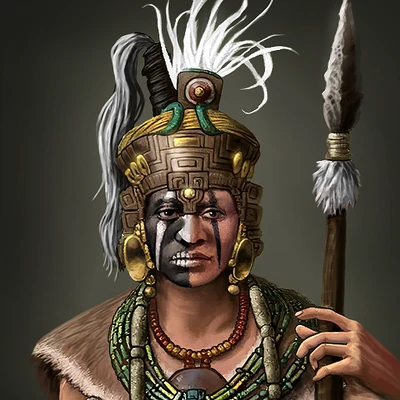
Holcan Javelineer
Holcan Javelineer is Maya (Mexicans) Heavy infantry in Age of Empires III, available from the Commerce Age; Revolution (Maya); obtained through Trading Post or Tambo on a Maya settlement, Native Embassy, Barracks (Maya), Fort (Maya), War Hut (Maya), American Citadel*.
Recorded values
- Available
- Commerce Age; Revolution (Maya) · Trading Post or Tambo on a Maya settlement; Native Embassy; Barracks (Maya) ; Fort (Maya) ; War Hut (Maya) ; American Citadel*
- Training
- 30 sec · 10 XP per train
- Durability & mobility
- 185 hit points · 10% hand resistance · 4.5 speed · 16 line of sight
- Ranged attack
- 10 base damage · range 12 · attack interval 1.5
- Siege attack
- 24 base damage · range 6 · attack interval 3.0
- Hand attack
- 10 base damage · attack interval 1.5 · bonus damage: 3.0x vs. Cavalry; 2.25x vs. Shock troops
Role, availability & values
Production is available through Trading Post or Tambo on a Maya settlement, Native Embassy, Barracks (Maya), Fort (Maya), War Hut (Maya), or American Citadel. It has 185 hit points. It moves at 4.5 speed. Training costs 75 Food and 25 Wood; it takes 30 seconds to train. Attack profile: Ranged attack: 10 damage at range 12; every 1.5 seconds. Siege attack: 24 damage at range 6; every 3.0 seconds. Hand attack: 10 damage; every 1.5 seconds.
Matchup & timing
Holcan Javelineers are Maya heavy infantry whose short-range javelins fire every 1.5 seconds; their reliable purpose is to stop Cavalry and Shock troops with the melee multipliers. Their 24 siege damage gives them a follow-up role against buildings, but the 12-range attack and access limits make them dependent on a protected approach from the Maya settlement or other listed source.
Current profile and combat tags
The Holcan Javelineer is a Maya native warrior introduced in Age of Empires III: Definitive Edition. Its current profile costs 75 Food and 25 Wood, takes 30 seconds to train, has 185 hit points, 10% ranged resistance, speed 4.5, and line of sight 16. It uses no population space as a Native American warrior, so it can add combat strength after the normal population cap becomes tight. Its tags include Heavy Infantry, AbstractPikeman, ranged Infantry, Musket Infantry, archaic Infantry, and Native warrior; the exact classification matters because upgrades and enemy multipliers check unit tags. It has a 10-damage ranged attack at range 12 with a 1.5-second rate of fire, a 10-damage hand attack, and a 24-damage siege attack at range six. Those values explain why it can contribute at both distance and close quarters, while its strongest bonus applies in melee.
Cavalry counter and battlefield limits
The hand attack deals three times its normal damage to Cavalry and 2.25 times damage to Shock troops. This makes the Javelineer a useful answer when mounted units reach the Maya line, but the unit still needs time to close into hand range to use that bonus. Its ranged attack is modest, so do not mistake the ranged unit classification for a long-range Skirmisher role. Light Infantry, counter-skirmishers, and Artillery are listed weaknesses and can hurt the group while it advances or holds position. Against ordinary Infantry, the Javelineer can contribute steady fire; against Cavalry, keep it close enough to engage without letting it be isolated. Its 4.5 speed supports repositioning, but it should not chase faster units across the map. Use another force to pressure ranged counters and artillery while the Javelineers guard the approach.
Native settlement access and build limit
The regular Holcan Javelineer is recruited from a Trading Post or Tambo built on a Maya settlement. The settlement imposes a limit of 17 per Maya site, so a larger army depends on access to more than one source or on shipments and civilization-specific routes. Maya revolutionary forces can also train the unit from a Barracks, Fort, War Hut, or American Citadel. The Mexicans can reach Maya allies through the Central American Allies card after the Mexico revolution, which allows recruitment at Native Embassies. Yucatán has a separate path: its Mayan Supporters shipment includes six Javelineers, and the Maya revolution begins with a base limit of ten that rises by one for every shipment sent. These are distinct availability rules; a normal Maya settlement limit should not be applied to every revolutionary route.
Civilization shipments and upgrades
Aztec Home City cards can supply 11 or 24 Holcan Javelineers through Mayan Allies cards, with an additional Imperial Age sending that can bring the total to 140 under the listed card rules. The Mexicans can send 24 and upgrade them to Elite, then send the card again in Imperial Age for 48 total. Their Tzotzil Uprising card after choosing Chiapas adds three Javelineers per Hacienda on the map. The unit can advance through Maya Warrior Societies for Elite at +25% hit points and damage, then Champion Maya for +35% with the earlier technology required; Legendary Native Warriors raises hit points and damage by 50%. The listed costs are 100 Wood and 75 Coin for the Elite technology, 400 Wood and 300 Coin for Champion Maya, and 1,500 Food plus 1,500 Wood for the Legendary upgrade. These large improvements reward a force expected to remain in use rather than a handful of temporary units.
Revolutionary and mercenary versions
Some routes change the source of the unit without changing its central anti-Cavalry role. The Maya revolution has a starting build limit of ten, increased by one with every shipment, and both the Maya and Yucatán routes can use Jungle Warfare to add poison damage to the hand attack. The ordinary native unit should also be distinguished from the Industrial Age mercenary version. Aztecs, Inca, and Spanish can receive that version from the Home City, regardless of map, through the 17 Mayan Allies card. That shipment sends 17, upgrades them to Elite and Champion if necessary, and can be sent repeatedly. A player using this route relies on shipments rather than a Maya Trading Post settlement. The mercenary version otherwise shares the central profile and should not be counted as a new base civilization unit available for normal training.
Practical army use
The unit combines ranged pressure, a strong anti-Cavalry hand bonus, and siege damage. A group can screen ranged Infantry and threaten buildings after the enemy's Cavalry is driven away, but its lower attack and hand resistance compared with a Musketeer make unsupported advances risky. Keep it near units that can draw fire or remove Light Infantry; use the Javelineer to punish Cavalry that commits to the fight. Its no-population trait makes it especially attractive when the army is close to its population ceiling, though resources and the settlement build limit still constrain production. If using a shipment-based army, protect the Home City card timing and avoid losing the entire group before it has forced the opponent to respond. Choose Elite or higher upgrades when the Maya force is a major part of the composition, and retain the distinction between this unit's close-range Cavalry counter role and dedicated ranged Infantry.
Siege contribution and population planning
The 24-point siege attack fires every three seconds at range six, allowing the Javelineer to help dismantle a building after the enemy's Cavalry has been driven back. Its role is not limited to fighting mounted units: the combination of no population cost and siege damage can make a Maya settlement force unusually efficient at the population cap. The player still pays Food and Wood for each unit and must respect the per-settlement limit, so the unit is not free to mass. Build enough other troops to protect the Javelineers from Light Infantry and artillery, then let them add siege pressure when the battlefield is safe. This is especially useful when a shipment has supplied a large group that cannot be replaced quickly through ordinary training.
Choosing native access or a shipment
A Trading Post or Tambo on a Maya settlement provides repeatable access within the settlement's unit limit, while Home City and revolution cards deliver groups without relying on ordinary training. Aztec players can send Mayan Allies, and Mexican players can use the 24-unit card or the Chiapas Hacienda reward; Maya and Yucatán revolutionary routes add their own building access and limits. Compare those routes before spending on a native alliance, since a shipment can deliver a large force immediately but a settlement provides a production point if the player can defend it. The mercenary shipment available to Aztecs, Inca, and Spanish is another distinct option. It does not mean those civilizations have normal Holcan training in every match. Keep the availability rule attached to the selected civilization and revolution.
How to turn the unit's bonuses into value
The Holcan Javelineer should be positioned so its anti-Cavalry hand attack is ready when mounted units engage, while its ranged fire contributes during the approach. It is not a dedicated long-range skirmisher: its best result comes from combining the attack modes and keeping the unit alive long enough for its zero-population advantage to matter. If Cavalry stays away, let the Javelineers help pressure Infantry or buildings, but move them out of range when Light Infantry or Artillery begins to focus them. The Maya settlement limit and the chosen shipment route determine how many can be fielded; keep those limits in view before planning an army composition around them.
Ranged Heavy Infantry with an anti-Cavalry hand attack
The Holcan Javelineer is ranged Heavy Infantry similar to a Musketeer. It has a melee bonus against Cavalry, allowing it to protect ranged units when mounted enemies close. Compared with a Musketeer, the documented profile has lower attack and hit points, so the unit should be used for its specialized Native role rather than treated as a direct replacement.
Light infantry and artillery are dangerous
Holcan Javelineers are vulnerable to artillery and light infantry. Keep them behind a screen, focus Cavalry and withdraw when Skirmishers take the field. Their access through a Native settlement, card or map-specific option can be limited; check the current alliance before planning a sustained force. Combine them with ranged units that can remove their counters.