Horse Artillery
Horse Artillery is mobile Industrial Age artillery for European civilizations other than the Maltese and for Federal Americans. It combines a long-range Bombard attack with a close Case Shot attack.
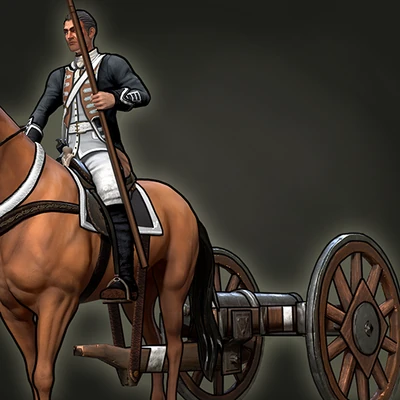
Recorded values
- Available
- Industrial Age · Artillery Foundry
- Training
- 45 sec · 6 population · 60 XP per train
- Durability & mobility
- 200 hit points · 75% ranged resistance · 6.0 speed · 30 line of sight
- Bombard attack
- 125 base damage · range 26 · attack interval 4.0 · area of effect 3 · bonus damage: 3.0x vs. Infantry; 3.0x vs. Ship; 2.0x vs. Building; 0.5x vs. Arrow Knight, 16
- Case shot attack
- 12.5 (7) base damage · range 13 · attack interval 4.0 · area of effect 5 · bonus damage: 3.0x vs. Infantry; 0.5x vs. Cavalry; 0.5x vs. Shock troops; 0.5x vs. Arrow Knight, 16 · requires Case Shot card
Role, availability & values
It is trained at the Artillery Foundry and has a recorded movement speed of 6, making it faster than most artillery. Bombard reaches 26 range, while Case Shot reaches 13 and affects a wider area; the unit occupies six population.
Matchup & timing
Use its mobility to reposition between firing lines, and switch to Case Shot only when enemy units approach within its shorter reach. Keep a screen nearby and reserve population for that support force.
Base profile and battlefield role
Horse Artillery is an Industrial Age mobile cannon trained at the Artillery Foundry. The standard unit costs 100 Wood and 500 Coin, takes 45 seconds to train and uses six population. It has 200 hit points, 75% ranged resistance, speed 6.0 and line of sight 30. Its main bombard attack deals 125 siege damage every four seconds at range 26, with an area of effect of three. Against infantry and ships it has a 3.0 multiplier; against buildings it has a 2.0 multiplier. This makes it a fast-moving answer to concentrated infantry and naval targets, with useful building pressure when a position is already controlled. Its low hit points mean the high ranged resistance should not be confused with general durability: melee attacks, cavalry and artillery counters remain dangerous.
Bombard attack and Case Shot
The main bombard shot is designed to strike groups at distance. Its splash area rewards firing into a dense formation or at a ship cluster, while the 0.5 multiplier against Arrow Knights reduces its effectiveness against that ranged native unit. Swedish players can send the Case Shot card to unlock a second attack profile at range 13. Case Shot fires every four seconds, deals 12.5 base damage with a listed 7 damage value, and has an area of effect of five. It applies a 3.0 multiplier against infantry but only 0.5 against cavalry, shock troops and Arrow Knights. This gives the gun a close-range anti-infantry option, but it is not a safe way to handle cavalry. Keep escorts between the artillery and fast attackers, and change target or withdraw if the opponent closes before the Horse Artillery can fire.
Mobility, positioning and escort
Speed 6.0 is the unit’s defining practical advantage: it can reposition more quickly than a Falconet or foot artillery and can follow a moving army without falling as far behind. Trunion can improve speed by 15%, with Apache Endurance providing another 5% where available. Mobility is for choosing firing angles and retreating before a cavalry charge, not for engaging alone. Keep a screen of heavy infantry or other anti-cavalry nearby and use light ranged cavalry or dedicated artillery counters to contest enemy guns. Before firing, leave a route to pull back; narrow terrain can trap the carriage and prevent the speed advantage from helping. A line of sight of 30 supports target acquisition, but the crew’s 200 hit points make scouting or forward deployment without an escort a poor exchange.
Standard recruitment and Consulate access
In the standard European roster, Horse Artillery is available at the Industrial Age Artillery Foundry to European civilizations other than the Maltese and to Federal Americans. It also appears in campaign forces. Asian civilizations can acquire a Consulate version through French or Portuguese alliances. The French Expeditionary Army supplies two Horse Artillery to the Chinese and Indians; the Portuguese Brigade provides four to the Indians and Japanese. Japan can also gain the ability to train it for 200 Export after choosing Japanese Isolation and researching Meiji Restoration, with access at the Consulate and National Government. The Consulate profile starts with +10% hit points and damage and receives automatic Industrial and Imperial Age increases. These routes are distinct from regular Foundry recruitment, so a player should check alliance and campaign conditions before expecting the unit in production.
Upgrade path and civilization variation
The ordinary Industrial Age upgrade Heavy Horse Guns costs 250 Food and 250 Wood and adds 25% hit points and damage. Danes can instead research Norwegian Artillery for 400 Food and 400 Wood, granting +30% hit points and damage and +5% siege resistance. In the Imperial Age, the applicable Imperial upgrade costs 1,500 Wood and 1,500 Coin and adds 50% hit points and damage, requiring the matching Heavy Horse Guns or Norwegian Artillery step first. These technologies turn an already fast support cannon into a more durable investment, but they require a later-age economy and the right civilization. Professional Gunners can add 10% hit points, Smokeless Powder adds 5% attack, and Heated Shot increases the ship multiplier by 50%. Check the target class before valuing an upgrade: bonuses against ships do not improve every land engagement.
Matchups and counters
Horse Artillery is strongest when it can fire at infantry, ships or buildings from a protected distance. Cavalry and shock troops can close quickly, while Culverins can outrange and destroy artillery; Arrow Knights also have a favorable answer despite taking reduced damage from the cannon. Avoid leaving a gun exposed after the first volley. A useful sequence is to screen the approach, focus fire on infantry or ships, then move before enemy artillery can establish a firing line. When attacking buildings, first secure the nearby area so the slow firing cycle does not expose the unit to a cavalry countercharge. In a naval fight, its 3.0 ship multiplier makes it valuable only where it can safely bring the bombard weapon to bear; the fleet still needs protection from enemy ships.
Choosing it over Falconets
Horse Artillery deals 25% more damage than a Falconet and moves faster, but it arrives later in the Industrial Age, costs 100 more Coin and uses one additional population. The choice is therefore about timing and role rather than a simple replacement. Falconets can support earlier pressure; Horse Artillery is suited to later armies that need mobile heavy firepower and can afford its larger Coin and population commitment. If the opponent is already massing cavalry or artillery counters, adding a Horse Artillery without support may be worse than spending those resources on a screen or counter-unit. The cannon pays off when its range, movement and anti-infantry damage can affect repeated engagements.
Consulate scaling and support cards
The Consulate Horse Artillery begins 10% stronger in hit points and damage than the standard unit and is automatically improved by +25% in the Industrial Age and +50% in the Imperial Age. Asian players therefore receive a different progression from the Foundry’s Heavy Horse Guns technology. Card access also varies: shared shipments can deliver two or three Horse Artillery to particular European civilizations, while Asian decks may access siege upgrades or recruit Wokou alongside artillery. These shipments can create an immediate force, but they do not replace the need to protect the guns after arrival. If the army is already at its population cap, make room before the shipment arrives so the artillery can contribute immediately.
Siege use and firing discipline
The building multiplier gives each 125-damage shot a 2.0 factor against structures, while the ship and infantry multipliers are 3.0. Keep the cannon stationary long enough to fire at a useful target, but do not let the four-second reload tempt the army to stand in an unsafe position. Move during a lull if the enemy is closing, and regroup with the screen before firing again. When defending, place the unit behind walls or a safe approach rather than directly on the front edge. When attacking, use infantry or cavalry to force defenders into the bombard area and prevent them from diving onto the guns. Its mobility is strongest when the player controls when and where the artillery stops.
Safe approach to artillery counters
Because Culverins can outrange it, avoid moving Horse Artillery into a visible enemy gun line without first locating or distracting those counters. Use the unit’s speed to approach from a different angle, then let the rest of the army engage the Culverins while the Horse Artillery fires at infantry or structures. Arrow Knights are also a listed weakness despite the reduced multiplier in their favor; their range lets them threaten from safety. If those units appear, screen them with mobile troops and retreat the cannon rather than continuing a poor exchange.
Mobile artillery that relocates with the army
Horse Artillery brings cannon fire to a force that needs to reposition more quickly than ordinary artillery. It is useful for supporting a push, shifting between fronts and punishing infantry or buildings when the battle moves across open ground. It still needs time and space to fire effectively, so do not send it ahead of the unit screen. Keep Cavalry away from the guns and choose firing positions with a retreat route.
Preserve the guns and their firing line
Mobile artillery is valuable because it can follow a changing front, but it remains an expensive target for enemy Cavalry and artillery. Protect it with anti-Cavalry troops and avoid bunching several guns where one attack can hit them. A Horse Artillery force should focus on a clear target—enemy infantry, artillery or a key structure—while the rest of the army holds the line. Check the civilization and version for exact age, range, cost and damage values.