Navajo Rifleman
Navajo Rifleman is ranged infantry in Age of Empires III, available from the Commerce Age; obtained through Trading Post or Tambo on a Navajo settlement, Native Embassy.
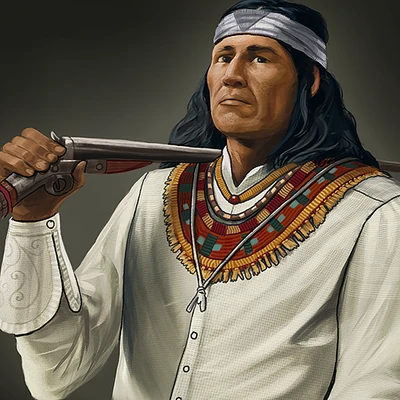
Recorded values
- Available
- Commerce Age · Trading Post or Tambo on a Navajo settlement; Native Embassy
- Training
- 20 sec · 10 XP per train
- Durability & mobility
- 200 hit points · 10% ranged resistance · 5.0 speed · 14 line of sight
- Ranged attack
- 11 base damage · range 2-16 · attack interval 3.0 · bonus damage: 2.5x vs. Light ranged cavalry; 2.5x vs. Ranged shock trooper; 2.0x vs. Heavy infantry; 0.6x vs. Cavalry; 0.6x vs. Shock troops
- Siege attack
- 10 base damage · range 6 · attack interval 3.0
- Hand attack
- 6 base damage · attack interval 1.5 · bonus damage: 2.0x vs. Light ranged cavalry; 2.0x vs. Ranged shock trooper; 2.0x vs. Heavy infantry; 0.75x vs. Cavalry; 0.75x vs. Shock troops
Role, availability & values
Production is available through Trading Post or Tambo on a Navajo settlement or Native Embassy. It has 200 hit points and 10% ranged resistance. It moves at 5.0 speed. Training costs 60 Food and 40 Wood; it takes 20 seconds to train. Attack profile: Ranged attack: 11 damage at range 2-16; every 3.0 seconds. Siege attack: 10 damage at range 6; every 3.0 seconds. Hand attack: 6 damage; every 1.5 seconds.
Matchup & timing
Navajo Riflemen combine a 5.0 speed with a range-16 rifle, letting them reposition between volleys more easily than slower ranged infantry. Their 11 base damage rises against Light ranged cavalry, Ranged shock troops and Heavy Infantry; Cavalry and Shock troops are poor targets. Keep the unit with the Native settlement force and screen it from melee pressure.
Ranged pressure and matchup profile
The Navajo Rifleman is a Commerce Age Native ranged infantry unit available through a Navajo Trading Post or Tambo and, in some rosters, a Native Embassy. It costs 60 Food and 40 Wood and trains in 20 seconds. The current profile has 200 hit points, 10% ranged resistance and speed 5.0, giving it more mobility than many conventional rifle infantry. Its ranged attack deals 11 damage at range 2–16 every three seconds; the hand attack deals six, and its siege attack deals ten. These modest base values need to be read with the unit’s matchup modifiers and access limits. The rifleman can be strong against selected infantry or cavalry classes but is not a universal counter. Its 14 line of sight and range allow it to fire from behind a screen, while the relatively slow attack interval makes focus fire useful: concentrate several riflemen on one priority target instead of spreading their shots. Keep Cavalry and melee units away from the group, and use its speed to withdraw when the opponent closes. The settlement’s unit limit means it is not an unlimited substitute for a civilization’s core infantry production.
Native access, caps and version changes
Navajo Riflemen use Native settlement access rather than an ordinary Barracks queue. The Trading Post or Tambo on a Navajo settlement is therefore both a map-control investment and the route to this unit; a Native Embassy may offer a separate way to recruit it where the selected civilization and mode allow. The build limit is 15 per Navajo settlement in the current Definitive Edition listing. That cap encourages the player to combine the Riflemen with the regular army instead of relying on a single settlement for an entire force. The unit belongs to The WarChiefs and remains in Definitive Edition, but its cost, training time, limit, hit points, attack, stealth speed and target multipliers have changed across updates. Older guides may list 50 Wood instead of 40, a 30-second training time or different combat bonuses; use the current version’s values when planning a live match. Native Treaties and other Home City Cards can grant additional Riflemen or improve Native units, but these effects require the card and settlement condition stated in the current deck. A forward Trading Post should be defended: losing the site can cut off recruitment and waste the resources used to establish it. The Rifleman’s speed and resilience make it useful for a controlled flank, but its slow ranged interval and finite settlement cap reward support from other units.
Definitive Edition statistics
The current native profile costs 60 Food and 40 Wood, trains in 20 seconds and has a limit of 15 per Navajo settlement. It has 200 hit points, 10% ranged resistance, speed 5.0 and line of sight 14. Its ranged attack deals 11 damage every three seconds at range 2–16. The attack applies a 2.5 multiplier against light ranged cavalry and ranged shock troops, and 2.0 against heavy infantry; it is less effective against cavalry at 0.6 and shock troops at 0.6. Its hand attack is only six damage, although it has class multipliers, and its siege attack deals 10 at range six. The low base ranged damage makes target bonuses essential: choose favorable units rather than firing indiscriminately at every target.
Classification and balance changes
The Rifleman’s current classifications include light infantry, ranged infantry, gunpowder trooper, rifle infantry and native warrior. The light-infantry and rifle-infantry tags were added in Definitive Edition update 13.9057. Balance values have also changed: update 13.12327 adjusted its wood cost, training time, settlement limit, hit points, XP values, hand damage, ranged damage and range. Earlier profiles list 190 hit points, 20 ranged damage and range 2–12, while the present profile uses 200 hit points, 11 damage and range 2–16. Update 13.58326 increased its ranged multipliers against light ranged cavalry and ranged shock troops and changed its cavalry multiplier; a later update adjusted the shock-troop value. Old guides may therefore describe a much harder-hitting but shorter-range unit. Use the version label and current profile when planning an army.
Native recruitment and mercenary versions
The ordinary native version can be trained at a Trading Post or Tambo built on a Navajo settlement, up to the settlement’s limit. It is a population-free addition in its native-warrior role, making it useful when spare Food and Wood are available but population is committed to the main army. Mexico can also train Navajo Riflemen at Native Embassies through Central American Allies. The mercenary form is separate and can be shipped regardless of map for Mexico and the United States; it does not share the native settlement limit. Mexican Renegade Navajo sends ten and adds a 0.75 bonus multiplier against Villagers. The United States Navajo Scouts card sends 21, improves them to Elite and Champion, grants Stealth and can be sent multiple times under the listed rules. A shipment route should not be confused with permanent native-site recruitment.
Stealth and scouting utility
The Navajo Scouts card gives the mercenary version access to Stealth. This ability is a special card-gated feature rather than a universal property of every Navajo Rifleman. The unit’s line of sight is only 14, so it is not a replacement for a dedicated Explorer or long-range scout. Its speed of 5.0 and ranged reach can still help a player screen a resource line or keep watch on an approach, especially when Stealth is available. Use concealment to reposition or observe where an opponent is not already searching; do not rely on it to survive a direct fight with cavalry or artillery. Reveal the Riflemen when they can fire from a safe position and return them to a protected line if the opponent brings counters.
Matchups and formation
The unit is effective against heavy infantry, light ranged cavalry and ranged shock troops because of its ranged multipliers. Heavy cavalry, hand shock troops, counter-skirmishers and artillery are unfavorable targets. Its low ranged resistance and modest line of sight mean that it can be removed quickly when a counter reaches it. Keep it behind a screen and focus fire on units its bonuses reward. Against cavalry, use the Riflemen to contribute ranged damage while a dedicated anti-cavalry unit prevents a charge; their own reduced multiplier against cavalry means they are not a stand-alone answer. The native site’s population-free roster can supplement an army efficiently, but the resource cost and per-settlement cap still constrain production.
Upgrade path
Navajo Warrior Societies costs 100 Wood and 75 Coin in the Commerce Age and adds 25% hit points and damage in Definitive Edition; the older upgrade cost more. Champion Navajo costs 400 Wood and 300 Coin in the Fortress Age and adds 35% after the first step, while earlier versions used a different bonus. The applicable Imperial native-warrior technology costs 1,500 Food and 1,500 Wood and adds 50% for Legendary status. Access depends on civilization and the relevant upgrade building; African civilizations follow their automatic native-warrior upgrade rule where applicable. Cards can also improve ranged attack, hit points, range, speed or training time. Because the base attack is low, an attack improvement is especially useful when the Riflemen have favorable targets and can remain protected long enough to fire repeatedly.
When to recruit
Recruit Navajo Riflemen when a Navajo settlement is secure, the opponent is fielding heavy infantry or favorable ranged cavalry, and Food and Wood are not urgently needed elsewhere. Their quick 20-second training time can add reinforcements to an ongoing fight, but the settlement cap prevents unlimited scaling. If the enemy transitions to heavy cavalry or artillery, stop adding Riflemen and invest in counters. Their value is best measured as a specialized ranged supplement, not as a generic replacement for Skirmishers: they have different target bonuses, lower base damage and less scouting range.
Older version values and range
Older guides may also list a 16-unit settlement cap before update 13.12327, a 30-second training time before the same update, and a 12-unit range before the update extended it to 16. The current faster training time lets the native site reinforce an army more quickly, but it does not increase the per-settlement limit. Its low line of sight remains 14 even though the weapon can fire farther, so another unit may need to reveal targets beyond that vision. Keep the difference between weapon range and sight range in mind when choosing a firing position.
Shipment quantities and special effects
The United States Navajo Scouts card delivers 21 Riflemen and improves the shipped units to Elite and Champion while enabling Stealth. Under its listed repeat rules, it can supply four groups of 21 for a total of 84. Mexico’s Renegade Navajo instead sends ten and adds a bonus against Villagers. These are special shipment effects, not the baseline native profile. A large shipment can overwhelm a weak line, but its low base damage still benefits from target selection and protection. Against a prepared counter force, split the group only if each section has a safe retreat path.
Map presence and value
The Rifleman’s settlement route makes map control part of its cost. A safe Navajo site provides repeated training and access to native upgrades, while a lost or contested site can end recruitment. The mercenary shipment avoids that dependency but has its own card timing.
Population-free support
Native Riflemen are valuable when population space is the limiting resource because the ordinary native-warrior version does not consume population. The mercenary version follows a separate shipment profile, so do not extend that assumption automatically to every card version. Even as a population-free unit, each Rifleman still requires Food and Wood, time at the settlement and space under its cap.
Recruitment check
Confirm the Navajo site, shipment or Native Embassy route before selecting Riflemen as a core counter. Without reliable access, choose a standard unit that fills the same battlefield role.
Quick Native rifle production
The Navajo Rifleman is a Commerce Age Native ranged Infantry unit trained from a Trading Post or Tambo on a Navajo settlement, or from a Native Embassy when available. It costs 60 Food and 40 Wood, takes 20 seconds to train and is limited to 15 per settlement. The current profile has 200 hit points, 10% ranged resistance, speed five and sight 14. Its ranged attack deals 11 damage at range 2–16 every three seconds, and it has a class bonus against Light ranged Cavalry, Ranged Shock troops and Heavy Infantry. The unit’s fast training time can reinforce a Native army quickly, but the 15-unit cap and exposed settlement access limit how long the force can be sustained.
Use range and bonuses with a screen
Keep Navajo Riflemen behind a durable frontline and focus the target classes their bonuses are intended for. Their range 16 helps them begin firing early, while speed five lets them reposition better than slower rifle units. They still deal reduced damage to Cavalry and Shock troops, so protect the line from a charge rather than asking it to hold by itself. A Trading Post on the Navajo settlement also unlocks Native technologies; weigh those upgrades against the cost of training more units. The Native Embassy offers alternate access in some civilizations, but does not remove the settlement cap unless its rules say so. Scout the site and secure the route before committing to a build order that relies on continued Navajo reinforcements.