Quebec
Quebec can place a player near the shoreline or near the Trade Route. Cree and Inuit settlements are available, with Qivittoq and Highwayman outlaws. These alternate starts change whether early water access or route control is the nearer objective.
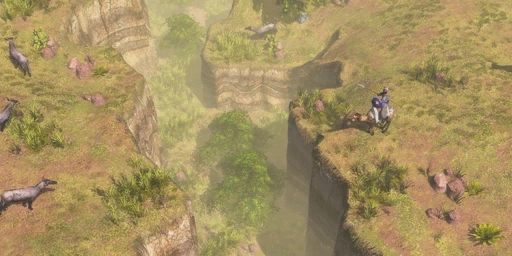
Terrain, routes and neutral sites
- Possible starting areas
- Shoreline · Trade Route
- Native settlements
- Cree · Inuit
- Outlaws
- Qivittoq · Highwayman
- Opening choice
- Water access or Trade Route control, based on spawn
Map character
Use the minimap to identify your start, then scout the closest settlement, shoreline and Trading Post site. If near the coast, check whether a Dock can be protected; if near the route, assess whether the post is defensible before investing.
What to scout
Adapt the opening to the actual starting position rather than following a single Quebec build. Secure nearby resources first, then contest the more distant objective when the army can hold its approach.
Coastal start: make water pay for its opening cost
A shoreline start gives earlier access to water, but proximity alone does not make a Dock worthwhile. Scout for usable fishing space, a safe place to build, and routes that friendly ships can protect. A Dock and Fishing Boats use resources and time that could have gone into land production, so decide what the water will contribute before committing. If the coast is exposed, keep Villagers near the Town Center and secure the approach before expanding onto the shore. Water can support the economy or movement when the match layout allows it; it should not become a separate, undefended front.
Trade Route start: claim only what the army can hold
A player who begins nearer the Trade Route can scout its Trading Post positions earlier than a player starting by the coast. Reveal the route and surrounding Mines and Hunts, then identify a segment that can be reinforced from the base. A post that accelerates shipments or advances route control is valuable only while it remains in friendly hands. Do not send several Villagers to distant sites merely because the route is close; first check the opponent’s approach and preserve enough troops to protect workers. Route access creates a first expansion choice, not a reason to ignore the Cree and Inuit sites or other useful ground.
Treat settlements and outlaw camps as separate choices
Cree and Inuit settlements offer alliance options, while Qivittoq and Highwayman identify outlaw recruitment choices. These are different investments: a Trading Post secures a settlement’s available alliance benefits, whereas outlaw access depends on the civilization’s recruitment rules and the camp’s reachability. Scout their positions from either starting side before choosing what to pursue. Compare the available roster with the army’s needs and include the cost of holding the route. If the opponent can take a neutral site before support arrives, securing nearby resources and returning with a force is safer than splitting the opening army.
Use the Cree and Inuit sites for different early needs
Quebec’s alternate starts make it useful to compare the settlement roster with the nearest resources and routes. The Commerce Age Cree Tracker costs 40 Food and 80 Wood, trains in 20 seconds and has 260 hit points, 10% ranged resistance and 18 line of sight. Its ranged attack has bonuses against light ranged cavalry, ranged shock troops and heavy infantry; it is less effective against Cavalry, so keep a screen nearby. The Inuit Hunter costs 60 Food and 50 Wood, trains in 30 seconds and has 130 hit points with 20% ranged resistance. Its bonuses against Pets, Mercenaries, Outlaws and Native warriors make it a specialist counter to those targets. The Cree Coureur des Bois costs 120 Food and can gather, build and claim Treasures, giving the Cree site an economic option as well as troops. Pick the alliance for the role the army lacks, not just the one that appears closest.
A Fortress Age Qamutik is a later shore option
The Inuit Qamutik is a separate timing from the early Hunter: it becomes available in the Fortress Age, costs 110 Food and 110 Wood and trains in 35 seconds. Its 420 hit points, speed 7.25 and 30% ranged resistance make it a durable mobile unit; its ranged attack deals 15 damage at range 14, with a 15-damage siege attack at range 10. That profile can support pressure on a shoreline or exposed building after the player has secured the route, but the cost competes with the age-up and other Fortress Age production. If the starting position is near the Trade Route, preserve enough army to hold the post while the unit trains. If it is near the coast, check that the landing and retreat route are safe before directing the Qamutik toward the far bank.
Adapt the first investment to the actual spawn
A route-side start and a coast-side start change which objective can be protected early. From the route, identify a Trading Post position that can be reinforced and avoid taking the entire army away to chase both settlements. From the coast, scout whether a Dock can protect fishing or a transport crossing before spending Wood on naval production. Cree and Inuit sites remain neutral investments: each needs builders, a Trading Post or Tambo, and troops to keep the approach open. Harpooner and Qivittoq outlaws are separate recruitment possibilities, not substitutes for an alliance. Recheck the map after scouting, since the distance between the starting position, settlement and opponent determines whether a forward post can survive.