Quechua Huaminca
Quechua Huaminca is Heavy infantry in Age of Empires III, available from the Commerce Age; obtained through Trading Post or Tambo on a Quechua settlement, Native Embassy.
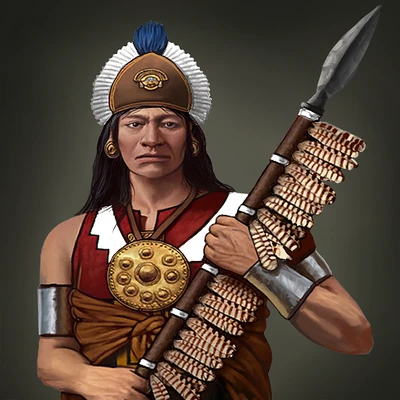
Recorded values
- Available
- Commerce Age · Trading Post or Tambo on a Quechua settlement; Native Embassy
- Training
- 30 sec · 12 XP per train
- Durability & mobility
- 170 hit points · 20% hand resistance · 5.0 speed · 12 line of sight
- Hand attack
- 15 damage · 1.5 attack interval · bonuses: 3.0x vs. Cavalry; 2.25x vs. Shock troops
- Siege attack
- 28 damage · 6 range · 3.0 attack interval
Role, availability & values
Production is available through Trading Post or Tambo on a Quechua settlement or Native Embassy. It has 170 hit points. It moves at 5.0 speed. Training costs 100 Food and 20 Wood; it takes 30 seconds to train. Attack profile: Hand attack deals 15 damage. Siege attack deals 28 damage. Hand attack bonuses: 3.0× against Cavalry and 2.25× against Shock troops.
Matchup & timing
Bring the Huaminca forward when Cavalry is threatening the army or a building needs pressure: its hand attack has the heavy-infantry Cavalry bonus and its 28-damage siege attack is substantial for an infantry unit. It lacks the ranged option to punish enemies while approaching, so keep support close and use the settlement’s upgrades to strengthen the role.
Role and current base profile
The Quechua Huaminca is a melee heavy infantry native warrior recruited at a Trading Post or Tambo on a Quechua settlement, or at a Native Embassy when the alliance supports it. Its current listed price is 100 Food and 20 Wood, train time is 30 seconds and the limit is 13 per settlement. It consumes no population space. The base profile has 170 hit points, 20% hand resistance, speed 5.0 and line of sight 12. Its spear and heavy-infantry classification make it an anti-cavalry and anti-shock unit with useful siege damage. It has no ranged attack, so it must close the distance and is vulnerable during approach.
Combat damage and counters
The hand attack deals 15 damage every 1.5 seconds, with a 3× multiplier against cavalry and 2.25× against shock troops. Its siege attack deals 28 damage at range 6 and a three-second interval in the Definitive Edition profile; the original version used a higher listed damage and slower rate. This makes Huamincas useful against cavalry charges and exposed buildings, but their lack of range means light infantry and counter-skirmishers can damage them before they engage. Artillery is also a strong counter. Pair them with ranged infantry that can pressure skirmishers and with units able to protect the approach. Do not send them alone into a defensive line simply because they have a cavalry bonus.
Building pressure and tactical use
Huamincas can threaten structures when the opponent’s army is elsewhere. Their siege attack lets a small group punish an exposed Trading Post, military building or damaged Town Center, but the slow attack cycle gives defenders time to respond. Use their speed to accompany a main army or to strike a side route after scouting. Against cavalry, keep them between the enemy and fragile ranged units; against buildings, clear nearby defenders first. Since they cost more Food than Wood, they can be a useful Wood-efficient reinforcement when the economy has abundant Food. Their zero population requirement is valuable late in a crowded army, but the settlement’s training cap limits mass production.
Upgrades and settlement access
Incan Warrior Societies upgrades the unit to Elite in the Fortress Age and currently costs 150 Wood and 100 Coin, increasing hit points and damage by 25%. Champion Inca requires the prior upgrade and costs 500 Wood and 400 Coin, granting the Champion rank with 35% more hit points and damage. Legendary Native Warriors costs 1,500 Food and 1,500 Wood in the Imperial Age and gives the Legendary rank with 50% more hit points and damage. African civilizations use their own rule for native warrior upgrades, while other civilizations research upgrades through their designated building. Access depends on the map’s Quechua settlement and the player’s Trading Post, Tambo, Native Embassy or revolt options.
Relationship to other spear units
Huamincas share a broad anti-cavalry job with Pikemen and other spear infantry, but their native classification, population cost and upgrade path are different. Compared with ordinary Pikemen, they have a distinct hit-point and resistance profile, a stronger cavalry multiplier and a native settlement limit. They are not the same as the playable Inca Plumed Spearman, which has its own civilization-specific availability and statistics. The Quechua unit can be recruited by civilizations that secure the settlement, so it can supplement a roster without changing the player’s civilization. Exact counters should be selected by unit class and current patch, not by visual similarity alone.
When to train them
Train Huamincas when scouting reveals cavalry, shock troops or a need for a population-free melee screen. If the opponent is massing ranged infantry, spend resources on a complementary counter instead of adding more Huamincas to an exposed army. They are most effective when the player can control the engagement distance: let ranged allies soften the target, then close when cavalry commits. On maps with a Quechua settlement near the center, secure the site early enough that its units can arrive before the opponent’s decisive timing. In late-game battles, a capped settlement may limit replenishment, so keep the production structure alive and mix Huamincas with the civilization’s normal army.
Strengths and weaknesses in practice
Huamincas are strongest when cavalry or shock troops are forced to fight at close range. Their 3× cavalry and 2.25× shock multipliers make a small group a credible deterrent, while the siege attack can punish a building after the defenders have been driven away. Their weaknesses are lack of range and vulnerability to ranged infantry, counter-skirmishers and artillery. They must cross the enemy’s firing zone before dealing damage. Use friendly ranged units to soften the approach, exploit a flank and avoid charging through a protected gun line. If the enemy is massing skirmishers, the Huaminca’s nominal heavy-infantry status does not make it a safe counter.
Economy and production limits
A Huaminca costs 100 Food and 20 Wood, takes 30 seconds to train and has a cap of 13 per Quechua settlement. It consumes no population, which gives it a late-game role when population is tight, but resource and training costs still apply. Its Food-heavy price can fit an economy with plentiful Food and scarce Wood. The player must first locate and secure the Quechua settlement, then keep its Trading Post, Tambo or Native Embassy access available. The cap means one site cannot sustain an unlimited mass; plan to reinforce it with regular anti-cavalry units if a prolonged fight is expected.
Siege and anti-cavalry choices
The Huaminca’s siege value lets it contribute to a push after its frontline role is complete. Its attack cycle is slower than that of many dedicated siege units, so it should not be the only answer to a Fort or Town Center. Use it to threaten buildings when enemy cavalry cannot punish it, and withdraw if ranged defenders approach. Against cavalry, hold position near vulnerable artillery or ranged infantry instead of chasing every target across the map. The unit’s speed of 5.0 helps it keep pace with a mobile army, but its melee attack still requires the player to choose where the engagement happens.
Patch and naming distinctions
The unit was called Incan Huaminca before update 47581 and is now named Quechua Huaminca. The Definitive Edition standardized its siege attack interval at three seconds, while the older version listed different damage and firing timing. Do not transfer values from the playable Inca Plumed Spearman: that is a separate unit with its own costs, training access and statistics. Older unit guides may also reflect different train times and native upgrade costs. Use the exact version and civilization when comparing the Huaminca with Pikemen or other anti-cavalry troops.
Summary for unit selection
Choose Huamincas when the enemy commits cavalry or shock troops and the player can protect a melee approach. Their population-free cost and siege attack are useful additions, but ranged infantry and artillery can stop them before contact. Mix them with ranged support and maintain access to the Quechua settlement for reinforcements.
Use the cap deliberately
A single Quechua settlement can train only a limited number of Huamincas. Avoid queuing to the cap when the army already has enough anti-cavalry; reserve access for replenishment after casualties. If the map offers multiple sites, secure them only when the extra production is worth the Trading Post investment and can be defended.
Positioning reminder
Keep Huamincas near the units they protect from cavalry, then commit once the enemy is close. Their melee range is a limitation against ranged armies, so use cover, flanks and supporting fire instead of leading a charge across open ground.
Check the unit profile before training
The Huaminca profile describes the Quechua settlement warrior. Its cap, upgrade access and siege interval have changed between releases, so compare it with the current in-game unit card rather than an older Incan Huaminca build guide.
Where it fits
Use them as a protected anti-cavalry screen, not as an unsupported assault force.
Reinforcement note
Keep its Quechua production site protected so the unit remains available after losses.
Quechua settlement spear infantry
The Quechua Huaminca is a Commerce Age Native warrior available from a Trading Post or Tambo built on a Quechua settlement, as well as from a Native Embassy where permitted. It costs 100 Food and 20 Wood, takes 30 seconds to train and has a limit of 13 per settlement. The unit has 170 hit points, 20% hand resistance and speed five. Its 15-damage hand attack fires every 1.5 seconds and deals 3× damage against Cavalry and 2.25× against Shock troops; its 28-damage Siege attack helps threaten structures. This profile makes the Huaminca a dedicated melee answer to mounted units, not a universal Infantry choice. The settlement determines both recruitment and the maximum force, so maintain the Trading Post if the army depends on this unit.
Hold the line and preserve the train cap
Use Huamincas to protect ranged troops, siege or workers from Cavalry. Their damage multipliers make a small group dangerous to a mounted charge, while 170 hit points provide enough durability to engage if the army can support them. Keep them screened from ranged Infantry and artillery, which can attack before the Huaminca reaches melee. Their speed five helps them follow a formation, but it is not enough to chase fast Cavalry across open ground. The 13-per-settlement cap can be shared with map positioning: an exposed Native site threatens reinforcement access, while a secure post supports a durable defensive line. A Trading Post on a different settlement grants that settlement’s own unit pool, so do not assume the Quechua limit applies to every Native alliance.