Saxon Cuirassier
Saxon Cuirassier is a House of Wettin heavy cavalry unit with a straightforward melee role. Its access comes through the relevant settlement alliance rather than a universal Stable roster.
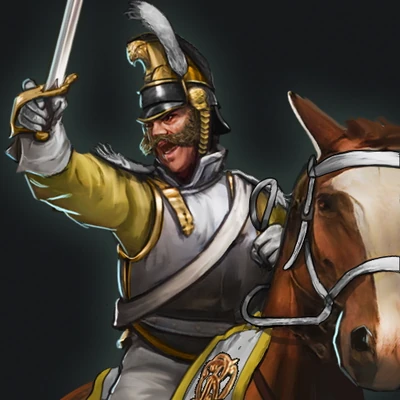
Recorded values
- Available
- Fortress Age · Trading Post or Tambo on a House of Wettin palace; Native Embassy
- Training
- 60 sec · 30 XP per train
- Durability & mobility
- 425 hit points · 20% ranged resistance · 6.25 speed · 15 line of sight
- Hand attack
- 25 damage · 1.5 attack interval
- Siege attack
- 25 damage · 6 range · 3.0 attack interval
- Trample attack
- 17 damage · 2.0 attack interval
Role, availability & values
The unit is available from the Fortress Age through a House of Wettin palace or Native Embassy. Its profile lists 425 hit points and 6.25 speed, with hand, siege and trample attacks; its Food and Wood cost differs from Coin-heavy mercenary cavalry.
Matchup & timing
Use it as a durable mounted force when the House of Wettin roster suits the army. Its slower movement makes scouting and timing important; keep it away from prepared anti-cavalry lines and use support to cover targets it cannot reach safely.
Fortress Age native cavalry
The Saxon Cuirassier is a Fortress Age Heavy Cavalry native warrior added in Knights of the Mediterranean. It costs 150 Food and 150 Wood, trains in 60 seconds and has a cap of seven per House of Wettin palace. It has 425 hit points, 20% ranged resistance, speed 6.25 and line of sight 15. A Trading Post or Tambo on a House of Wettin palace provides access, and an eligible Native Embassy can also train it. Like the French Cuirassier, it is a melee-only cavalry unit with area damage. The wood cost and lack of population use under standard native rules distinguish it from its French counterpart.
Area damage and army role
The Cuirassier’s melee attack can damage several nearby units, which makes it useful against groups of Light Infantry and Artillery. Its high hit points help it absorb ranged fire while closing, but Heavy Infantry and Light Ranged Cavalry remain dangerous counters. Pair Saxon Cuirassiers with Skirmishers to handle Heavy Infantry, or with Hussars and other Cavalry to reach Artillery more safely. Do not send the limited group into a mass of anti-Cavalry units simply because it has a large health pool. Its seven-per-palace limit makes each battle a choice about when area damage is worth risking.
Increase the native cap
A House of Wettin palace controls the standard seven-unit limit. A second Trading Post at another House of Wettin palace adds another production pool, and the Native Alliance Home City card can also raise access. This creates a map-dependent way to field more Cuirassiers without changing their per-site rules. Protect each Trading Post or Tambo, since losing the settlement can stop replacements. Native upgrades such as Legendary Native Warriors or Exalted Natives can improve the unit, with research locations determined by civilization. The combination of a hard cap and upgrade costs means the player should secure the alliance before committing to a large long-term plan.
German variant
Germans can train Saxon Cuirassiers from the Royal Embassy after sending Prince-Electors and choosing House of Wettin as an ally. This special route also allows Trabants. In that configuration, Cuirassiers use three population, have a limit of fourteen and can reach Royal Guard level. These rules differ from the ordinary no-population native version with a seven-per-palace cap. When comparing an army composition, check whether it uses the standard alliance or the German card and ally package before calculating population and production.
Balance access and replacement time
A 60-second train time is slow compared with many frontline units, and Wood plus Food competes with economic buildings and military production. Use a small number to add an area-damage cavalry flank, then preserve the group rather than repeatedly replacing it. Its speed 6.25 helps it reposition but does not make it as fast as light Cavalry. If the opponent fields Heavy Infantry or Light Ranged Cavalry, build counters before expanding the Cuirassier queue.
Compare with the French Cuirassier
The Saxon shares the French Cuirassier’s broad idea: heavy melee Cavalry with area damage and a large hit-point pool. It gives up ordinary population use under the standard native profile and replaces Coin with Wood in its cost, but imposes a small per-palace cap and slower replacement. The French unit can generally be massed through a Stable, while the Saxon force depends on House of Wettin access. This makes the Saxon a useful complement to an army rather than a direct replacement for an unlimited French cavalry queue.
Use area damage against groups
The Saxon Cuirassier’s splash is most valuable when Light Infantry or Artillery is tightly packed. Approach with a screen so the heavy cavalry can reach the target without being surrounded by Heavy Infantry or Light Ranged Cavalry. If the enemy spreads out, the area damage contributes less; focus a valuable ranged target or retreat until the formation bunches again. Skirmishers can help remove Heavy Infantry while the Cuirassiers pressure softer units. The unit has no ranged attack, so it cannot safely contribute while waiting behind the front.
Production and upgrades
The standard Trading Post or Tambo route uses Food and Wood, and the unit does not consume population. Its House of Wettin limit is seven; Native Alliance or an additional palace settlement can increase the available total. Native upgrades can improve the unit, but research buildings vary between European, American, Asian and Native American civilizations. Germans have a distinct Royal Embassy route after Prince-Electors and the House of Wettin alliance, with population and limit rules different from the native version. Keep those configurations separate when deciding whether the Cuirassier fits a population-limited late army.
Counterplay
Heavy Infantry and Light Ranged Cavalry are dangerous because they can exploit the Saxon’s melee-only approach. Use terrain and a supporting screen to prevent those units from reaching the Cuirassiers first. Artillery is one of the Saxon’s attractive targets, but artillery can be guarded by Pikemen or Skirmishers; send the cavalry only when the path is open. A limited force should avoid prolonged attrition. Heal or withdraw injured Cuirassiers and use another unit type to hold a position that would otherwise cost the entire capped group.
Deployment and cap management
Because the unit cannot be massed quickly, treat the Saxon Cuirassier as a planned flank group. Build to the limit only when the House of Wettin site can be defended and the army has the supporting Skirmishers or Hussars it needs. If Heavy Infantry arrives, disengage and let the ranged support handle it before the Cuirassiers return. In the German Royal Embassy variant, the fourteen-unit limit and three population cost change the calculation; reserve population before starting that queue.
Know which version you are using
The German Royal Embassy Cuirassier has a fourteen-unit limit and uses population; the standard House of Wettin native warrior is capped at seven per palace and does not use population. Those two access routes have different army costs.
House of Wettin heavy Cavalry
The Saxon Cuirassier is a Fortress Age Native heavy Cavalry unit tied to a House of Wettin palace. It costs 150 Food and 150 Wood, trains in 60 seconds and is limited to seven per palace. Its 425 hit points, 20% ranged resistance and speed 6.25 make it durable, while its 25-damage hand attack fires every 1.5 seconds and affects an area of two. A 17-damage Trample attack affects an area of four, and the Siege attack deals 25 damage. This gives the unit a strong role against clustered formations and buildings, but its long queue and settlement cap make replacement slow. It is recruited from a Trading Post or Tambo on the Wettin palace, or from a Native Embassy where available, rather than an ordinary Stable.
Commit only when the area attack can matter
Saxon Cuirassiers are most valuable when they can reach a group of units or break through to a defended structure. Use an Infantry screen to control anti-Cavalry threats and avoid letting ranged units kite the slow group across the map. The Trample attack’s wider area rewards engaging a compact enemy formation, but does not remove the need to select the right target. Seven units per palace is a meaningful limit, and a 60-second training time prevents rapid replacement after a failed charge. Preserve them when an opponent is retreating toward a prepared counter. The Food-and-Wood cost also competes with economy and construction, so plan the shipment or resource transition before starting production. Their House of Wettin access should not be confused with other German Native palace units; each alliance has its own cap and combat role.