Siege Elephant
Siege Elephant is Indian mobile artillery available from the Fortress Age through an Indian Castle or an Agra Fort with the Red Fort upgrade. It brings a long-range bombard attack on a durable but population-intensive platform.
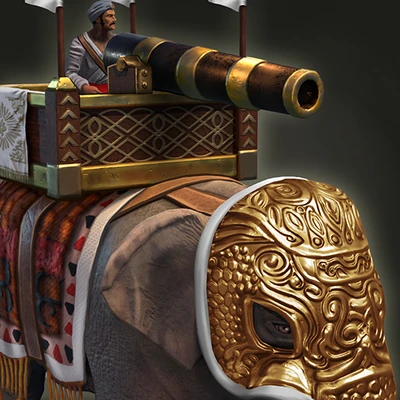
Recorded values
- Available
- Fortress Age · Indian Castle; Agra Fort (with the Red Fort upgrade)
- Training
- 45 sec · 7 population · 65 XP per train
- Durability & mobility
- 700 hit points · 35% ranged resistance · 4.0 speed · 34 line of sight
Role, availability & values
The Siege Elephant has 700 hit points, 35% ranged resistance and a seven-population cost in its recorded profile. Its attack reaches 28 range and deals siege damage to structures; it is slower and more expensive in population than ordinary frontline units.
Matchup & timing
Use it to pressure fortifications from behind the army and protect it from cavalry or other units that can reach it. Reserve population for a screen and support force before adding the Elephant to the army.
Fortress Age artillery elephant
The Siege Elephant is an Indian Fortress Age artillery unit in The Asian Dynasties and Definitive Edition. It costs 300 Wood and 350 Coin, takes 45 seconds to train, uses seven population and has 700 hit points. It moves at speed 4.0, has line of sight 34 and 35% ranged resistance in the current profile. Indians train it at a Castle; an Agra Fort can also produce it after the Red Fort upgrade. Its cannon attack reaches 28 and reloads every six seconds, with a ten-times multiplier against buildings, eight times against ships and 2.5 times against Artillery. The elephant frame gives it far more durability than ordinary cannons.
Mobile siege without setup
Unlike many artillery units, the Siege Elephant does not need to stop and deploy before firing. It can move with the army, attack a structure and retreat without the setup delay that makes ordinary cannons vulnerable during repositioning. Its range 28 allows it to pressure buildings and ships from a distance, while a 1.25× bonus against walls applies in the current profile. This mobility makes it useful for a fast siege push or a sudden strike against a coastal target. It remains slow compared with Cavalry and carries a seven-population cost, so bring only as many as the army can protect.
What counters it
The Siege Elephant has Light Ranged Cavalry tags as well as Artillery tags. Skirmishers, Abus Gunners, Fusiliers and other ranged counters can exploit the cavalry classification; Culverins and similar artillery hunters threaten it as an artillery piece. Melee Cavalry is also dangerous, including units with strong multipliers such as Meteor Hammers or Kanya Horsemen. Its cannon deals only half damage to Cavalry and shock troops, so it should not be used as the main answer to a charge. Pikemen are less effective than their normal anti-Cavalry role suggests because the elephant lacks the standard Cavalry tag. Keep dedicated counters nearby and avoid letting melee units surround it.
Targets and attack efficiency
The cannon is most effective against buildings, ships and enemy Artillery. Ten-times building damage and eight-times ship damage make it a strong objective unit, while its 2.5× Artillery multiplier helps remove opposing guns. The one-radius area effect offers some value against clustered targets, but its six-second reload means every shot matters. It deals half damage against Cavalry, shock troops and Fixed Guns, so retarget if those units become the main threat. For a fortified push, let Infantry and Cavalry protect the elephant while it fires at the structure; do not leave it standing alone as a general-purpose tank.
Indian production and support
The Castle and upgraded Agra Fort production routes give Indians a way to make Siege Elephants without using a standard Artillery Foundry. The Agra route requires the Red Fort upgrade, so include that requirement in the timing plan. Brahmins can provide support and the Terror Charge aura can help the elephant move faster while retreating or repositioning. The unit is expensive in both Wood and Coin, so balance its queue against Settlers, upgrades and the rest of the army. A protected Siege Elephant can decide a structure fight; several unsupported elephants can consume population while an opponent’s counters remain untouched.
Use it as a siege platform
The Elephant carries its cannon with it, so it can attack while advancing and reposition without waiting for a deployed state. This lets the Indian player threaten buildings from a moving army, or turn toward ships and enemy guns as the battle changes. The range of 28 and area radius one reward firing from a protected position with a clear line to the target. A 45-second training time and seven population still make the unit a costly commitment. One protected elephant can support an assault; too many can crowd out the Infantry needed to protect it.
Classification explains unusual counters
The Siege Elephant is tagged as both Light Ranged Cavalry and Artillery. Those classifications explain why Skirmishers, Abus Gunners, Fusiliers and archers can threaten it as light cavalry, while Culverins and ranged Cavalry can counter its artillery role. Conversely, Axe Riders are less effective until Battle Anger is researched, because the elephant does not carry the ordinary Heavy Cavalry classification. Pikemen also lack their usual strong multiplier against it. Read the tags rather than assuming that every anti-Cavalry unit works equally well.
Version and upgrade notes
The Siege Elephant’s Coin cost was 400 before Definitive Edition, and its ranged resistance was 30% before update 15.59076. Its line of sight increased from 29 to 34 in Definitive Edition, and the Artillery classification was added with patch 15.30007. These changes affect how older guides describe its price, durability and counters. The current profile’s 350 Coin, 35% ranged resistance and range of sight 34 should be used for Definitive Edition planning. The Red Fort upgrade is also required before the Agra Fort becomes a production route.
Support it during a structure push
The elephant’s high hit points and ranged resistance help it survive some fire, but its seven population leaves fewer slots for screening units. Advance with a force that can intercept melee Cavalry and artillery hunters while the cannon focuses a building or ship.
Retreat before the cavalry closes
The Elephant’s speed 4.0 is better than a deployed cannon but cannot outrun all melee Cavalry. Use its firing mobility to begin the retreat early and let friendly units intercept pursuers; the cannon itself deals reduced damage to Cavalry and shock troops.
Watch the population cost
Seven population per Elephant makes the unit a major army investment. Add enough screening Infantry and anti-Cavalry support to protect the cannon rather than filling the population cap with unsupported siege platforms.
Choose the Red Fort route
Agra Fort production is available only after its Red Fort upgrade. If you need an Elephant sooner, plan around the Indian Castle rather than assuming the Wonder’s default production menu includes it.
Indian elephant built for siege pressure
The Siege Elephant is an Indian heavy unit designed to bring substantial damage against buildings while remaining mobile enough to accompany an army. Its elephant platform gives it durability and battlefield presence, but its siege role makes it a poor substitute for units that counter infantry or Cavalry. Escort it with troops that can keep anti-Cavalry units away, then focus on a structure whose loss will disrupt production or map control.
Protect the expensive siege investment
Siege Elephants require a significant investment and population space, so avoid sending them ahead of the army or into a defended base without support. Ranged counters, anti-Cavalry units and concentrated fire can punish them before they deal enough damage. Use them after the opponent’s screen is occupied, and keep ranged units or infantry nearby to respond to a flank. Check the Indian unit profile for the selected version’s cost, attack and access before committing to repeated production.