Napoleon Bonaparte
Napoleon Bonaparte is the French skirmish AI personality in Age of Empires III. His profile favors aggressive play and can combine cavalry with artillery as the match advances. It is an opponent behavior guide for computer games rather than a separate campaign protagonist or civilization.
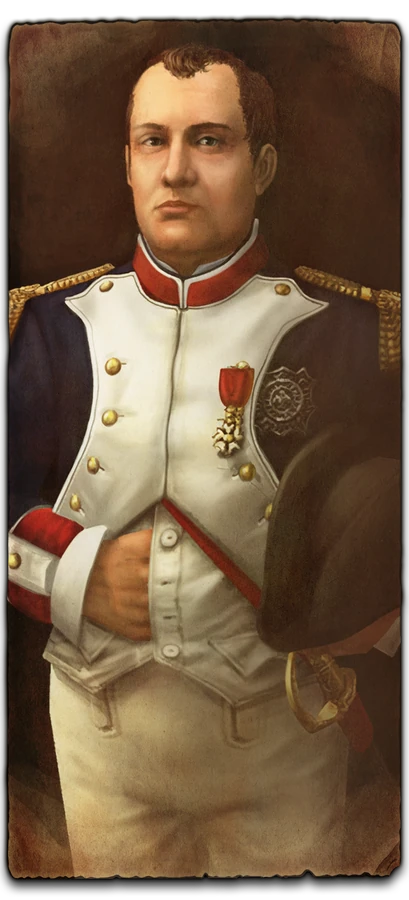
AI identity & army profile
The French army may start with early infantry and later add Hussars, Cuirassiers and Falconets. Crossbowmen can appear as ranged infantry, and Outposts may support defensive positions. The exact timing and mix depend on the match, so the listed tendencies are a scouting aid rather than a fixed build order.
How to prepare
Watch for the transition from early infantry into cavalry and artillery. Keep anti-cavalry units near vulnerable artillery and workers, then use ranged or siege pressure to challenge Outposts and production. A prepared defense should cover the route of attack without allowing the AI to raid an undefended side.
AI personality and military direction
Napoleon Bonaparte is the French AI personality in Age of Empires III. The game presents him as confident, ambitious and strongly offensive. His armies favor direct attacks built around Cavalry and Artillery rather than a purely defensive posture. He uses Outposts to secure territory and can research Fortified Outposts, although he usually leaves them at a basic defensive level. As a French opponent, he benefits from the Coureur des Bois economy, which gathers quickly and supports a strong production cycle. Players should expect him to turn an economic lead into pressure rather than wait passively behind walls. His willingness to claim native settlements can also add Native warriors to the army, while The WarChiefs installation allows him to field some Mercenaries.
Typical army development
In the early Ages, Napoleon begins with archaic Infantry. As the match advances, he increasingly relies on Hussars, Cuirassiers and Falconets. He may use Crossbowmen as ranged Infantry even though the French can field Royal Guard Skirmishers. This choice leaves his army vulnerable to units that counter Cavalry, especially well-supported anti-Cavalry Infantry and Artillery. The Cuirassier and Falconet combination is dangerous when allowed to reach the player’s base, so scout his production and prepare a unit mix that attacks both components. Anti-Cavalry Infantry can stop the mounted force, while Culverins or other Artillery counters remove the guns. Do not answer his Cavalry with only Skirmishers or his Falconets with only Infantry; his mixed army is designed to punish a one-type response.
Economic strengths and map control
Napoleon’s economy is described as particularly strong because the French Coureur des Bois gather quickly and are more resilient than ordinary Settlers. This helps him field well-upgraded armies and recover after losses. He actively looks for Native settlements; after securing a first site, he often trains groups of Native warriors to supplement his core army. This behavior resembles Queen Elizabeth’s native recruitment, although Napoleon uses fewer Mercenaries when The WarChiefs is installed. Denying a key Trading Post or disrupting the Coureurs can delay this expansion, but direct raids must account for his Outposts and Cavalry response. Protect your own map control, contest valuable Native sites and avoid allowing him to accumulate both a strong economy and additional native production.
Diplomacy and ally behavior
In team or treaty interactions, Napoleon is portrayed as a proud ally who wants to control the plan. He may hesitate to cooperate with the British and reacts poorly to being directed by another player. His dialogue often frames requests and battlefield decisions in terms of campaigns, strategy and the French nation. He can request or offer Food, Wood and Coin, comment when an ally advances faster, responds to Trading Posts and Treasures, and reports when his Explorer is incapacitated or rescued. These lines are personality flavor; they do not change unit statistics. The practical implication is that ally coordination should use clear, simple plans rather than assuming his AI will follow every instruction reliably.
Countering Napoleon in a skirmish
Scout for Falconet production and the approach of Hussars or Cuirassiers. Keep anti-Cavalry units near the back line and use Culverins or equivalent Artillery to remove his guns. If he builds Outposts, avoid sending single units into their range and choose a flank where his defenses are thin. His use of Crossbowmen can be punished by Skirmishers or Cavalry, but watch for a switch into Royal Guard Skirmishers or native support. Because his French economy can sustain pressure, a successful early defense should be followed by a counterattack on exposed Coureurs, Trading Posts or Native settlements. Simply trading units near his base may favor his faster economy.
Voice and historical framing
Napoleon is voiced as a military leader who frequently references campaigns, strategy and the scale of his ambitions. His remarks appear when an ally asks for resources, when either side finds Treasures, when his Explorer is lost or restored, and when the player advances or changes a plan. He tends to present agreement as a tactical decision and resource exchanges as support for a campaign. The character profile combines this confident tone with the AI’s offensive unit choices. His historical identity as First Consul and Emperor is part of the personality entry, while the tactical behavior described here concerns the in-game AI and does not represent a playable French unit or technology.
How his dialogue reflects the AI
Napoleon’s ally dialogue covers the same practical events as other AI personalities but presents them through a military-campaign voice. At the start of a match he may refer to the outcome of a previous game or praise a capable ally; when requesting resources he frames Food as supplies for an army and Wood as material for an empire. He acknowledges receiving or sending Food, Wood and Coin, and may decline requests when his stock is insufficient. If the player advances faster, he treats the timing as a tactical advantage. These are character lines attached to game events, not special resource bonuses or diplomacy mechanics.
Map and exploration responses
Napoleon reacts to exploration and map-control events. He may allow the player to claim a Treasure near his base if he does not plan to collect it immediately, and he comments when a Food Treasure is found. When the player establishes a Native Trading Post, he recognizes the new alliance as a strategic advantage. He also reports when his Explorer is incapacitated, killed by Treasure guardians or rescued, and may say that the ally must cover more scouting until the Explorer returns. These responses reinforce his confidence and impatience while describing ordinary scenario events. They do not mean the AI’s vision, Treasure rewards or Explorer statistics have changed.
Building and attack callouts
When Napoleon constructs a Town Center, he describes the site as an annexed territory; when he builds a Fort, he frames it as a strategic base that will trouble the enemy. His attack announcements often identify a target area, claim that the timing is right or promise that capturing a base will unravel the opponent’s position. He may agree to a strategy with brief approval or a promise to comply. This dialogue gives the AI an assertive, directive tone. In gameplay, however, the player should evaluate the actual army and map rather than treating a line as a prediction of the next attack.
Adapting to the French AI’s choices
Because Napoleon may favor Crossbowmen despite having Royal Guard Skirmishers, scout his actual production instead of assuming an ideal French composition. His late army commonly includes Hussars, Cuirassiers and Falconets; anti-Cavalry Infantry and Artillery counters are reliable responses. If he builds Outposts near the frontier, attack the economy from another direction or bring siege under protection rather than walking into a defended area. He seeks Native settlements, so contesting them can reduce additional warrior support. The Coureur des Bois economy can recover quickly, so use a successful battle to pressure workers and map control rather than pausing after one defense.
Historical identity and in-game role
Napoleon Bonaparte lived from 1769 to 1821 and is identified in the entry as the French AI personality in Age of Empires III. The article distinguishes the historical First Consul and Emperor from the character used in skirmish and team play. He is voiced by André Sogliuzzo and appears through an avatar and history portrait. His personality combines confidence in French military strength with a preference for taking territory and launching attacks. The game’s portrayal is reflected in his army composition and dialogue, but does not make him a player-controlled hero or grant a unique unit ability.
Requests, gifts and setbacks
Napoleon’s dialogue also reacts to resource exchanges. He can ask for Food, Wood or Coin, offer resources to an ally, thank the player for a shipment or explain that he cannot help when supplies are low. If the player gathers a Treasure near his base, he may concede it; if an Explorer is lost or rescued, he reports the setback or return. These interactions make the AI feel like a campaign-minded ally, while the underlying diplomacy and resource rules remain standard.
Attacking frontier defenses
Napoleon’s frontier Outposts can slow a direct push and give his Cavalry time to respond. Use scouts to identify whether the structure is fortified, then attack from a different approach or bring protected siege. His preference for offensive play can leave another side of the map exposed; raid Coureurs or Native settlements while the main army occupies his attention.
Using the personality page
The entry is useful for anticipating the French AI’s broad tendencies, not for predicting every build. Difficulty, map layout, installed expansion and scenario rules can change what units Napoleon actually fields. Scout his current production and treat the descriptions above as behavioral patterns rather than fixed scripting.
French AI personality and in-game behavior
Napoleon Bonaparte is the French AI personality in Age of Empires III and is voiced by André Sogliuzzo. The character is confident and frequently refers to military campaigns. In gameplay, the French AI favors a direct strategy built around artillery and Cavalry. This is a tendency rather than a guaranteed script: difficulty, map resources and the opponent’s actions can change the units it fields. Scout its production and army instead of assuming that every match will follow the same attack timing.
Prepare for artillery and mobile pressure
A French force combining artillery and Cavalry can threaten both a defensive line and the units protecting it. Keep anti-Cavalry units near guns, use mobile troops to reach enemy artillery and avoid clumping where a cannon can hit several units. If Napoleon is an ally, coordinate around a clear objective and support his guns with a front line; if he is an opponent, pressure resource access and production before the artillery mass becomes difficult to dislodge. His historical identity supplies character, while match tactics depend on the AI’s visible choices.