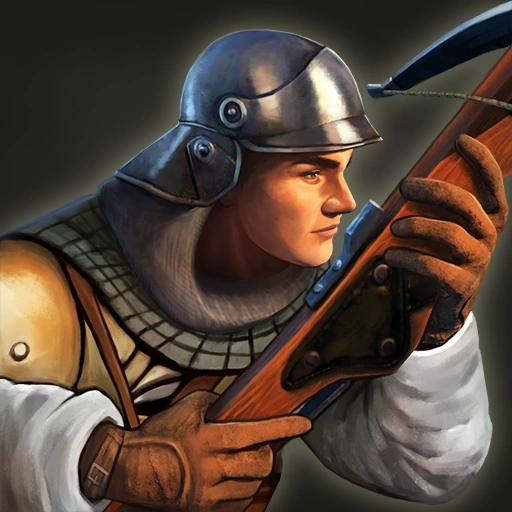
Crossbowman
The Crossbowman is inexpensive archaic ranged Infantry available to many European civilizations. Its bolt attack gives an early army a way to damage Infantry from a distance before more specialized units arrive.
Recorded values
- Available
- Commerce Age · European Barracks; Fort; Galleon; American Citadel
- Training
- 27 sec · 1 population · 8 XP per train
- Durability & mobility
- 100 hit points · 20% ranged resistance · 4.0 speed · 20 line of sight
- Ranged attack
- 16 base damage · range 2-16 · attack interval 3.0 · bonus damage: 2.5x vs. Light ranged cavalry; 2.5x vs. Ranged shock trooper; 1.25x vs. Heavy infantry; 0.6x vs. Cavalry; 0.6x vs. Shock troops
- Siege attack
- 8 base damage · range 6 · attack interval 3.0
- Hand attack
- 7 base damage · attack interval 1.5 · bonus damage: 2.0x vs. Light ranged cavalry; 2.0x vs. Ranged shock trooper; 1.25x vs. Heavy infantry; 0.75x vs. Cavalry; 0.75x vs. Shock troops
- Ranged siege attack
- 10 base damage · range 18 · attack interval 3.0 · requires Steel Bolts card
Role & counters
Crossbowmen are effective against Heavy Infantry but vulnerable to Cavalry and artillery. Their siege capability is limited, and they should not be expected to hold the frontline without melee protection. Civilization access, upgrades and transition timing vary.
When to field it
Use Crossbowmen for early pressure or as a low-cost answer to enemy Heavy Infantry. Add anti-cavalry troops when mounted units appear, and transition into stronger units or upgrades as the game advances. Keep them behind the frontline and avoid fighting artillery at its preferred range.
Availability and early timing
Crossbowmen are Commerce Age ranged infantry trained at European Barracks, Forts, or Galleons. The standard unit is available to Danes, French, Germans, Maltese, Poles, Portuguese, Spanish, and Swedes. That roster is distinct from civilizations with replacement archers or skirmishers. Early access is a major advantage: they can form a ranged line before Fortress Age Skirmishers become available to most European civilizations. Dutch access to Commerce Age Skirmishers and the French TEAM House of Bonaparte card are important exceptions to that timing comparison. Always check the chosen civilization’s roster and cards before assuming the standard Crossbowman is available.
Cost, durability, and basic attack
A standard Crossbowman costs 40 Food and 40 Wood, takes 27 seconds to train, and uses one population. Its base profile is 100 hit points, 20% ranged resistance, 4.0 movement speed, and 20 line of sight. The ranged attack deals 16 damage at range 2–16 every three seconds. Its hand attack is seven damage and its ordinary siege attack is eight damage at range six. This is an inexpensive early ranged unit, but its relatively short range and low durability mean it needs a protected firing line and should not be sent alone toward an enemy army.
Targets and damage multipliers
The ranged attack is specialized: it has 2.5 damage against Light Ranged Cavalry and Ranged Shock Troops, 1.25 against Heavy Infantry, and reduced 0.6 damage against Cavalry and Shock Troops in the current profile. The hand attack also has class multipliers, including 2.0 against Light Ranged Cavalry and Ranged Shock Troops and 1.25 against Heavy Infantry. Earlier balance updates used different values, so use the current Definitive Edition profile when planning present-day matches. These modifiers make the unit suitable against selected infantry targets, not a universal answer to cavalry or every infantry class.
How its range compares with Skirmishers
Crossbowmen are similar to Skirmishers as ranged infantry that pressure infantry, but they are available earlier and cost less. The standard Crossbowman’s range is 16, shorter than the Skirmisher’s 20, and its base attack and upgrade path differ. In exchange, the player can field the unit in Commerce Age and preserve resources for other plans. The Dutch can train Skirmishers in Commerce Age, and French teams may access them through TEAM House of Bonaparte, so those matchups do not follow the usual timing advantage. Treat Crossbowmen and Skirmishers as related roles with different timing and values, not interchangeable names.
Use range against slow non-ranged units
The Crossbowman performs best against slow units that cannot return ranged fire immediately. The early volley can weaken Heavy Infantry while it advances, especially when the Crossbowmen have a screen or a retreat route. Their four movement speed helps reposition, but does not make them safe from heavy cavalry. Keep the formation behind tougher units, focus fire on dangerous targets, and withdraw before the opponent reaches hand range. A Crossbowman line that is forced to fight in melee loses the benefit of its ranged attack and modest durability.
Vulnerabilities and army support
Heavy Cavalry and artillery are the principal threats. Cavalry can close the distance and exploit the Crossbowman’s reduced damage multipliers, while artillery can hit the low-hit-point formation from beyond its effective response. Add a dedicated anti-cavalry unit and mobile pressure against artillery. If the opponent fields only slow infantry, Crossbowmen can trade efficiently; if the enemy changes into cavalry or guns, continuing to mass them becomes a poor use of Food and Wood. The army composition should change with the opponent rather than rely on the Crossbowman’s early strength throughout the match.
Siege attack and the Maltese Steel Bolts card
The standard siege attack deals eight damage at range six. Maltese can send the Steel Bolts Home City Card, which replaces that attack with a ranged siege attack of ten damage at range 18 every three seconds. This allows the Maltese variant to contribute to structure pressure from farther away, changing the unit’s tactical use. The card is civilization-specific; other Crossbowmen should not be assumed to have the same attack. Protect the unit while it attacks buildings, since a longer siege range does not remove its vulnerability to cavalry or artillery.
Veteran and later upgrade paths
Veteran Crossbowmen is the Commerce Age upgrade for the listed civilizations, costing 200 Wood and 200 Coin and increasing hit points and damage by 20%. Later paths depend on the civilization and often require Veteran first. French, German, and Spanish players can access Guard Crossbowmen after Veteran and the Papal Guard; the Guard upgrade costs 600 Wood and 600 Coin and adds 30% hit points and damage. These upgrades extend the unit’s usefulness, but require resources that could otherwise fund new troops. Research when a substantial Crossbowman mass is already active or will be produced soon.
Civilization-specific elite upgrades
Several civilizations have their own later upgrade instead of one universal Guard form. Danes can research Royal Crossbowmen after Veteran, gaining the Guard profile plus 10% more hit points and damage and 15% hand resistance. Maltese Arbalesters add one range and a civilization-specific hit-point and damage improvement. Portuguese Order Besteiros gain a Guard-style upgrade with increased hit points and damage. These routes have different costs and card or age conditions, so do not apply one civilization’s upgrade values to another. The exact upgrade name also changed for Portuguese Besteiros in later versions.
Polish Leičiai conversion
Poles can use the Leičiai Home City Card to unlock Leičiai Crossbowmen after Veteran. The upgrade costs 300 Wood and 300 Coin and adds 10% hit points, two line of sight, one ranged attack range, 20% siege resistance, and a ranged siege attack. It changes the unit’s durability and structure-pressure options, giving a Polish player reasons to preserve the Crossbowman line beyond its ordinary early role. The card requirement and separate upgrade mean this benefit is not part of the generic unit profile.
Imperial upgrades and ceiling
Imperial Crossbowmen generally require the relevant Guard upgrade and, for French, German, and Spanish routes, The Papal Guard. The Imperial research costs 1,500 Wood and 1,500 Coin and increases hit points and damage by 50%. Danish, Maltese, Polish, and Portuguese variants follow their own preceding upgrade. Swedes are the exception noted in the source: they cannot upgrade Crossbowmen beyond Veteran, even with The Papal Guard. This civilization-specific ceiling affects whether early Crossbowmen remain a sound late-game investment.
Portuguese and German transformations
Older Portuguese versions used Besteiros, which received a Veteran-style improvement and additional hit points and damage. Definitive Edition instead includes Portuguese-specific Order Besteiros and Ordenança, which can convert existing Crossbowmen into Ordinance Riflemen and change later production at Barracks, Forts, and Galleons. Germans can use Scharnhorst Reform to convert all Crossbowmen into Landwehrs and grant the corresponding Guard and Imperial upgrades. These transformations can preserve an existing army investment, but they change its unit role and depend on the card and release. Read the current version’s entry before combining these systems.
Spanish training tempo
Spanish cards can create an unusually fast Crossbowman and Pikeman production window. TEAM Hidalgos and Liberation March can reduce training time so the two units train in 6.75 seconds; combining the cards with Standing Army can make the training instant under the recorded interaction. The Spanish can use this to create a rapid early response or mass, but the cards and improvement occupy deck or resource capacity. The production timing is most useful when the player can afford the units and has room for them; rapid training does not solve the need for counters or a safe frontline.
Shipment and age-up access
Choosing The Adventurer while the Spanish or Maltese advances to Fortress Age supplies eight Crossbowmen. This gives an immediate ranged group without waiting for each unit to train, and can complement an existing army. The shipment’s value depends on whether the player can preserve the group and continue production or upgrades afterward. Keep population capacity available for the eight units and avoid sending them into a matchup where cavalry or artillery can remove them before the player establishes support.
Practical production and matchup plan
Use early Crossbowmen to pressure slow infantry and protect a growing army, while reserving Wood for the unit and Food for workers or other troops. Add a cavalry counter before the opponent’s heavy cavalry reaches the backline. If artillery arrives, pressure it with mobile units and reposition the Crossbowmen instead of accepting a volley. Upgrade only after enough units exist to benefit, and check the civilization’s Guard, Royal Guard, conversion, and Imperial options. Their early availability and low cost are strengths; their 16 range, limited hit points, and narrow target bonuses define the limits.
Research conditions and resource sequencing
The Veteran upgrade’s 200 Wood and 200 Coin cost competes with further unit production, Houses, and age advancement. Later Guard paths can cost substantially more and may depend on The Papal Guard, a Home City Card, or a specific civilization. Decide whether the existing force is large enough to justify those upgrades before researching them. An upgrade applied to two surviving Crossbowmen has less immediate value than a fresh unit batch, while a large mass can gain substantial durability and damage from the same investment.
Keep the firing line from being surrounded
The unit’s range of 16 is long enough to pressure slow infantry, but short enough that enemy artillery or a longer-ranged Skirmisher can threaten it from outside its comfortable position. Place Crossbowmen behind a screen and avoid narrow terrain where cavalry can wrap around both sides. If the opponent approaches from multiple directions, retreat toward a protected line instead of splitting the group into isolated pockets. A concentrated ranged volley is most valuable when the army can maintain a clear target and withdraw together.
Changes across releases
The entry spans the original game, expansions, and Definitive Edition. Unit tags, damage multipliers, Portuguese names, and specific upgrade costs have changed over time. The current profile uses the current Crossbowman values, while older figures are called out when they differ. A historical unit name such as Besteiro or Ordinance Besteiro should be read in its release context; it is not a separate universal unit available to every civilization in current play.
Choosing between more units and an upgrade
When the Crossbowman line is doing useful damage and the opponent has no immediate counter, a Veteran or civilization-specific upgrade can preserve the force. If cavalry or artillery is already on the field, new Crossbowmen alone may be lost quickly; use resources for screening units or a response that can reach the threat. If the opponent has shifted away from infantry, stop investing in the counter and transition production. This keeps the unit’s inexpensive early access from turning into a sunk-cost commitment.
Link production to the next counter
Train Crossbowmen to answer the current opposing unit mix, then keep observing for cavalry or artillery. A protected ranged line is a responsive support force, not a permanent army template.
Commerce Age archaic ranged Infantry
The Crossbowman is an archaic ranged Infantry unit available to most European civilizations in the Commerce Age. It costs 40 Food and 40 Wood, takes 27 seconds to train and uses one population. It has 100 hit points, 20% ranged resistance, speed four and sight 20. The ranged attack deals 16 damage at range 2–16 every three seconds, with bonuses against Light ranged Cavalry and Ranged Shock troops and a smaller bonus against Heavy Infantry. The attack deals reduced damage to Cavalry and Shock troops. Its low resource cost makes it a practical early ranged line, but its role becomes less favorable as the opponent fields heavier units, artillery or upgraded gunpowder Infantry.
Steel Bolts and later upgrade choices
The Steel Bolts Home City Card replaces the Crossbowman’s ordinary Siege attack with a ranged Siege attack, allowing it to pressure structures from range 18. This is a card-dependent ability and should be included in the deck before relying on it. The normal eight-damage Siege attack is short-ranged, so use it only when the army controls the area. Crossbowmen work best behind Pikemen or other Infantry that prevent Cavalry from closing; their own reduced Cavalry damage makes them a poor answer to a mounted charge. Production at Forts and eligible ships can support a forward position or water map, while Barracks offer the standard land queue. Add them when their target bonuses fit the early matchup and transition as the enemy army changes.