War Elephant
War Elephant is Heavy cavalry in Age of Empires III, available from the Commerce Age; obtained through Trading Post or Tambo on a Bhakti Temple holy site, Native Embassy.
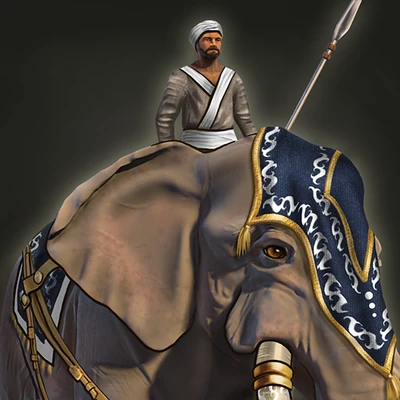
Recorded values
- Available
- Commerce Age · Trading Post or Tambo on a Bhakti Temple holy site; Native Embassy
- Training
- 40 sec · 28 XP per train
- Durability & mobility
- 425 hit points · 30% ranged resistance · 6.0 speed · 15 line of sight
- Hand attack
- 20 damage · 1.5 attack interval · bonuses: 1.75x vs. Infantry; 0.57x vs. Heavy infantry
- Siege attack
- 36 damage · 3.0 attack interval
- Trample attack
- 20 damage · 2.0 attack interval · bonuses: Same as hand attack
Role, availability & values
Production is available through Trading Post or Tambo on a Bhakti Temple holy site or Native Embassy. It has 425 hit points and 30% ranged resistance. It moves at 6.0 speed. Training costs 200 Food and 80 Wood; it takes 40 seconds to train. Attack profile: Hand attack deals 20 damage. Siege attack deals 36 damage. Trample attack deals 20 damage. Hand attack bonuses: 1.75× against Infantry and 0.57× against Heavy infantry.
Matchup & timing
Hand attack is especially effective against Infantry (1.75×). Its reduced multipliers against Heavy infantry (0.57×) make it less suitable for those targets. Hold the melee attack for Infantry when they enter contact. Keep a frontline between this unit and threats that can reach it safely.
Statistics and native access
The War Elephant is a Commerce Age Native warrior from The Asian Dynasties. It costs 200 Food and 80 Wood, trains in 40 seconds and has a local limit of eight per Bhakti Temple in Definitive Edition; the earlier limit was seven. It has 425 hit points, 30 percent ranged resistance, speed 6 and sight 15. Its attack has a two-unit area: the normal melee strike deals 20 damage every 1.5 seconds and has 1.75 times damage against Infantry, but only 0.57 times against Heavy Infantry. Before Definitive Edition those multipliers were 1.5 and 0.67. The trample attack deals 20 damage over an area of three every two seconds, and the siege attack deals 36 damage every three seconds. The elephant uses no population as a Native warrior, but its Food-Wood price and low settlement cap limit the force. Train it at a Trading Post or Tambo built on a Bhakti Temple site; before update 13.12327 the holy site was called a Sufi Mosque. Native shipments and Home City cards can provide additional access. The large hit point pool and area damage make the unit a durable close-combat threat, but the lack of a ranged attack means it must physically reach its targets.
Choose fights that reward splash damage
War Elephants are strongest when they can engage clustered Infantry or Artillery. Their area melee and trample attacks punish units packed together, and the 36-point siege attack lets them damage buildings while advancing. Heavy Infantry is a poor target because the normal attack is reduced to 0.57 times, and Light Ranged Cavalry, ranged Shock units and Ninjas are listed weaknesses. Keep a screen around the elephants and use ranged Infantry or other cavalry to handle their counters. They have 425 hit points and 30 percent ranged resistance, but those defensive values do not prevent a large force from focusing them down. Their speed 6 helps them close distance and rotate between targets, yet their lack of a ranged attack allows opponents to kite them if the army cannot control the field. Use terrain and a frontline to create an engagement rather than sending them alone toward a firing line. An Indian Home City can improve elephant hit points and damage, reduce cost and training time, grant a Wood trickle through Grazing, or ship six War Elephants with an infinitely repeatable card. Those cards can change the resource and replacement plan substantially.
Bhakti ranks and civilization variants
Bhakti Discipline Training costs 100 Wood and 75 Coin in Definitive Edition and adds 25 percent hit points and damage; its older cost was 200 Wood and 150 Coin. Bhakti Honor Training requires Discipline, costs 400 Wood and 300 Coin, and adds 35 percent in the current release, versus 40 percent before Definitive Edition. Update 13.12327 extended these technologies to War Elephants. The final native upgrade grants 50 percent hit points and damage for 1,500 Food and 1,500 Wood, with its research building determined by civilization. Danish Order Elephants are a Royal Guard variant with 10 percent more hit points and damage. Their Home City cards can ship four, grant Bhakti upgrades, enable Fort or Battleship training, and add reinforcements when a Danish Battleship is sunk. Indonesia can use Sumatran Elephants to receive an elephant with every shipment and unlock production at several military buildings and ships; that revolutionary version uses one population. These differences affect access, population and repeat production, and should not be applied to the standard native War Elephant. Check the selected civilization and card route before estimating how many elephants can be fielded.
A population-free heavy cavalry investment
The native War Elephant uses no population, which makes it attractive in late-game armies near the population cap. Its 200 Food and 80 Wood price still has an opportunity cost, and the eight-unit Bhakti cap prevents unlimited local production. This combination supports a compact group of durable splash attackers while leaving population for ranged Infantry or artillery. Native Warriors can also arrive through Home City cards, and Indians have an infinitely repeatable Hire 6 War Elephants shipment. Tame Elephants reduces cost and training time by ten percent, Elephant Combat adds twenty percent hit points and damage, and Grazing provides six Wood per minute. These improvements can turn the unit into a scalable part of an Indian army, but they consume deck slots and shipment timing. The Warrior should be backed by units that cover Heavy Infantry and mobile ranged counters. Do not count free population as free resources: the Food-Wood price and production time still affect the economy, and losses can be hard to replace when the local cap is full.
Order Elephant and Sumatran Elephant rules
The Danish Order Elephant is a Royal Guard version with ten percent more hit points and damage than a standard War Elephant. Order of the Elephant ships four and unlocks the Bhakti Discipline and Honor upgrades. The Elephanten card sends a Battleship carrying six Order Elephants, enables their training at Forts and Battleships, and causes four more to appear at the Home City gather point whenever a Danish Battleship is sunk. Indonesia has a separate Sumatran Elephants revolution card: it ships one War Elephant plus another with every Home City shipment, including infinite cards, and unlocks training at Stables, Forts, Native Embassies, Galleons and Wokou Junks. The revolutionary units use one population and receive both Bhakti upgrades through that card. These are powerful access exceptions and should not be used to describe the normal Bhakti settlement unit. Danish and Indonesian players can field larger forces by relying on cards and special production, while other civilizations remain limited by their own alliances, settlement caps and shipments.
Upgrade and target priorities
The Imperial native upgrade adds 50 percent hit points and damage for 1,500 Food and 1,500 Wood, and selected civilizations may have additional cavalry cards such as hit point, combat or speed improvements. Indians have elephant-specific cards; Lakota, Haudenosaunee and African civilizations can access other listed improvements when their decks and alliances allow them. A hand-attack increase strengthens melee, while Pillage improves the siege multiplier against buildings. Use the attack-type details rather than treating every upgrade as a general bonus. In battle, seek packed Infantry and exposed artillery, protect the approach from ranged Cavalry and avoid a Heavy Infantry screen. The War Elephant is an area-damage unit, not a reliable duelist against every expensive target. If it reaches an undefended building, its siege attack is useful; if the enemy still has anti-elephant counters nearby, clear those first.
Use splash attacks without losing the formation
The regular attack affects a two-unit area and Trample affects an area of three, so a close formation of enemies increases the value of each elephant. Separate units can reduce the number hit, while terrain can prevent the elephant from reaching a packed ranged line. The unit has no ranged weapon and is not meant to stand idle under fire. Coordinate its entry with the rest of the army, use its 30 percent ranged resistance and 425 hit points to absorb some pressure, then focus on Infantry or artillery. If the enemy withdraws behind Heavy Infantry, stop the pursuit and use a different unit to clear the screen. Elephant losses are expensive in Food and Wood and may be limited by the settlement cap.
Home City shipments and map strategy
The War Elephant can be trained from Bhakti access and may also arrive through Home City cards, so it can appear before a local production queue finishes. Indian cards make the unit a repeatable strategic option: Hire 6 War Elephants can be sent infinitely, while Tame Elephants and Elephant Combat alter cost, train time, hit points and damage. Native Treaties can ship one if the player has built a Trading Post or Tambo at the Bhakti site. Other cards are limited by civilization. Secure the site early if the plan relies on training, and use shipments to create a timing or replace losses when the local cap is occupied. On a map with no Bhakti settlement, card access or another civilization-specific route may be the only way to field them.
Protect the elephants from mobile counters
Light Ranged Cavalry and ranged Shock units can attack before the elephant reaches melee, while Heavy Infantry withstands its reduced attack. Pair the unit with ranged support and pursue only when the opposing screen is broken. Its area damage rewards a decisive engagement, not a slow chase.
Upgrade investment and replacement cost
Discipline and Honor improve hit points and damage, while the Imperial native upgrade adds another 50 percent. Research them when enough elephants remain to benefit and the economy can still fund Food and Wood replacements.
Use its sight to prepare the charge
The elephant has sight 15. Scout the approach and avoid entering a ranged line before the rest of the army is ready.
Do not chase ranged units alone
A screened elephant can engage clustered Infantry; an isolated one can be kited or focused by its counters.
Retreat before counters surround it
Its high hit points buy time to withdraw, but cannot replace an escort.
Use a screen against Heavy Infantry
The reduced multiplier makes that matchup costly.
Maintain the Bhakti alliance
Secure its local production site.
Support the heavy charge
Keep ranged support close.
Bhakti heavy cavalry, cap and area damage
The Bhakti War Elephant costs 200 Food and 80 Wood, trains in 40 seconds and is limited to eight per Bhakti Temple. It has 425 hit points, speed 6 and 30% ranged resistance. Its hand attack deals 20 damage every 1.5 seconds in area two, with a 1.75× multiplier against Infantry and 0.57× against Heavy Infantry. The Trample attack deals the same listed base damage in area three, so it can pressure a compact formation, but its reduced Heavy Infantry matchup remains important. At 36 Siege damage, it can also contribute against buildings when the army has created a safe opening. The native cap limits how quickly a player can replace a lost group from one site, and its high Food cost competes with Villager and Cavalry production. Preserve the elephant through the initial engagement instead of trading it for a low-value chase; its hit points and area attacks are more valuable when it remains beside a supporting army.
Keep the alliance and the supporting line alive
An elephant’s durability does not remove its need for support. Heavy Infantry that resist its target bonus can hold it in place, while mobile anti-cavalry forces can force it away from the ranged units it is trying to reach. Use the main army to clear those counters before committing the War Elephant to its charge, and keep a route open for withdrawal. The Bhakti Temple alliance also provides a limited production source, so losing control of the site can interrupt future reinforcements as well as the unit roster’s technology choices. A Native Embassy can provide an alternate production location where the civilization has access, but does not erase the strategic value of the original settlement. Decide whether the army needs the elephant’s splash pressure or another Bhakti unit’s specialized role, then invest in upgrades for the units that will remain in service. Related entries for Tiger Claw and the Bhakti Temple explain how the roster works together.