Yoruba Oyo Legionary
Yoruba Oyo Legionary is ranged Heavy infantry with a long attack range and a poison damage effect. It adds persistent pressure to the Yoruba army while remaining vulnerable to units that can close the distance.
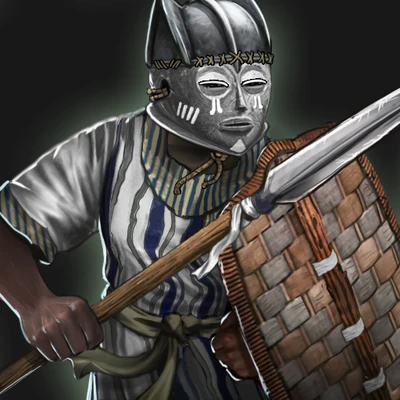
Recorded values
- Available
- Commerce Age · Trading Post or Tambo on a Yoruba kingdom; Native Embassy
- Training
- 50 sec · 18 XP per train
- Durability & mobility
- 220 hit points · 25% ranged resistance · 4.0 speed · 16 line of sight
- Ranged attack
- 26 base damage · range 2-16 · attack interval 3.0-1.5
- Siege attack
- 16 base damage · range 6 · attack interval 3.0
- Hand attack
- 16 base damage · attack interval 1.5 · bonus damage: 3.0x vs. Cavalry; 2.2x vs. Shock troops
- Poison damage
- 1 base damage · attack interval 1.0 · bonus damage: 2.0x vs. Cavalry; 1.25x vs. Shock troops · requires Yoruba Ida Swords
Role, availability & values
The Legionary is accessed through a Yoruba kingdom or Native Embassy. Its recorded profile lists up to 16 range, ranged resistance and poison damage; the poison is separate from the immediate ranged attack and supports continued damage after contact.
Matchup & timing
Keep Oyo Legionaries behind a frontline and let their range pressure enemy infantry or exposed targets. Protect them from cavalry and melee units, which can cross the gap before the slow infantry can reposition.
Recruitment and native access
The Yoruba Oyo Legionary is a native Heavy infantry unit added in The African Royals. A Trading Post or Tambo on a Yoruba kingdom can recruit it; some civilizations can also access it through a Native Embassy or alliance. The standard unit costs 90 Food and 90 Wood, takes 50 seconds to train, and is limited to eight per Yoruba kingdom in the current profile. It has 220 hit points, 25 percent ranged resistance, speed 4, line of sight 16, and occupies the native warrior role rather than the ordinary barracks line. Hausa players can choose the Yoruba alliance at the Industrial or Imperial Age and then train Legionaries at Palaces and Native Embassies. Other civilizations can receive small shipments if they have established the required Trading Post or Tambo. Access is therefore tied to the map and selected alliance, and the kingdom cap can limit how quickly a player replaces losses.
Attack profile and poison effect
The Legionary throws javelins for 26 damage at a range from 2 to 16. Its attack interval becomes faster as the target moves closer, improving from three seconds to 1.5 seconds at close range. It has a 16 damage hand attack every 1.5 seconds, with a three times multiplier against Cavalry and 2.2 times against Shock troops. Its siege attack deals 16 damage at range 6. After researching Yoruba Ida Swords, the hand attack also applies poison damage of one point per second for four seconds, with two times bonus damage against Cavalry and 1.25 times against Shock troops. The damage can stack, adding value when multiple Legionaries land attacks on a target. The poison is an upgrade effect and should not be assumed on a newly trained unit before the technology is researched.
Combat strengths and limits
The Legionary's large shield and 25 percent ranged resistance help it survive ranged fire while its javelins pressure opponents. It is effective against melee cavalry and Shock troops, especially as enemies close and its firing rate improves. Its speed is moderate, however, and it trains slowly at 50 seconds. Light infantry and artillery can threaten it, while its siege attack is too low to replace dedicated siege. Use it as a durable ranged screen and focus fire on cavalry approaching the army. Do not send a small isolated group chasing fast targets across the map; a speed 4 unit may fail to close or may be caught by the opponent's support. Because the Legionary costs both Food and Wood, it competes with buildings and other native units for the same economy. Produce it when the opponent's composition gives its anti-cavalry bonuses value, and maintain units that can protect it from ranged counters.
Upgrade and shipment interactions
African civilizations automatically receive native warrior upgrades for free, while other civilizations may research Legendary Native Warriors through the appropriate Capitol, State Capitol, or Town Center. Yoruba Oyo Legionaries can also benefit from native warrior cards and civilization specific technologies. Hausa alliance access is repeatable through Palaces and Native Embassies after the chosen age-up, while Haiti can receive them through African Roots and gain Yoruba alliance access at the Native Embassy; this revolution interaction also grants Stealth mode to the unit. Native Treaties can ship a small group when a Trading Post or Tambo is built on a Yoruba kingdom, and other shipments check the presence of that site. Separate those card based reinforcements from ordinary production: the shipment may establish an immediate force, but it does not remove the per kingdom training limit or replace a production building.
Patch and classification context
The current training limit is eight per Yoruba kingdom; earlier data listed fourteen before update 13.18214. Speed is now 4.0, reduced from 5.0 in that update. Some data tags the Legionary as Musket infantry even though its weapon is a javelin; class based cards and counters may therefore behave according to the tag rather than its visual equipment. Current attack values list 26 ranged damage and 16 hand damage, with the close range attack interval changing dynamically. When comparing older guides, check both the patch and whether the source describes a standard Legionary, an alliance version, or a revolution unit with additional abilities.
Combining Legionaries with other native units
The Legionary fits beside Yoruba units that cover its slow movement or its vulnerability to artillery. A mobile unit can screen the flanks, while ranged support removes enemy Light infantry before it focuses the Legionaries. If Yoruba Ida Swords is researched, concentrate hand attacks on Cavalry or Shock troops so the poison effect and class bonus contribute together. Do not spend the technology solely to improve ranged volleys; the poison is attached to the hand attack. Because production is capped at eight per kingdom and takes 50 seconds, preserve the existing group and reinforce it with shipments when available. A Hausa player with the Yoruba alliance can maintain production from Palaces, while a player relying on a single Trading Post should protect the settlement and avoid taking unnecessary fights that consume the capped force.
Maintaining access
If the Yoruba kingdom is contested, build the Trading Post or Tambo with an escort and keep a reserve nearby. Losing the settlement removes the normal recruitment route and can leave the army below its kingdom cap with no easy replacement. A shipment can bridge that gap, but preserving the site is the more reliable long term plan.
Melee cavalry counter with close-range attack speed
The Yoruba Oyo Legionary is a strong melee unit related to the Gascenya and Somali Issa Warrior, but with a stronger overall profile. It is effective against melee Cavalry and attacks faster when enemies are close. Compared with those related units, it has ranged resistance, more hit points and stronger ranged attack. This makes it useful as a durable screen that can punish cavalry trying to reach the back line.
Ida Swords adds poison pressure
When Yoruba Ida Swords is researched, the Oyo Legionary’s hand attack can poison targets, adding damage over time to its melee role. Use the unit to hold close engagements and protect ranged troops, but avoid sending it alone into artillery or Heavy Infantry. The technology and unit access depend on Yoruba progression, so plan the resource cost alongside the alliance army. Its improved durability is most valuable when it can stay in combat with support rather than being focused by a whole army.