Frederick the Great
Frederick the Great is the German skirmish AI personality in Age of Empires III. His army can combine ranged infantry and cavalry, then add artillery as the match advances. The name is used for an AI profile and does not indicate that Frederick appears as a controllable hero in ordinary matches.
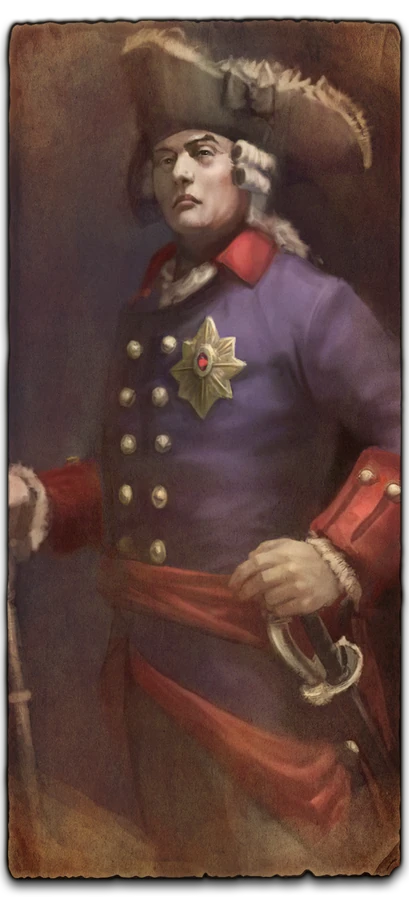
AI identity & army profile
Skirmishers, Doppelsoldners, Uhlans and War Wagons are among the units associated with his force. Later armies may add artillery and cavalry support. German shipments can also affect the composition, so the battlefield mix is more useful to track than a presumed fixed build order.
How to prepare
Scout his production and adapt as the army changes. Keep anti-cavalry near vulnerable ranged units, and add a way to deal with artillery if he establishes a gun line. Use cavalry or siege pressure against unsupported production, but avoid letting Uhlans raid workers while the main force is engaged.
AI army composition and timing
Frederick the Great is the German AI personality in Age of Empires III. His profile favors aggressive, cavalry-heavy play built around Uhlans and War Wagons, with Falconets and, in The WarChiefs, Horse Artillery as supporting guns. He may also add Doppelsoldners and Skirmishers, and he improves those units when the match continues. At lower AI levels his deck may include Landsknechts, while more experienced versions shift to other German options. The AI deck includes cavalry upgrades, which supports his tendency to invest in mounted units. This is a behavior pattern rather than a guaranteed build order: map treasures, difficulty and available shipments can alter his opening. He usually reaches the Commerce Age quickly and may move toward a Fast Fortress plan. If he finds treasures, the first attack may arrive later; without that detour he often attacks once his first military shipment arrives. The source describes a common early force of two to five Uhlans, one to three Doppelsoldners and five to nine Crossbowmen. Treat those figures as an observed range, not an exact spawn script. In the Fortress Age he tends to send a Fort Wagon and place the Fort close to the opponent, creating forward production and pressure.
How to defend against his pressure
Scout his Stable and other production early, then keep anti-cavalry units close to workers and ranged Infantry. Uhlans can raid exposed Settlers while War Wagons add a durable ranged-cavalry threat, so do not let the army composition focus entirely on one counter. Add Skirmishers or equivalent ranged support against his Crossbowmen, and use cavalry or artillery counters when War Wagons arrive. Frederick does not willingly build Outposts according to the source entry, making his perimeter easier to approach than that of a defensive AI. Siege pressure on Stables and Artillery Foundries can interrupt reinforcement, but only push if the main army is positioned to handle Uhlans and Doppelsoldners. When the Fort Wagon appears in the Fortress Age, scout its destination and contest the forward Fort before it controls the map. The AI can also send Uhlans from shipments to raid, so protect distant hunts and mines even while the main force is visible. A compact defense near the economy can absorb the opening, then use mobile units to punish unsupported production buildings.
Personality and diplomacy
The historical Frederick II of Prussia lived from 1712 to 1786 and ruled as king from 1740 until his death. In the game he is voiced by Gregg Berger and represents the Germans in skirmish diplomacy. His dialogue is confident, boastful and direct: he comments on relative strength, treasures, shipments, alliances, tribute requests and attacks. These lines express the AI character rather than changing unit statistics or diplomatic rules. As an ally, he may request or offer Food, Coin and Wood, and he reacts to difficulty changes and treasure collection. Players should distinguish the character’s historical biography, his written dialogue and his skirmish behavior. The defining gameplay information is the cavalry-centered deck and early aggression; voice lines do not guarantee that a particular military action will follow immediately. Frederick prefers small, sudden forces according to the Definitive Edition description, which matches his use of raiding cavalry and forward Fort placement.
Opening patterns are tendencies rather than scripts
Frederick usually ages quickly to Commerce and favors a Fast Fortress approach, but his first attack can change with treasure opportunities and shipment timing. When he skips treasure hunting, he may attack soon after his first military shipments arrive. A common composition listed for that opening is two to five Uhlans, one to three Doppelsoldners and five to nine Crossbowmen. If he delays to hunt treasures, continue scouting because Uhlans may still raid the economy while the main army is held back. German Home City shipments from the Commerce Age onward commonly add Uhlans, so a shipment that appears economic can also increase his cavalry count. In Fortress, watch for the Fort Wagon and its forward Fort. Use cavalry to intercept the wagon if possible, then siege the completed Fort with the main force while protecting workers from Uhlan raids. The AI can choose different cards at different levels, and the source notes low-level Landsknechts may be replaced as the personality levels up; do not treat any single unit count as guaranteed.
Production and defensive weaknesses
Frederick leans on Stables and Artillery Foundries to sustain his cavalry and guns. The source describes him as reluctant to build Outposts, which leaves fewer warning structures around the perimeter. A player can exploit this by scouting the production buildings and applying siege pressure there, but should first account for the army that protects them. Uhlans punish exposed Settlers, War Wagons can resist ranged fire and Falconets threaten clustered units or buildings. Use a balanced counter force: anti-cavalry for Uhlans, ranged support against Doppelsoldners and Crossbowmen, and Culverins or mobile cavalry against artillery. If his forward Fort is completed, do not attack it with workers or a small raiding group; remove nearby production and deny reinforcement while the main army handles the fortification. Frederick’s cavalry upgrade cards make a long exchange increasingly dangerous, so target reinforcement routes and retreat when the German army regroups.
Read the personality through its dialogue
Frederick speaks as a confident monarch and often claims superiority, comments on the player’s score, and boasts about the New World and his army. His diplomatic lines cover offers and requests for Food, Coin and Wood, responses to tribute, treasure collection, native alliances, attack orders, Fort construction and refusal to help. Dialogue is flavor attached to the AI personality, not a direct economic bonus or reliable trigger for the next action. The historical figure was King of Prussia from 1740 to 1786 and is voiced by Gregg Berger. The AI profile is associated with the Germans, but the real Frederick does not appear as a controllable Hero in standard matches. Keep biography, dialogue and skirmish behavior distinct when describing this entry.
Shipment-driven German army
German shipments affect Frederick’s battlefield strength because most non-team deliveries from the Commerce Age onward bring Uhlans alongside the printed card cargo. A resource shipment can therefore be followed by a cavalry raid, and mercenary shipments include more Uhlans. Frederick also carries cavalry improvements in his deck, which reinforces the late-game threat. Track his shipment point and the units joining the army, not only the visible production queue. If his Uhlans appear in repeated small groups, keep anti-cavalry stationed near workers and avoid sending an isolated force across the map. War Wagons give his army durable ranged support, while Falconets and Horse Artillery add siege or area damage depending on the installed expansion. When he ages to Fortress, a forward Fort can make the German rally route especially short; attack the supporting production or control the approach rather than fighting each shipment as it arrives.
Difficulty and ally behavior
The personality is used in skirmish and team diplomacy, where difficulty and ally state influence its economic pace and available cards. The dialogue includes requests for resources, acceptance or refusal of tribute, announcements of attack and comments about treasure hunting. As an ally, Frederick may ask for Food, Coin or Wood or offer resources, but these are ordinary diplomacy interactions rather than unique German technologies. His confident lines can sound like a declaration of an immediate attack even when the AI is still building its force. Watch the minimap, Home City shipments and production buildings for actionable information. At higher levels his deck can shift away from early Landsknechts toward more developed German unit choices. His preference for cavalry and aggressive pressure remains the most useful broad tendency for preparing a counter plan.
Building a counterattack
After surviving the first cavalry push, use the time to remove Stables, Artillery Foundries or the forward Fort route. Keep workers behind the Town Center and avoid leaving a valuable Trading Post undefended. A counterattack should bring anti-cavalry and siege together: cavalry can chase Uhlans and reach artillery, while infantry protects guns from Doppelsoldners. Frederick’s limited Outpost construction means map scouting is comparatively easier, but do not assume an undefended base if a Fort Wagon is already advancing. Deny him the next shipment timing by controlling the Trade Route and forcing him to spend Uhlans defensively instead of raiding.
Fortress Age transition and forward position
Frederick tends to send a Fort Wagon immediately on reaching the Fortress Age and place the Fort close to the opponent. This can turn a raid-oriented army into a sustained forward siege. Scout the wagon path early, contest its site and be ready to remove nearby Stables or Artillery Foundries. If the Fort completes, attack with siege while anti-cavalry protects the guns from Uhlans. Do not chase the German army away from the base and leave the fortification operating behind you.
Personality details and voice lines
Frederick is portrayed as proud, forthright and convinced of his strategic superiority. His ally dialogue discusses resource gifts and requests, difficulty, previous victories, treasure collection, native alliances and attacks. He may praise an army or refuse a resource request when his own troops need supplies. These lines reinforce the role-playing personality but do not alter the rules of diplomacy or predict the exact composition of the next shipment. The historical king was born on January 24, 1712 and died on August 17, 1786; he ruled Prussia for most of the 18th century. The game credits Gregg Berger as the voice actor. His gameplay identity remains the German AI profile, whose cavalry focus and aggressive Fortress transition are more important to tactical preparation than the historical biography.
Adjust to what scouting reveals
If the German army contains more War Wagons than Uhlans, preserve artillery counters and avoid a pure ranged Infantry force. If Doppelsoldners lead the attack, use ranged fire and do not let them reach the guns. If Frederick delays his age-up, raid his economic units and prevent treasure control. The profile favors cavalry, but its exact composition changes with the match.
Keep the cavalry screen close
Protect workers while the main army faces Crossbowmen and artillery.
Raid defense
Keep anti-cavalry near distant workers.
Contest the forward Fort early
Stop the Fort Wagon before it establishes a close rally point.
Adapt after the first shipment
Scout which German units arrived before committing to a counter.
Keep scouting the German rally
Balance raid defense and siege
Guard workers while contesting the Fort.
Scout the next shipment
His deck can reinforce cavalry quickly.
Counter the German cavalry timing
Keep anti-cavalry units ready.
Read his shipments and AI responses
Frederick’s army can be reinforced by German Home City shipments that add Uhlans alongside eligible cargo, so a resource shipment may also foreshadow a Cavalry raid. Mercenary shipments can bring a larger Uhlan escort in the profile described by the source. Watch the Home City shipment point and rally routes as well as the Stable: counting only the units visible in production can underestimate the force that is about to appear. His dialogue reacts to score, treasures, shipments, alliances, tribute, attacks and previous matches. As an ally, he may offer or request Food, Wood or Coin; these are ordinary diplomacy interactions and do not guarantee his next military action. As an opponent, his boasts and threats signal the personality, not an exact army count. Scout the German base and use the unit mix to determine whether the next response should be anti-Cavalry, anti-Infantry or artillery support.
Difficulty, map and ally timing
Frederick’s tendencies vary with difficulty, map and treasure access. He often advances quickly and pressures early, but a treasure detour or different shipment sequence can delay the first attack. Treat the commonly observed opening composition as a guide to what may arrive, not a fixed script. In team play, his willingness to coordinate and the size of his force affect when an attack is worthwhile; do not wait for a perfect army while exposed workers are being raided. If he is an ally, protect his forward Fort and use the cavalry pressure to create space for a separate push. If he is an enemy, force the army to defend distant resources and then strike the unsupported Stable or Artillery Foundry. Dialogue can reveal when he has noticed a threat or an ally’s request, but the actual battlefield and production remain the reliable indicators.