Gatling Camel
Gatling Camel is a mobile artillery mercenary available through several mercenary buildings. It combines a ranged multi-hit profile with mounted movement, making it easier to reposition than a slow siege cannon.
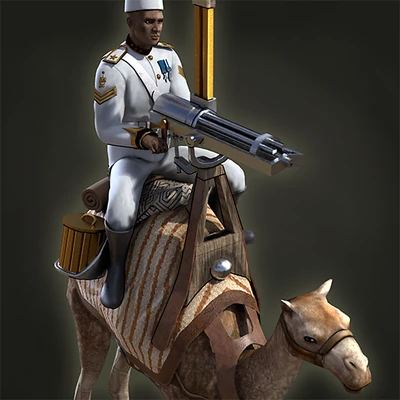
Recorded values
- Cost
- 450 Coin
- Available
- Industrial Age · Tavern (Europeans) ; Monastery (Asians) ; Saloon (Federal Americans) ; Palace (Africans) ; Lombard (Italians)
- Training
- 45 sec · 5 population · 45 XP per train
- Durability & mobility
- 320 hit points · 30% ranged resistance · 5.75 speed · 15 line of sight
- Ranged attack
- 14.5 (6) base damage · range 14 · attack interval 3.0 · area of effect 2 · bonus damage: 2.0x vs. Infantry; 1.25x vs. Heavy infantry; 0.5x vs. Cavalry; 0.5x vs. Shock troops; 0.34x vs. Artillery; 0.25x vs. Villager
- Siege attack
- 14.5 (6) base damage · range 14 · attack interval 3.0
Role, availability & values
The unit is hired from a Tavern, Monastery, Saloon, Palace or Lombard depending on civilization. Its recorded profile lists 5.75 movement speed, 30% ranged resistance and a five-population cost; it attacks at range rather than relying on a conventional cavalry charge.
Matchup & timing
Use its mobility to shift firing positions as the frontline moves, while keeping a screen between it and close-range attackers. Its high population and Coin cost suit a planned artillery role rather than an emergency low-cost unit.
Definitive Edition statistics
The Gatling Camel is an Industrial Age mercenary from The African Royals. Its current cost is 450 Coin, training time 45 seconds, population cost five, and experience value 45 for training or killing. It has 320 hit points, 30% ranged resistance, speed 5.75, and line of sight 15. Its ranged attack is an area attack with radius two: it deals 14.5 base damage every three seconds at range 14. The same listed damage and range apply to its siege attack. Its hand attack deals 22 damage every 1.5 seconds. Older values shown in update history differ, so these figures describe the current Definitive Edition profile. The high Coin cost and five population make each camel a substantial investment; use the unit where its mobility and infantry damage will matter rather than as a general-purpose Cavalry replacement.
Infantry damage and target multipliers
The ranged attack is designed to punish Infantry. Its multiplier is 2.0 against Infantry and 1.25 against Heavy Infantry, while it deals only 0.5 against Cavalry and Shock troops, 0.34 against Artillery, and 0.25 against Villagers. The hand attack also has a 2.0 Infantry multiplier and a 1.25 Heavy Infantry multiplier, but only 0.5 against Cavalry, Shock troops, and Villagers. An area radius of two lets a volley affect nearby targets, making a compact Infantry formation especially vulnerable. The Camel is therefore best used behind the main line where it can fire into Infantry and avoid being caught in melee. It can pressure buildings with its siege attack, but it should not be left beside a defended structure when the opponent has dedicated anti-Artillery units.
Mobility compared with a Gatling Gun
The camel mount gives the Gatling weapon mobility that a standard Gatling Gun does not have. With speed 5.75, it can reposition with a Cavalry force, turn away from heavy Cavalry, and pursue exposed Infantry more readily than a conventional artillery piece. That speed is still below ordinary fast Cavalry, so the unit cannot assume it will escape every mounted attack. It also trades away range and ranged resistance compared with other artillery: its 14 range and 30% ranged resistance leave it more exposed to Skirmishers and other long-range units. Keep a route open behind the army and move it between volleys when the opponent changes target. The Gatling Camel can support a mobile push, but the player must protect it as valuable artillery rather than send it ahead as a raider.
Counters and special vulnerabilities
Light Infantry is a central counter because it can attack the Camel from range and exploit its lower range and resistance. Cavalry and Shock troops also threaten it if they close in, since its own damage multipliers against them are low. Artillery is dangerous as well, particularly Culverins: they have an additional hidden 2.0 multiplier against the Gatling Camel, resulting in a total 4.0 damage multiplier. Arrow Knights and MercType2 units are also listed as threats. Keep the Camel screened by units that can engage Cavalry and Light Infantry, and scout for Culverins before grouping several of these expensive units together. Against an Infantry-heavy opponent, its strong multiplier and area damage can justify the investment; against a composition dominated by Culverins, Skirmishers, or Cavalry, another mercenary is safer.
Recruitment and civilization access
The recruitment building depends on the civilization: Europeans use Taverns, Asians use Monasteries, Federal Americans use Saloons, Africans use Palaces, and Italians use Lombards. Availability is still conditional on the unit appearing in the civilization's mercenary roster. The Ethiopians can obtain Gatling Camels after choosing the Arab Alliance to reach Imperial Age. German Battleships can train them through the Adler von Lübeck Home City Card when the unit is available in the Tavern. The United States can receive them in the random mercenary pool from the Poker card, which also enables them to appear in Saloons. These routes are separate from ordinary recruitment and should be checked before a deck or age-up is built around the Camel.
Technology support and army role
The Gatling Camel carries both gunpowder Cavalry and Artillery tags. As a result, Smokeless Powder applies twice according to the unit's listed class interactions. Other attack improvements include Ranged Cavalry Caracole, while Professional Gunners can improve hit points and Trunion can improve speed. Several civilization or map technologies provide further bonuses, but the exact benefit depends on the player's civilization. These interactions can strengthen the unit, yet the high Coin price and population cost remain. Use one or a small group as a mobile anti-Infantry battery alongside ordinary Cavalry and anti-Artillery support. Focus volleys on dense Heavy Infantry, then retreat behind the screen before Culverins or mounted units reach firing range. Do not judge the Camel by its Cavalry name alone: its main job is ranged area damage against Infantry, with mobility as a way to keep that artillery role alive.
Area fire, formation, and positioning
The two-point area effect means target selection matters as much as raw damage. Focus on a tight Infantry group so each three-second volley can affect nearby units, and keep the Camel far enough behind the frontline to avoid hand combat. At 14 range it can contribute from a useful distance, but its range is shorter than some dedicated artillery and ranged Infantry. Reposition when enemy Skirmishers or Culverins begin returning fire. The siege attack shares its listed base damage and range, so it can add pressure to buildings when no dangerous counter is nearby; its primary investment is still best spent removing Infantry. A protected angle on the flank often lets it fire into a formation while reducing the number of opponents who can target it directly.
Upgrades and late-game choices
Smokeless Powder affects the Gatling Camel through both its gunpowder Cavalry and Artillery classifications, so the unit receives the double interaction listed for those tags. Ranged Cavalry Caracole increases its attack and range, while Professional Gunners improves durability and Trunion improves movement. These upgrades can make the Camel more useful in a mobile composition, but do not remove its weak multipliers against Cavalry, Shock troops, and Artillery. A large investment is most defensible when the enemy relies on Infantry and the player can screen the mercenary. If the opponent changes into Culverins or long-range Light Infantry, preserve the existing camels and shift resources into a counter rather than continuing to build a unit that is losing favorable firing positions.
Prioritize value over raw unit count
A small number of protected Gatling Camels can do more than a larger group sent into the wrong counter. Their five-population cost and 450 Coin price make replacements slow, while their area volleys can quickly punish tightly packed Infantry. Use cavalry or other fast units to reveal the enemy's anti-Artillery position, then move the Camels into range only when a firing lane is clear. Avoid chasing individual Villagers: the attack multiplier against Villagers is only 0.25, and the Camel is more valuable against an Infantry group or as siege support. If the opponent's units spread out, select a different target or preserve the artillery until a better engagement appears.
Mobile anti-infantry gun on a Camel
The Gatling Camel carries a Gatling Gun role onto a faster platform. It retains the main purpose of countering infantry and gains enough mobility to reposition or evade Heavy Cavalry, but trades away some ranged resistance and firing range compared with the ordinary Gatling Gun. Use it to pressure infantry while moving between positions, and do not expect it to hold a static firing line as safely as a conventional artillery piece.
Balance mobility against reduced range
The Gatling Camel’s shorter range can force it closer to enemy units, where its lower resistance becomes more dangerous. Keep a screen nearby, attack from a protected flank and withdraw if Heavy Infantry or artillery can reach it. Its speed can help avoid Heavy Cavalry, but it is still vulnerable when trapped or slowed. Choose it when the army needs mobile anti-infantry fire; choose a standard gun when range and durability matter more.
Mobile gun platform and patch changes
Gatling Camel attacks in multiple shots while retaining mounted movement, giving it a mobile artillery role rather than the sustained staying power of a conventional frontline Cavalry unit. It now costs 450 Coin, has 320 hit points, moves at 5.75 and uses five population; before update 13.4412 those values were 400 Coin, 300 hit points, 6.25 speed and four population. The current attack has a 3-second interval and 14 range, down from a 2-second interval and 16 range before update 13.4412. Its multi-shot damage is currently 14.5 per shot (six shots), compared with 13 before that update. Current multipliers include 2.0× against Infantry, 1.25× against Heavy Infantry, and 0.5× against Cavalry and Shock Troops. These low anti-cavalry modifiers make a screen essential: reposition to keep firing on appropriate targets, but do not let the camel formation be caught by melee units.