Gotland
Gotland is a Baltic island map with Vasa and Oldenburg Royal House settlements. These alliance choices compete with ordinary resource and route control; their locations vary with generation, so the map rewards early scouting of both neutral sites and the approaches between players.
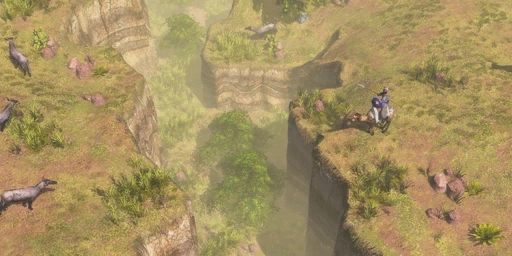
Terrain, routes and neutral sites
- Map character
- Baltic island map
- Royal Houses
- Vasa · Oldenburg
- Generation
- Settlement positions vary
- Planning point
- Scout neutral sites and the approaches between players
Map character
Reveal where each Royal House lies in relation to resources and the opponent before placing a Trading Post. Compare the two alliance options for the units or technologies your army needs, then establish a force that can protect the chosen site.
What to scout
Use an alliance when its roster fits the plan and the route to its settlement can be held. Avoid sending all Villagers across an exposed island approach, and keep units near the Trading Post if control is likely to be contested.
Choose a Royal House before spending on both sites
Gotland’s Vasa and Oldenburg Royal Houses create a choice between neutral rosters, not a reason to claim every settlement immediately. Scout both locations and compare the units or technologies in their linked entries with the army and economy you intend to build. The nearest site may be easier to hold, while the other may offer a better fit; include the cost of defending the route in that comparison. Establish nearby resources and production first, then make the Trading Post investment that supports a real plan. An alliance that cannot be protected can cost more than it contributes.
Island control depends on the route to the post
The settlements and resource sites vary with map generation, so trace how Villagers and reinforcements will travel before committing to a distant position. Keep the Explorer ahead of builders and check whether the opponent can reach the same site by a shorter approach. If both Royal Houses are contested, secure one defensible location rather than spreading workers and troops between two vulnerable fronts. A compact army near the chosen Trading Post can protect the alliance while the economy continues at home; expand toward the second site only when the first route and nearby gathering are stable.
Use the neutral roster to answer a specific need
A Royal House alliance is most useful when its available units or technologies fill a gap in the current composition or improve an intended transition. Check the entries before paying for the Trading Post, then compare that benefit with producing ordinary units from existing buildings. Reassess if the opponent changes strategy: a roster choice that helped early may not answer a later army. Gotland’s map identity is its pair of Royal House options and island setting; the match still depends on which site appears safely reachable and what the player can afford to defend.
Compare the Vasa and Oldenburg rosters by age and role
Gotland’s two Royal Houses support different compositions. The Vasa Royal Arquebusier is available in the Commerce Age for 70 Food and 30 Wood; it trains in 26 seconds, has 150 hit points and fires for 12 damage at range 15. It supplies ranged pressure early. Vasa’s Companion is a more expensive Commerce Age cavalry option at 100 Food and 100 Coin, with 335 hit points and speed 7.0, but it takes 50 seconds to train. Its Lance Charge and Bleeding effect require the Fortress Age Rohatyna technology. Oldenburg instead offers a Commerce Age Royal Huntsman for 140 Food: a 150-hit-point ranged unit with 30% ranged resistance that can gather Food from huntable animals. Its Fortress Age Northern Musketeer costs 110 Food, has 120 hit points and deals 22.5 ranged damage at range 14. Choose Vasa when the army needs a mobile cavalry or early ranged unit; choose Oldenburg for a hunt-capable counter-skirmisher and a later high-damage musketeer.
Oldenburg converts hunting and fishing into Coin
The House of Oldenburg’s economic technologies can make a coastal or island position useful beyond its military roster. Hunting Expeditions is an Exploration Age research costing 300 Food and 300 Wood; it lets Villagers and Fishing Boats or Fishing Canoes gather Coin equal to 10% of their Food gathering rate while hunting or fishing. This requires workers or boats to be actively gathering those Food sources, so secure the shore and hunting ground before counting on the Coin. Baltic Sea Trade is another Exploration Age option, costing 250 Food and 250 Wood and researching in 30 seconds; it grants a small Coin trickle based on the cost of eligible War Ships and defensive buildings. Both choices can support an extended game, but the research cost competes with the units and shoreline defense needed to hold Gotland.
Plan for Oldenburg’s later upgrades before taking the site
Oldenburg’s roster can be reshaped in later Ages. League of Armed Neutrality costs 300 Wood and 300 Coin in the Commerce Age and replaces Royal Huntsmen with Royal Hunters at Trading Posts, Native Embassies and on the map; the replacement is a stronger fighter but loses the Royal Huntsman’s food-gathering role. Kalthoff Repeaters is a Fortress Age technology costing 175 Wood and 175 Coin. It improves the anti-Light-Infantry bonus of light infantry and counter-skirmishers, with a larger increase for Royal Huntsmen and Royal Hunters. Research only after deciding whether the alliance should supply economic huntsmen, upgraded fighters or the Northern Musketeer line. Scouting both Houses before committing lets the player compare that age-up plan with Vasa’s cavalry and charge technology.