Haudenosaunee Mantlet
Haudenosaunee Mantlet is a Commerce Age siege infantry unit with high ranged resistance. It combines a ranged weapon with strong siege damage for pressure on buildings and defended positions.
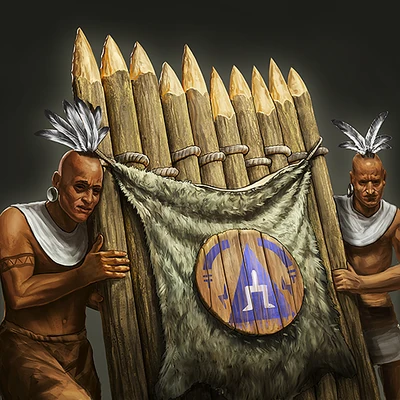
Recorded values
- Available
- Commerce Age · Trading Post or Tambo on an Haudenosaunee settlement; Barracks; Fort; Stronghold; Agra Fort; (with Haudenosaunee League)
- Training
- 30 sec · 15 XP per train
- Durability & mobility
- 250 hit points · 40% ranged resistance · 3.5 speed · 12 line of sight
- Hand attack
- 10 damage · 1.5 attack interval
- Ranged attack
- 25 damage · 10 range · 3.0 attack interval
- Siege attack
- 45 damage · 6 range · 3.0 attack interval
Role, availability & values
The Mantlet is available through a Haudenosaunee settlement and, with Haudenosaunee League, can be trained at several military buildings. Its recorded profile includes 40% ranged resistance and 45 siege damage. It moves slowly compared with Cavalry and can be threatened by melee units.
Matchup & timing
Use Mantlets to advance under ranged fire and pressure a building once the route is clear. Support them against melee and Cavalry units that exploit their slow movement. Protect the access point or production building if the army depends on Mantlets for siege.
Current statistics and settlement limit
The Haudenosaunee Mantlet is a Commerce Age native siege Infantry unit. It costs 50 Wood and 100 Coin, takes 30 seconds to train, and has 250 hit points with 40% ranged resistance. Its speed is 3.5 and line of sight 12. As a Native American warrior, it uses no population. Its ranged attack deals 25 damage at range 10 every three seconds, while its hand attack deals 10 damage and its siege attack deals 45 damage at range six. Training from a Haudenosaunee minor settlement is limited to five Mantlets per settlement. That makes each site valuable but caps ordinary production; shipments and civilization-specific access are separate from the settlement limit.
Siege role and attack range
The Mantlet's purpose is to absorb ranged fire while it damages buildings. Its 45 siege damage and ten-unit range let it attack structures from a safer distance than a melee siege unit, while the ranged resistance and 250 hit points help it survive ordinary defensive fire. It has no bonus against enemy unit classes, so its 25-point ranged attack should not be mistaken for a strong combat counter. Keep the Mantlet at range and use other units to remove defenders. It is especially effective against military and economic buildings when a screen can keep Heavy Cavalry away. Closing into hand-to-hand combat or letting the enemy surround it wastes the protection and range that define its role.
Counters and field protection
Heavy Cavalry and Artillery are the main listed threats. Cavalry can close the distance and attack a slow unit that has no population cost but still requires time and resources to replace. Artillery can outrange or inflict heavy damage on the Mantlet, while melee Infantry can reduce the value of its ranged resistance. Keep a mobile screen nearby and use the Mantlet as a rear siege piece. Its 3.5 speed is slow, so choose a route before beginning a push and avoid sending it across open ground alone. When the opponent reveals heavy Cavalry, pause the siege and let anti-Cavalry troops establish a safe approach before the Mantlet resumes attacking.
Settlement, civ, and shipment availability
The standard Mantlet is trained at a Trading Post or Tambo built on a Haudenosaunee minor settlement. After The WarChiefs made the Haudenosaunee a playable civilization, the old minor settlement was replaced by the Huron and the Haudenosaunee Mantlet was replaced by the standard Mantlet unit. The Haudenosaunee Morning Wars card can provide one Mantlet for every two minutes elapsed, up to fifteen by the thirty-minute mark. Playable Haudenosaunee forces can also build or train the unit through their own access routes, including Barracks, Forts, Strongholds, and certain age-up buildings. Check the selected civilization and the map before relying on native-site production.
Elite, Champion, and Legendary improvements
The Mantlet's native upgrade path improves its durability and damage. Haudenosaunee Warrior Societies costs 150 Wood and 100 Coin and upgrades it to Elite for 25% more hit points and damage. Champion Haudenosaunee costs 500 Wood and 400 Coin, requires the earlier technology, and adds 35%. Legendary Native Warriors raises hit points and damage by 50% for 1,500 Food and 1,500 Wood. Those upgrades are useful when the Mantlet group remains a central siege force, but they do not remove its lack of combat multipliers or its vulnerability to Heavy Cavalry. Research them when a sufficient group exists and is expected to survive multiple engagements.
How to use the Mantlet in a push
Bring Mantlets behind Infantry that can engage Cavalry and protect them from melee units. Focus their siege attacks on a single military building or Town Center, then move the group before enemy Artillery can settle on the same location. Their zero-population cost allows the army to field extra siege pressure near the population cap, but Wood, Coin, build limit, and training time still constrain the number available. If the opponent has no buildings in a vulnerable position, the Mantlet's combat damage may not justify the investment. Use it when the army can exploit its range and ranged resistance, and withdraw when its protection is threatened.
Use the free population carefully
No population cost is a strong benefit when the army is near its cap, but it does not make the Mantlet costless. Each unit still uses 50 Wood, 100 Coin, and 30 seconds of production, and a native settlement caps training at five. Keep the unit for a planned siege or a durable rear line rather than queueing it without an available target. This converts its population efficiency into actual map pressure.
Map history and unit naming
The unit was called Iroquois Mantlet before Definitive Edition. Its current name follows the Haudenosaunee terminology used in the game. It originated as a minor-civilization siege warrior; after The WarChiefs made the Haudenosaunee a playable major civilization, the Haudenosaunee settlement was replaced by the Huron as a minor ally. The old Mantlet's map role passed to the Huron Mantlet, while the playable Haudenosaunee use a separate Mantlet entry. These names refer to related but distinct units and should not be used interchangeably when checking building access, settlement limits, or statistics.
Why it is not a conventional Mantlet
The Haudenosaunee Mantlet is a ranged native warrior with an explicit siege attack, rather than the generic protective Mantlet used by the playable Haudenosaunee. Its 25 ranged damage and 45 siege damage are separate attacks, and its 40% ranged resistance helps it remain in position while targeting buildings. It has no bonus against enemy units, so the player should not send it forward to fight Infantry simply because it has high hit points. Use it at range as a building attacker and let other troops determine the land battle.
Native ally choice and army timing
The Haudenosaunee settlement is one of several minor alliances available through Trading Posts. Choosing it gives access to the Mantlet's building pressure and its population-free siege role, but it competes with other native settlements and their units or technologies. Consider the map and the timing: a settlement close to the enemy can provide a forward training source, while a distant site may be hard to defend. The five-unit limit per settlement makes additional sites relevant if a larger force is needed.
When a native settlement is worth securing
Choose the Haudenosaunee settlement when its population-free siege unit and other alliance options fit the map. A nearby site can provide forward production, but the five-Mantlet limit means a single settlement cannot supply an unlimited force. Scout enemy Cavalry before sending the Mantlets toward a building.
Order of operations in a siege
A safe Mantlet advance begins with scouting, then a screen, then the building attack. Use mobile units to locate enemy Cavalry and artillery before the slow Mantlets leave the protected area. Keep the ranged siege units behind the main force, focus their attacks on one building, and reposition if the enemy brings a direct counter. The Mantlet does not consume population, but it still has a production limit and a replacement cost; free population is not a reason to expose it. If the opponent's army is already close, delay the siege until the frontline can hold. A Mantlet that survives several volleys contributes more than one that charges ahead and is removed before its siege damage matters.
Durable siege unit against ranged fire
The Haudenosaunee Mantlet has no attack bonuses against enemy units, but combines a good siege attack with outstanding durability against ranged damage. It can absorb fire while approaching a building and help the army create a siege window. Use it alongside units that can remove melee defenders; the Mantlet’s purpose is to pressure structures and protect the approach, not to win ordinary unit fights.
Melee Cavalry and Infantry reduce its value
The Mantlet is less effective when melee Cavalry or Infantry can reach it, so screen it with anti-Cavalry troops and ranged support. Its ranged resistance does not protect it from close attacks or artillery indefinitely. Choose a valuable building, advance with the main force and withdraw when the escort is lost. Check the Haudenosaunee unit limit and production option before planning multiple Mantlets.