Quechua Bolas Warrior
Quechua Bolas Warrior is ranged infantry in Age of Empires III, available from the Commerce Age; obtained through Trading Post or Tambo on a Quechua settlement, Native Embassy.
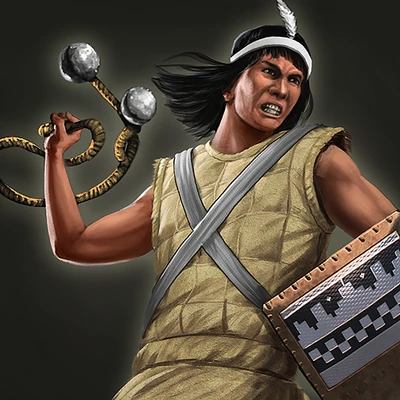
Recorded values
- Available
- Commerce Age · Trading Post or Tambo on a Quechua settlement; Native Embassy
- Training
- 28 sec · 10 XP per train
- Durability & mobility
- 200 hit points · 10% ranged resistance · 4.5 speed · 14 line of sight
- Hand attack
- 4 damage · 1.5 attack interval · bonuses: 2.0x vs. Light ranged cavalry; 2.0x vs. Ranged shock trooper; 2.0x vs. Heavy infantry; 0.75x vs. Cavalry; 0.75x vs. Shock troops
- Ranged attack
- 8 damage · 2-12 range · 3.0 attack interval · bonuses: 2.5x vs. Light ranged cavalry; 2.5x vs. Ranged shock trooper; 2.0x vs. Heavy infantry; 0.6x vs. Cavalry; 0.6x vs. Shock troops
- Siege attack
- 10 damage · 6 range · 3.0 attack interval
Role, availability & values
Production is available through Trading Post or Tambo on a Quechua settlement or Native Embassy. It has 200 hit points and 10% ranged resistance. It moves at 4.5 speed. Training costs 40 Food and 55 Wood; it takes 28 seconds to train. Attack profile: Hand attack deals 4 damage. Ranged attack deals 8 damage. Siege attack deals 10 damage. Hand attack bonuses: 2.0× against Light ranged cavalry, 2.0× against Ranged shock trooper, 2.0× against Heavy infantry, 0.75× against Cavalry, and 0.75× against Shock troops*. Ranged attack bonuses: 2.5× against Light ranged cavalry, 2.5× against Ranged shock trooper, 2.0× against Heavy infantry, 0.6× against Cavalry, and 0.6× against Shock troops*.
Matchup & timing
Use Quechua Bolas Warriors where their area attack can hit grouped targets, then reposition before Cavalry or Shock troops close. Their short range and 8 base ranged damage require a protected firing lane, while the melee attack is an emergency response rather than the main plan. A Quechua settlement or Native Embassy route makes the force map-dependent.
Role and current base profile
The Quechua Bolas Warrior is a ranged native warrior recruited from a Quechua settlement through a Trading Post or Tambo, or from a Native Embassy when the relevant alliance is available. The current listed cost is 40 Food and 55 Wood, with a 28-second train time and a limit of 10 per Quechua settlement. It uses no population space. Its base profile has 200 hit points, 10% ranged resistance, speed 4.5 and line of sight 14. The unit combines a short hand attack with a thrown bolas attack that has area damage, making it a useful support unit against selected enemy infantry and mounted ranged units.
Attacks and target matchups
The ranged attack deals 8 damage at range 2–12 with a three-second rate of fire and a three-unit area effect. Its current multipliers are 2.5× against light ranged cavalry and ranged shock troops, 2× against heavy infantry, 0.6× against cavalry and 0.6× against shock troops. The hand attack is only 4 damage at a 1.5-second interval, so maintaining distance is important. The unit is designed to pressure heavy infantry and certain ranged cavalry, not to duel heavy cavalry or close-combat shock units. Artillery and counter-skirmisher units can also punish it. Keep a screen between Bolas Warriors and melee attackers and focus fire on the class their bonus is meant to counter.
Area attack and positioning
The Bolas projectile’s area effect can damage clustered targets, so the unit benefits when enemy troops bunch around a choke or engage another frontline. Its minimum range and moderate movement mean that it should not be ordered into melee. Use the 12-range maximum to begin firing before the opponent closes, then move back while the frontline holds. A group of native warriors can complement ordinary infantry without increasing population usage, which is especially useful near the population cap. The settlement’s unit limit still constrains the number available, and each additional Trading Post or Tambo may require map control and construction investment.
Upgrades and version changes
In the Commerce Age, the warrior starts at its base rank. In the Fortress Age, Incan Warrior Societies costs 150 Wood and 100 Coin in the current Definitive Edition profile and upgrades Quechua Bolas Warriors to Elite with 25% more hit points and damage. Champion Inca requires that technology and costs 500 Wood and 400 Coin, granting the Champion rank with 35% more hit points and damage. Legendary Native Warriors in the Imperial Age costs 1,500 Food and 1,500 Wood and upgrades the unit to Legendary with 50% more hit points and damage. Original-era values and update history differ: earlier costs, unit caps, attack multipliers and train times were not identical. Use the current civilization and patch when making exact comparisons.
Native Bolas Warrior is a different unit
Do not confuse the Quechua Bolas Warrior with the playable Inca civilization’s Bolas Warrior in Definitive Edition. The Quechua unit is a map-native warrior with a 200-hit-point profile, no population cost and the settlement’s training cap. The Inca unit has a different cost, role and statistics and is closer to a conventional ranged cavalry counter unit. Similar artwork and names do not make their values interchangeable. Quechua settlements are map-dependent, so the native version may not be recruitable in a match where the Inca unit is available. Check the unit’s full name and source building when comparing an army roster.
Recruitment and practical use
The player first needs to locate a Quechua settlement and build or capture the Trading Post or Tambo that grants access. Consider whether the map offers enough Wood and whether another native unit better answers the opponent. Bolas Warriors pair well with units that hold cavalry and hand shock troops away, while their ranged attack chips down infantry clusters. They do not replace artillery for buildings or heavy cavalry for raiding. Because the unit limit is per settlement, additional allied sites can expand production where the map provides them. Protect the settlement building: losing it can cut off reinforcement and any associated native technology research.
Strengths and weaknesses in practice
The warrior’s best targets are heavy infantry and selected ranged cavalry or shock units covered by its bonuses. Its ranged attack has a wide enough effect to punish clustered formations, and no population cost makes it attractive in a full army. Its limitations are equally important: 4.5 speed, 12 maximum range, a three-second ranged cycle and weak hand damage mean it can be pinned or caught. Heavy cavalry, melee shock troops, counter-skirmishers and artillery are dangerous. Use terrain and allied frontline troops to preserve its firing time. If the enemy switches to a direct counter, add another unit type rather than continuing to invest in the same native warrior.
Training limits, cost and population
The current 10-unit cap applies per Quechua settlement, so multiple allied settlements can increase total access where the map permits. Each unit costs 40 Food and 55 Wood and occupies no population, but it still consumes training time and production access. The zero-population rule does not make the unit free: resources, the Trading Post or Tambo investment and the settlement cap remain. Near the population limit, a small reinforcement group can add damage without displacing regular troops. Early in the game, compare its cost against Villager production and the resources needed for age advancement before queuing a large batch.
Combat micro and formation
Keep the Bolas Warriors in a separate control group from melee units so they can maintain spacing. When the opponent closes, move them back behind the frontline instead of ordering an attack into contact. Focus volleys on a single high-value target to benefit from the class multiplier, and take advantage of a choke where the area effect can hit several units. Avoid firing into a formation protected by artillery or heavy cavalry. In a mixed force, use anti-cavalry infantry to hold the enemy’s mounted units while the Bolas Warriors attack from the rear. Their ranged attack can contribute against other targets, but the bonus matchups are where their cost is most efficient.
Name and patch history
The native unit’s name changed from Incan Bolas Warrior to Quechua Bolas Warrior in update 47581. Its classifications and statistics have also changed across updates: the current profile lists it as light infantry and ranged infantry, while several earlier balance versions used different costs, population limits, multipliers and train times. The native unit belongs to the Age of Empires III map settlement system. The playable Inca civilization’s Bolas Warrior is a separate Definitive Edition unit. When reading older build orders, check the unit name, patch date and whether the author means the Quechua settlement unit or the Inca roster unit.
Summary for unit selection
Choose the Quechua Bolas Warrior when the map offers the Quechua settlement and the opponent relies on heavy infantry or eligible ranged cavalry. Its area attack and free population usage add value, but its limited range, slower cycle and weak melee mean that it needs a frontline. Do not confuse it with the Inca civilization’s separately balanced Bolas Warrior.
Keep the settlement available
The unit’s strength depends on continued access to its map settlement. Protect the Trading Post or Tambo, and remember that a per-settlement limit constrains production. A small native force can be a useful addition, but it should not replace units that the civilization can produce reliably at its own Barracks or Stable.
Positioning reminder
Maintain a gap between the enemy and the Bolas Warriors. Their three-unit area attack is most useful when targets are clustered, but the short hand attack is not a fallback for being surrounded. Use an allied frontline and retreat paths to keep the ranged group firing.
Check the unit profile before training
The base numbers here identify the Quechua settlement warrior, not the playable Inca unit. For exact values, verify the current match version because Definitive Edition updates changed its limit, costs and damage multipliers.
Where it fits
Recruit them for their native ranged support and keep regular units covering their approach.
Quechua ranged unit with area bolas
The Quechua Bolas Warrior is a Commerce Age Native ranged unit recruited from a Trading Post or Tambo on a Quechua settlement, or through a Native Embassy. It costs 40 Food and 55 Wood, takes 28 seconds to train and is limited to ten per settlement. The unit has 200 hit points, 10% ranged resistance, speed 4.5 and sight 14. Its ranged attack deals eight damage at range 2–12 every three seconds and affects an area of three. The attack has bonuses against Light ranged Cavalry, Ranged Shock troops and Heavy Infantry, while Cavalry and Shock troops take reduced damage. The broad area makes it useful against clustered Infantry, but the low base damage means its bonuses and target grouping matter.
Slow a formation and defend the Native site
Use Bolas Warriors to soften a packed enemy line while another unit protects them from Cavalry. Their area attack can pressure several targets at once, but they move at speed 4.5 and cannot escape every flank. Keep the Quechua Trading Post or Tambo safe if the army needs further units; the ten-unit limit per settlement makes the alliance position important. Their low attack against Cavalry and Shock troops means they should not be left alone at the frontline. Combine them with Huamincas or another anti-Cavalry unit and use their Wood-heavy cost when Food is committed elsewhere. A single settlement can support a limited group, so preserve experienced units after a favorable fight.
Settlement limit and Definitive Edition economy
Quechua Bolas Warrior is a Native ranged Infantry unit produced through Quechua settlement access. The current settlement limit is ten, up from eight before the Definitive Edition. Its current Wood cost is 55 and training time 28 seconds; before Definitive Edition it cost 60 Wood and trained in 20 seconds. Its hand profile has 2.0× against Light Ranged Cavalry, Ranged Shock Troops and Heavy Infantry. Its ranged profile has 2.5× against the two ranged classes and 2.0× against Heavy Infantry, while modifiers against Cavalry and Shock Troops are lower. The 2.5× ranged bonuses were 2.0× before update 13.58326, and current Cavalry/Shock Troop modifiers are 0.6× rather than older 0.75× and 0.5× snapshots. Use the settlement cap and train time when planning a Native force rather than assuming the earlier smaller cap.