Berber Camel Rider
Berber Camel Rider is Berber heavy cavalry with a charged Musket Attack. Its blend of close combat, trample damage and a ranged ability gives it more than a conventional mounted melee role.
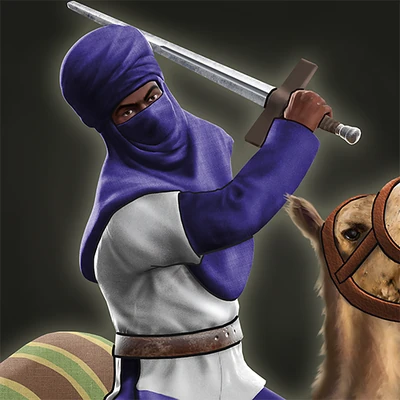
Recorded values
- Available
- Commerce Age · Trading Post or Tambo on a Berber kingdom; Native Embassy
- Training
- 40 sec · 20 XP per train
- Durability & mobility
- 300 hit points · 20% hand resistance · 7.0 speed · 12 line of sight
- Siege attack
- 14 base damage · range 6 · attack interval 3.0
- Hand attack
- 22 base damage · attack interval 1.5 · bonus damage: 2.0x vs. Cavalry; 1.6x vs. Shock troops; 1.5x vs. Artillery; 0.75x vs. Villager; 0.5x vs. Light infantry
- Trample attack
- 14.67 base damage · attack interval 2.0 · area of effect 3 · bonus damage: Same as hand attack
- Musket attack (charged)
- 24 base damage · range 15 · attack interval 3.0 · bonus damage: Same as hand attack · recharge 30 · requires Berber Fantasia
Role, availability & values
It is accessed through a Berber kingdom or Native Embassy. The recorded profile lists 300 hit points and 7.0 speed; the charged Musket Attack reaches 15 range, while the ordinary hand attack is used at close quarters. It is still a heavy cavalry unit and takes damage quickly if committed into a prepared counter line.
Matchup & timing
Use the ranged charge to pressure a target before deciding whether to close for melee. Keep the Riders moving with a force that can cover their approach, and do not treat the special attack as a reason to leave them exposed at range.
Statistics and unusual classification
The Berber Camel Rider is a Commerce Age native warrior from The African Royals. It costs 120 Food and 60 Coin, trains in 40 seconds and has a limit of nine per Berber kingdom. Its baseline profile has 300 hit points, 20% hand resistance, speed 7.0 and 12 line of sight. The hand attack deals 22 damage every 1.5 seconds, with 2.0× damage against Cavalry, 1.6× against shock troops and 1.5× against Artillery; it deals reduced damage to Villagers and light infantry. The unit is tagged as light ranged Cavalry even though its ordinary attack is melee. That classification means its counter relationships resemble ranged Cavalry, while its attack upgrades can interact with hand Cavalry bonuses. Read both its tags and its attack mode when choosing counters.
Role against cavalry and artillery
Camel Riders are fast enough to answer raids and their bonus multipliers make them dangerous to heavy Cavalry and shock troops. They also threaten exposed Artillery with their 1.5× attack bonus. The unit’s hand resistance helps it survive some exchanges, and speed 7.0 gives it the mobility to choose when to engage. Its unusual melee-only attack prevents it from using the hit-and-run pattern of a conventional Dragoon, however. Musketeers and other ranged heavy infantry can damage it while it closes, and light infantry such as Crossbowmen and Skirmishers are dangerous counters. Use the Camel Rider to intercept mounted units, flank artillery and protect a vulnerable army; avoid sending it straight into a line of anti-Cavalry infantry.
Trample and siege attacks
The trample attack deals 14.67 damage in a radius of three and uses the same target multipliers as the ordinary hand attack. This makes it most useful when several suitable targets are close together, especially cavalry, but it does not erase the unit’s vulnerability to light infantry. Its building attack deals 14 siege damage at range six every three seconds, so it can contribute to a siege without being a dedicated siege unit. Keep its main purpose in view: disrupting mounted forces and reaching artillery. The trample and siege attacks are additional tools that can add value during a mixed battle, not reasons to leave the Camel Rider stationary under defensive fire.
Musket Attack and Berber Fantasia
After researching Berber Fantasia, the Camel Rider gains Musket Attack. When charged, it automatically fires a musket shot for 24 ranged damage at range 15. The shot uses the same bonuses and penalties as its hand attack and recharges in 30 seconds. It gives the unit a brief ranged option before it reaches melee, but it is not a normal ranged attack that can be fired continuously. Berber Fantasia also increases line of sight by five in the source profile. Use the charged shot before a charge when possible, then close on a target the unit is suited to fight. Do not count on the musket attack to make the Camel Rider effective against light infantry, since the same unfavorable target multipliers apply.
Age upgrades and native improvements
Berber Warrior Societies upgrades the unit to Elite in the Fortress Age for 150 Wood and 100 Coin, increasing hit points and damage by 25%. Champion Berbers costs 400 Wood and 300 Coin in the Industrial Age and requires the earlier upgrade; it raises hit points and damage by 35%. Legendary Native Warriors or Exalted Natives upgrades the unit to Legendary in the Imperial Age, adding 50% hit points and damage. African civilizations upgrade native warriors automatically and for free in the listed rules. Other improvements can increase speed, hit points, attack or resistance, and several technologies affect native units broadly. Apply the bonuses shown for the active civilization and patch; not every civilization can research the same set of native upgrades.
Civilization access and shipments
African civilizations can train Berber Camel Riders for 155 Influence. The Hausa can recruit them at Palaces and Native Embassies after choosing the Berber Alliance. That alliance also sends four riders when advancing to the Fortress Age, five on the Industrial Age advance and ten on the Imperial Age advance. Indians can make their Berber Camel Riders automatically gather three Food per minute after sending the Grazing Home City Card, adding a small economic function to the cavalry. Standard native-site recruitment is limited to nine per Berber kingdom, so the army’s size depends on the map and the number of accessible settlements. Check alliance and shipment conditions before expecting a full group.
Practical army use
Pair Camel Riders with ranged infantry that can screen them from Musketeers and light infantry. Let the infantry hold the front while the riders move around the edge to threaten artillery or intercept enemy Cavalry. Since the native-unit limit is low, use each rider deliberately and avoid losing them in a poor frontal fight. Their speed lets them switch between a defensive response and an offensive flank, but that flexibility depends on keeping the group together and scouting before it commits. If the opponent shifts to Skirmishers or Crossbowmen, reduce the Camel Rider’s exposure and use a more suitable unit to take the engagement.
Control the cooldown and population cap
Berber Fantasia’s charged shot returns only after its 30-second cooldown, so do not plan on a musket burst in every engagement. The per-kingdom limit of nine also makes replacements and losses significant; protect the unit group and rotate damaged riders out before they are surrounded.
Use native upgrades selectively
The age-based native upgrades improve durability and damage, but their Wood and Coin costs compete with army production. Research them when the riders will remain in service for several engagements, not simply because the technology is available.
Native training limit
The nine-rider cap applies per Berber kingdom, so a second accessible settlement can increase the total available force. Keep the Trading Post or Tambo that provides access protected.
Hand-attacking light cavalry counter
Berber Camel Riders are light Cavalry that perform hand attacks. They counter Heavy Cavalry and light ranged Cavalry, and benefit from improvements that affect hand Cavalry. This unusual attack type means their role differs from a conventional ranged Dragoon: they must close with the target to deal damage. Use them to intercept mounted units and protect a flank, while keeping ranged support nearby to weaken enemy screens.
Do not expose them to ranged Heavy Infantry
Musketeers and other ranged Heavy Infantry are especially dangerous because a Camel Rider’s hand attack cannot retaliate at range. Move around the infantry line and strike cavalry that becomes isolated; avoid running straight through a prepared formation. Their counters and upgrades depend on the Berber option that supplies them, so check whether they use the relevant mercenary, alliance or shipment route. A small group can be a specialized answer, but should not be the only cavalry in the army.