Desert Raider
Desert Raider is Heavy Cavalry available from the Commerce Age through several civilization-specific production buildings. It has broad access across European, Asian, African and Italian systems, but its availability depends on the player’s faction.
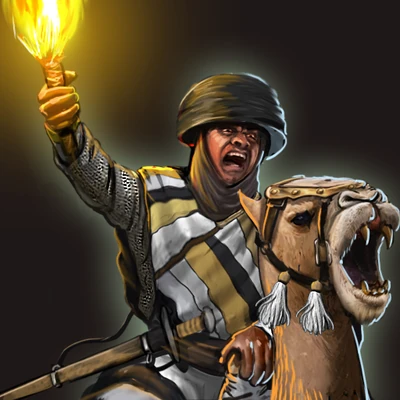
Recorded values
- Available
- Commerce Age · Tavern (Europeans) ; Monastery (Asians) ; Watch Tower (Africans) ; Lombard (Italians)
- Training
- 34 sec · 3 population · 36 XP per train
- Durability & mobility
- 280 hit points · 20% ranged resistance · 6.75 speed · 15 line of sight
- Hand attack
- 1.5 attack interval
- Siege attack
- 15 damage · 6 range · 1.5 attack interval
- Trample attack
- 2.0 attack interval
Role, availability & values
It can be recruited from a Tavern for Europeans, Monastery for Asians, Watch Tower for Africans or Lombard for Italians. The recorded profile has 280 hit points, 6.75 speed, 20% ranged resistance and a three-population cost of 50 Food and 130 Coin; training takes 34 seconds. Its listed siege attack is 15.
Matchup & timing
Use Desert Raiders for mobility and pressure against exposed targets, but keep them out of prepared anti-cavalry formations. Their three-population cost makes each loss significant. Check the correct production building for the civilization before planning to use them.
Heavy outlaw cavalry with a siege attack
The Desert Raider is a Commerce Age heavy cavalry outlaw in The African Royals. It is available on the Saharan Routes and Savanna maps through the appropriate outlaw production buildings: Tavern for Europeans, Monastery for Asians, Watch Tower for Africans and Lombard for Italians. African civilizations can train the Desert Raider, Desert Warrior and Desert Archer outlaw roster regardless of map, while Lakota, Argentina, Maya and Haiti have card or revolution-specific routes. Confirm the access condition for the civilization in use before planning an opening around it. The current Desert Raider costs 50 Food and 130 Coin, trains in 34 seconds and occupies three population. It has 280 hit points, speed 6.75, line of sight 15 and 20% ranged resistance. Its 26 hand damage attacks every 1.5 seconds. The unit also deals 15 siege damage at range 6 every 1.5 seconds and has a 16-damage trample attack every two seconds in an area of 3. The hand attack can ignore enemy hand-attack resistance, which lets the Raider pressure targets that are unusually resistant to melee damage. Its siege attack is modest in a single unit, but its doubled attack cadence compared with some basic heavy cavalry makes it more effective against buildings than the raw damage number suggests. This is still heavy cavalry: use its speed to reach exposed Light Infantry, counter-skirmishers and Artillery, and send it against a building when the route is safe. It is vulnerable to Heavy Infantry, Light Ranged Cavalry and ranged Shock Troops, so a direct charge into a prepared line can lose the three-population investment quickly. Keep it moving around the edge of the opponent’s force, choose a target it can finish, and withdraw if a counter unit turns to face it. Its building attack does not make it a replacement for dedicated siege when a defended Town Center or Fort must fall. The outlaw resource pattern often spends more Food and less Coin than a conventional unit, a practical benefit on African maps where Coin may be harder to secure than Food. At 50 Food and 130 Coin, however, the Raider remains an expensive three-population commitment. Compare it with the rest of the army before adding several; the force needs ranged support or infantry that can deter the counters. Use its 6.75 speed for map control, to punish isolated reinforcements or to protect a siege force by forcing the opponent to respond elsewhere. Age improvements depend on the civilization’s outlaw system. Compunction, Folk Heroes, Nomadic Bandits and Wild West provide the corresponding civilization-specific bonuses, while cavalry technologies such as Cavalry Cuirass can improve its health. Nomadic Bandits is especially associated with African outlaw units. Cards such as Mass Cavalry can reduce training time, while Pillage improves its siege multiplier against buildings. These upgrades broaden the Raider’s role but do not remove its counter matchups. Current values should be distinguished from earlier profiles: previous patches showed 100 Coin, a 20-second training time, 30% ranged resistance, 30 hand damage or a 20 siege attack. The current unit instead costs 130 Coin, trains for 34 seconds, has 20% ranged resistance and deals 26 hand and 15 siege damage.
Map access and timing decisions
The Desert Raider’s access is tied to the outlaw system and map rules, so the building shown for one civilization does not describe every player’s route. On Saharan Routes and Savanna, eligible civilizations can use the relevant Tavern, Monastery, Watch Tower or Lombard; African factions have a defined Desert outlaw roster on other maps as well. The Raider’s three population and 34-second training time make it a deliberate investment rather than a quick single-unit answer. Use its speed to threaten an exposed flank or reach artillery, then preserve the force if Heavy Infantry or ranged cavalry appears. Its trample and hand siege damage reward attacking a vulnerable structure after defenders have moved away, but the unit still needs a safe exit. Check whether the current Home City card or revolution gives the unit before reserving resources for it.
African outlaw Cavalry
The Desert Raider is a Commerce Age heavy Cavalry outlaw available at a Tavern for Europeans, a Monastery for Asians, a Watch Tower for Africans or a Lombard for Italians. It costs 50 Food and 130 Coin, trains in 34 seconds and uses three population. Its 280 hit points, 20% ranged resistance, speed 6.75 and sight 15 support a durable mounted attack. The hand attack deals 26 damage every 1.5 seconds, a 16-damage Trample attack covers an area of three, and its 15-damage Siege attack fires every 1.5 seconds. The three-population cost is substantial, so use Raiders in a focused force rather than treating them as cheap general Cavalry.
Choose the target before committing
Desert Raiders can move quickly enough to threaten exposed ranged units, pressure structures after winning ground and disrupt a compact formation with Trample. Their high Coin cost and population use make them vulnerable to a bad engagement; avoid charging a prepared anti-Cavalry line. Keep Skirmishers or other support near the Raiders so ranged Infantry cannot kite them without consequence. The available production building differs by civilization and map setup, and African access uses a Watch Tower rather than the ordinary Palace route used for some mercenaries. Check the current building and queue before planning a timing. Preserve the Raiders for a decisive flank or siege opportunity instead of trading them into a screen.