Desert Warrior
Desert Warrior is Heavy infantry in Age of Empires III, available from the Commerce Age; obtained through Tavern (Europeans), Monastery (Asians), Watch Tower (Africans), Lombard (Italians).
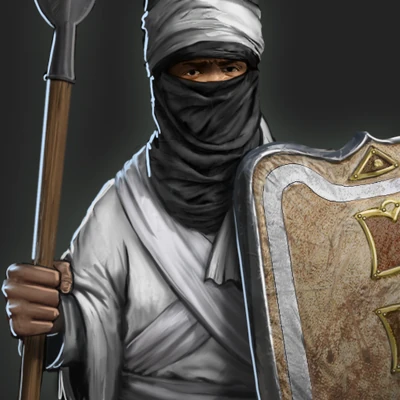
Recorded values
- Available
- Commerce Age · Tavern (Europeans) ; Monastery (Asians) ; Watch Tower (Africans) ; Lombard (Italians)
- Training
- 28 sec · 3 population · 21 XP per train
- Durability & mobility
- 140 hit points · 20% ranged resistance · 4.25 speed · 16 line of sight
- Hand attack
- 12 damage · 1.5 attack interval · bonuses: 3.5x vs. Cavalry; 2.8x vs. Shock troops
- Ranged attack
- 14 damage · 2-12 range · 1.5 attack interval
- Siege attack
- 24 damage · 6 range · 3.0 attack interval
Role, availability & values
Production is available through Tavern (Europeans), Monastery (Asians), Watch Tower (Africans), or Lombard (Italians). It has 140 hit points and 20% ranged resistance. It moves at 4.25 speed and uses 3 population. Training costs 30 Food and 75 Coin; it takes 28 seconds to train. Attack profile: Hand attack deals 12 damage. Ranged attack deals 14 damage. Siege attack deals 24 damage. Hand attack bonuses: 3.5× against Cavalry and 2.8× against Shock troops.
Matchup & timing
Hand attack is especially effective against Cavalry (3.5×), Shock troops (2.8×). Hold the melee attack for Cavalry and Shock troops when they enter contact. Keep a frontline between this unit and threats that can reach it safely.
Current profile and battlefield job
In Definitive Edition, a Desert Warrior costs 30 Food and 75 Coin, takes 28 seconds to train and uses three population. Its current profile has 140 hit points, 20% ranged resistance, speed 4.25 and line of sight 16; earlier data lists 150 hit points, 70 Coin and two population, so older build orders should not be transferred without checking the edition and patch. The unit combines Heavy Infantry and Outlaw roles with a ranged attack of 14 damage at range 2–12, a 1.5-second rate of fire, and a 24-damage siege attack. Its hand attack is 12 and gains 3.5× against Cavalry and 2.8× against Shock troops. This combination makes it a flexible anti-cavalry screen that can also fight at range.
Choose a stance for the incoming damage
The large shield is represented by five stance options, and the resistance change matters as much as the weapon mode. Volley Mode grants 20% ranged resistance; Stagger Mode grants 20% siege resistance; Melee Mode grants 20% hand resistance. Defend Mode and Stand Ground each give 20% hand, ranged and siege resistance while reducing the unit's damage by 20%. Use Volley against musket fire, Melee when Cavalry reaches the line, and Stagger when siege attacks are the immediate threat. Defend and Stand Ground are survival choices when the unit must hold a position under mixed fire. Switching stance does not erase the unit's class counters: it remains vulnerable to Light Infantry, counter-skirmishers and Artillery.
Pair it with cavalry and Griots
The unit's high rate of fire and respectable movement make it useful in an army that already has a durable frontline. Cavalry can keep enemy infantry from freely closing on the Desert Warriors, while their ranged volleys punish units approaching the fight. Hausa players can add Griots: nearby Desert Warriors receive a speed boost, and the Griot's ranged stun can interrupt an enemy long enough for the infantry to maintain distance or focus fire. Do not treat the Desert Warrior as a full replacement for a conventional Musketeer in every matchup. Its stance must be chosen for the threat, and its ranged resistance cannot prevent a melee surround if the player fails to protect its flanks.
Where it can be recruited
The Desert Warrior is associated with The African Royals and appears in the outlaw pools of many African maps, including Arabia, Atlas, Congo Basin, Darfur, Dunes, Gold Coast, Great Rift, Horn, Ivory Coast, Lake Chad, Lake Victoria, Niger Delta, Nile Valley, Sahel, Siwa Oasis, Sudd, Swahili Coast and Tripolitania. The available map pool varies by scenario. Recruitment routes also depend on the civilization: Europeans can use a Tavern, Asian civilizations a Monastery, Italians a Lombard, and African civilizations a Watch Tower. African civilizations use Desert Warriors, Desert Archers and Desert Raiders as their outlaw roster regardless of map, while other civilizations depend on what the map supplies.
Upgrades, shipments and revolutions
Compunction, Folk Heroes and Nomadic Bandits enable the listed Industrial Age and Imperial Age outlaw improvements: the Industrial Age increase is 30% to hit points and damage, and the Imperial Age increase is 50%. Which technology applies depends on civilization family. General improvements can add health or attack, while Somali Oryx Hide Shields add resistance in every stance. The unit can also arrive through Outlaw Band, Bandit Gang and other Home City support, with eligibility varying by civilization and revolution. Argentina and the Maya can draw it from their outlaw shipments; Haiti can train it through the Brethren of the Coast card when the unit is available in the Tavern. These routes are conditional rather than universal access.
Counterplay and resource use
The Desert Warrior is strongest when it can choose its stance and hold a line with support. Light Infantry and counter-skirmishers are reliable ranged answers, and Artillery can punish a clumped group from outside its effective reach. Its melee bonus does not mean it should chase Cavalry across the map: use the 3.5× hand multiplier after a charge reaches the infantry, then return to a ranged stance when the Cavalry withdraws. On African maps, the outlaw economy tends to exchange some Coin cost for more Food; here the 30 Food and 75 Coin profile makes Coin commitment significant. Compare the price and population against ordinary military production, and recruit the unit for its stance flexibility and anti-Cavalry role rather than assuming it is a cheap general-purpose troop.
Micro choices during a mixed engagement
The stance system rewards reading the opponent's damage before the first volley lands. If the enemy is approaching with Cavalry alone, wait until the charge commits and switch to Melee Mode so the 20% hand resistance applies while the 3.5× hand multiplier returns damage. Against a line of ranged Infantry, Volley Mode preserves more health without the 20% damage penalty of Defend Mode. Defend or Stand Ground is useful when the unit must absorb several damage types around a narrow approach, but the lower output makes it a holding stance rather than a damage stance. Stagger Mode is situational because siege resistance matters when artillery or siege attacks are already targeting the group. Reposition out of the danger area when possible instead of relying on armor to endure repeated shots.
Build the force around its limitations
A Desert Warrior army benefits from a second unit that handles threats it cannot efficiently answer. Light Infantry can focus it at range, so Cavalry or other fast units should disrupt those shooters. Artillery can force the infantry to move and punish groups that stand in one firing lane; use mobile support to reach the guns or spread the formation before they fire. The Desert Warrior's hand attack is specialized rather than universally strong, and the reduced damage in defensive stances can make it lose a prolonged fight if left alone. Treat it as a flexible contingent in a combined army: ranged pressure and anti-Cavalry damage are its main contributions, while allied units secure the flanks and remove its counters.
Outlaw Infantry with two ways to attack
The Desert Warrior is a Commerce Age Outlaw recruited from a Tavern for Europeans, a Monastery for Asians, a Watch Tower for Africans or a Lombard for Italians. The Definitive Edition profile costs 30 Food and 75 Coin, takes 28 seconds to train and uses three population; it has 140 hit points, 20% ranged resistance and speed 4.25. Older profiles list different health, Coin cost and population, so earlier build orders may not apply. Its ranged attack deals 14 damage at range 2–12 every 1.5 seconds. The hand attack deals 12 damage with 3.5× damage against Cavalry and 2.8× against Shock troops, while its Siege attack deals 24 damage. This mix lets it fight at range and deter mounted units that reach it.
Spend the population on its counter role
Three population per Desert Warrior is expensive, especially when the army also needs a screen or artillery. Use a small group where its anti-Cavalry hand attack can protect valuable ranged units, and keep it from being surrounded by faster troops. Its ranged attack can soften a target on approach, but the unit’s modest health means it should not act as a stand-alone frontline. The Siege attack contributes after a fight creates an opening; it is not a reason to expose the mercenary to defensive fire. Check the hiring building and active version, because African access uses a Watch Tower and the current profile differs from older descriptions.