Giant Grenadier
Giant Grenadier is Heavy infantry in Age of Empires III, available from the Fortress Age; obtained through Tavern (Europeans), Monastery (Asians), Saloon (Americans), Palace (Africans), Lombard (Italians).
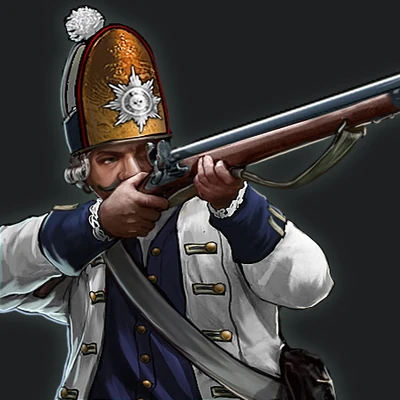
Recorded values
- Cost
- 250 Coin
- Available
- Fortress Age · Tavern (Europeans) ; Monastery (Asians) ; Saloon (Americans) ; Palace (Africans) ; Lombard (Italians)
- Training
- 50 sec · 2 population · 25 XP per train
- Durability & mobility
- 260 hit points · 30% hand resistance · 4.0 speed · 16 line of sight
- Hand attack
- 36 damage · 1.5 attack interval · bonuses: 1.75x vs. Cavalry; 1.4x vs. Shock troops
- Ranged attack
- 36 damage · 12 range · 3.0 attack interval
- Siege attack
- 50 damage · 12 range · 3.0 attack interval
Role, availability & values
Production is available through Tavern (Europeans), Monastery (Asians), Saloon (Americans), Palace (Africans), or Lombard (Italians). It has 260 hit points. It moves at 4.0 speed and uses 2 population. Training costs 250 Coin; it takes 50 seconds to train. Attack profile: Hand attack deals 36 damage. Ranged attack deals 36 damage. Siege attack deals 50 damage. Hand attack bonuses: 1.75× against Cavalry and 1.4× against Shock troops.
Matchup & timing
Hand attack is especially effective against Cavalry (1.75×), Shock troops (1.4×). Hold the melee attack for Cavalry and Shock troops when they enter contact. Keep a frontline between this unit and threats that can reach it safely.
Current combat profile
The Giant Grenadier is a Fortress Age mercenary that costs 250 Coin, takes 50 seconds to train and uses two population. Its current profile has 260 hit points, 30% hand resistance, speed 4.0 and line of sight 16. The ranged attack deals 36 damage at range 12 every three seconds with area damage in radius two. In melee it deals 36 damage every 1.5 seconds, with a 1.75 multiplier against cavalry and 1.4 against shock troops. Its siege attack deals 50 at range 12 every three seconds. The splash volley makes it especially dangerous against clustered units, while its hand and siege attacks let it defend itself and pressure buildings. It remains vulnerable to long-range infantry and artillery.
Version changes to statistics
Several values have changed through Definitive Edition updates. Its current 260 hit points were 250 before update 19.18309 and 300 before update 15.30007. Its current two-population cost was three between updates 14.43676 and 15.30007. Hand damage is now 36, compared with 42 before update 15.30007; ranged damage is 36, compared with 42 before update 13.38085. Current melee multipliers are 1.75 against cavalry and 1.4 against shock troops, while earlier values were lower. Older build guides may therefore describe a more durable, harder-hitting and more population-intensive unit. Keep the edition and update context attached to every stat comparison.
Strengths, weaknesses and army support
The Giant Grenadier is strong against cavalry and shock troops in melee and can damage buildings. Its area ranged attack can also punish large infantry groups, especially when attackers are packed closely together. Light infantry, counter-skirmishers, artillery and MercType2 mercenaries are effective counters. The 36 ranged damage is useful but range 12 is shorter than many skirmishers’ firing distance, so the unit should not stand alone in a prolonged ranged duel. Combine it with melee cavalry to reach the enemy’s ranged counters and with artillery such as Falconets or Heavy Cannons when the army needs stronger siege fire. A steady economy matters because each unit costs 250 Coin and takes 50 seconds to replace.
Recruitment and shipment routes
The unit appears among the random mercenary selections available from a Tavern for Europeans, Monastery for Asians, Saloon for Federal Americans, Palace for Africans and Lombard for Italians. Royal Saxon Grenadiers offers another route, delivering one Giant Grenadier and adding one to every future Home City shipment. That shipment effect can be particularly valuable to Native American civilizations that cannot use ordinary mercenary training buildings. Germans can unlock a Mercenary Camp through Mercenary Camps, and German Battleships can train Giant Grenadiers through Adler von Lübeck if the Tavern offers them. Swedes can recruit from Barracks, Blockhouses and Galleons after Contract Giant Grenadiers. These are distinct forms of access and should be described separately from random Tavern availability.
Civilization variants
Prussia and the German Confederation can replace Doppelsoldners with Giant Grenadiers through their revolution rules. The Prussian Leib Guard card can upgrade them to Leib Grenadiers, which cost 80 Food and 150 Coin, gain 10% ranged resistance, can be trained at Artillery Foundries and can be upgraded to Imperial. Polish players who send Treaty of Lublin can research Crown Grenadiers at the Church in the Fortress Age: it ships ten, raises hit points by 10%, grants regeneration and allows recruitment at Forts. Swedish players can unlock production from several military buildings with their contract card, while United States access is associated with the random Poker mercenary pool. These changes affect cost, durability, training location and shipment reliability.
Practical engagement sequence
Keep the unit behind a screen until the enemy has committed infantry or cavalry to a lane. Focus the splash attack on compact groups, then use its melee bonuses against cavalry or shock troops that reach the line. Do not let it chase skirmishers: speed 4.0 and range 12 make it vulnerable to being kited. If artillery appears, send mobile units around the flank while the Giant Grenadiers stay protected. In a siege, pair them with dedicated artillery so their 50-point siege hit is support rather than the only building damage. Preserve population space and Coin for replacements before starting a long fight.
Investment and population
At two population and 250 Coin, the current Giant Grenadier is a costly specialist rather than a cheap mass unit. Its reduced population compared with the older three-population profile improves army space, but the long training time still makes losses slow to replace. Cards that ship one with each shipment can reduce the pressure on local production, while mercenary combat upgrades can improve a larger force. If the opponent has already massed skirmishers or artillery, compare the cost of hiring more Giant Grenadiers with the value of cavalry or counter-artillery that can remove those threats.
Comparison with Soldados
Both units carry gunpowder weapons and grenades, but their recruitment and combat profiles differ. Giant Grenadiers are MercType1 mercenaries, cost only Coin and have ranged splash damage; Soldados are a civilization unit with their own resource and upgrade path. The Giant Grenadier has higher hand attack and hand resistance, longer-ranged siege damage, and a ranged attack that can hit a cluster. It trains slightly more slowly and is expensive to hire. Choose it when the economy has Coin, the target formation is dense and a mercenary route is available; choose the standard roster unit when repeatable production or lower cost is more important.
Improving siege and splash
Incendiary Grenades increases the siege multiplier against buildings by 15% and adds 0.5 to the ranged area effect. That improves two distinct roles: structure pressure and damage to clustered troops. The card does not make the Giant Grenadier a substitute for artillery against fortified buildings, because the unit still has to approach to range 12 and is vulnerable to counter-fire. Pair it with dedicated siege guns when attacking a base, and use the larger splash only when the enemy is grouped close enough to justify the investment.
Read the mercenary pool
The Tavern and equivalent buildings can offer a random selection of mercenaries, so availability is not guaranteed simply because a player has the building. Home City access, a Mercenary Camp, or civilization-specific training cards can make the route more dependable. Confirm the available unit before committing Coin and population, and remember that a Fort shipment or revolution may change the train location. Native American players who rely on Royal Saxon Grenadiers can plan shipments around the added Giant Grenadier, but the recurring delivery still arrives with Home City shipments rather than continuous local training.
Protecting the approach
Let mobile units threaten the skirmishers or artillery that outrange the Grenadier. Once those counters turn away, the splash attack can be brought forward to punish the main formation.
Choosing targets
A formation of infantry packed around its own artillery is a strong target for the Giant Grenadier’s splash, but do not send it into range before the counters are distracted. The unit’s strongest value comes from an escorted approach and repeated volleys.
Mercenary loyalty
The unit’s MercType1 classification defines how some combat effects treat it. Mercenary-specific counters can therefore matter even though it fights as heavy infantry and a grenade trooper. Check enemy tags when a familiar infantry counter behaves differently.
Mercenary ranged Infantry with area damage
The Giant Grenadier is a Fortress Age mercenary available through the relevant Tavern, Monastery, Saloon, Palace or Lombard for its civilization and expansion. It costs 250 Coin, takes 50 seconds to train, uses two population and has 260 hit points with 30% hand resistance. Its ranged attack deals 36 damage at range 12, hits an area of two and fires every three seconds. The hand attack also deals 36 damage, with 1.75× damage against Cavalry and 1.4× against Shock troops; a 50-damage Siege attack gives it a way to pressure structures. Its combination of ranged splash and melee bonuses makes it more flexible than a specialist Grenadier, but the limited hit points and two-population cost still call for a screen. Recruit it to add area damage to a mercenary force, not as a reason to ignore the opponent’s unit mix.
Use the splash without exposing the unit
The ranged area attack is most effective when enemy Infantry cluster, so keep the Giant Grenadier at firing distance and let the frontline hold targets in place. Its bonus against Cavalry and Shock troops helps if either type reaches melee, but a slow Infantry unit should not be sent forward alone to chase them. Artillery, Skirmishers and other ranged counters can punish it before its hand attack matters. The unit’s Siege attack also means a surviving group can help finish a structure after a battle, yet using it to siege without protection risks losing an expensive mercenary to defensive fire. Check the hiring building and available mercenary limit before planning the reinforcement; a long 50-second queue means a lost Giant Grenadier cannot be replaced immediately during a short fight.